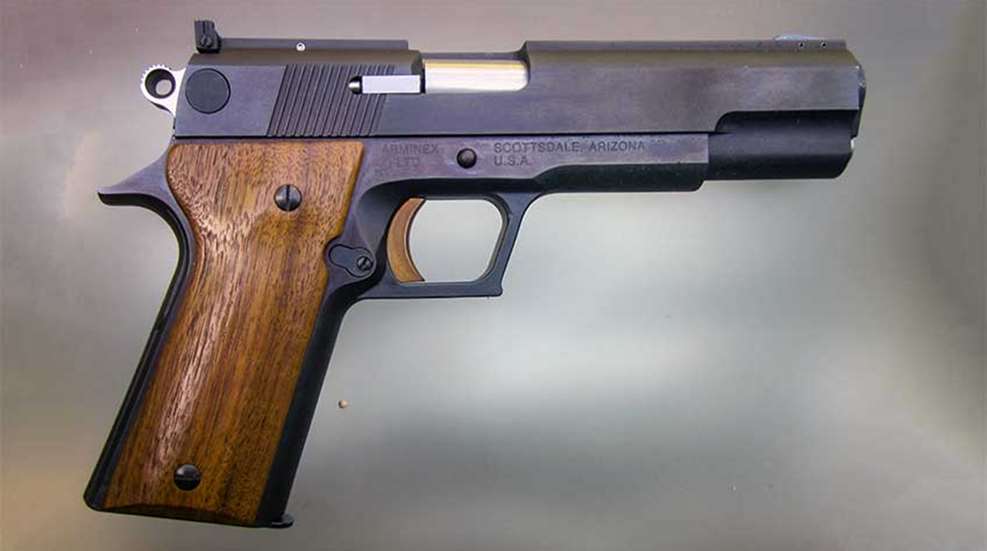
About 40 years ago, James Mongello had a great idea: Make a pistol like the classic M1911 Government Model, but with several different features. And, make it easily convertible from .45 ACP to .38 Super and 9 mm Luger. With the three chamberings in mind, he called it “TriFire.” Before we look at the result, though, let’s back up a few years and examine a Mongello pistol that preceded it.
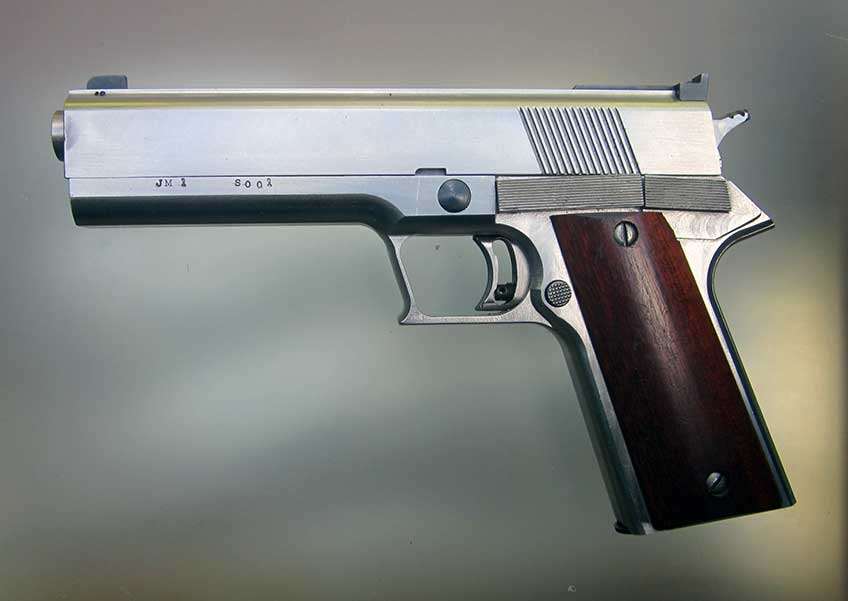
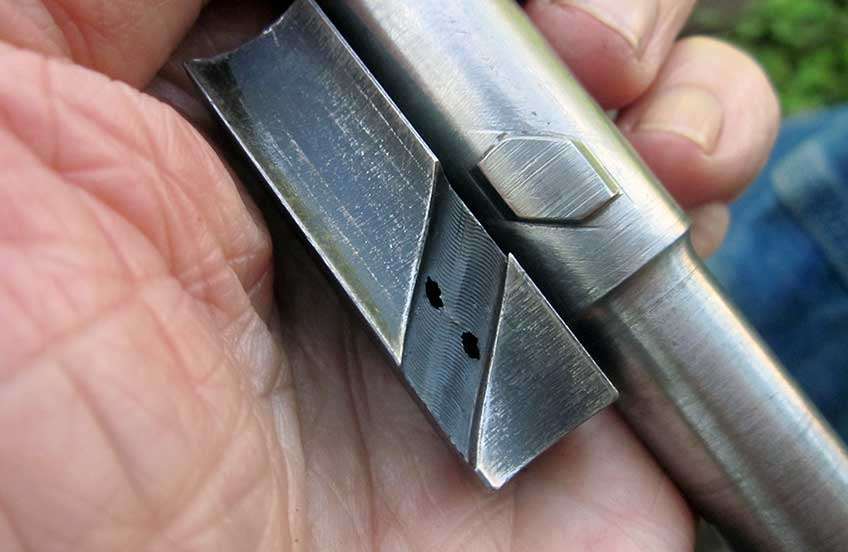
Earlier, Jim had been interested in turn-barrel locking systems. The nearest M1911-ish application of this was the Obregon, made briefly in Mexico. He obtained one for research and noted several areas that could be mechanically improved. A single prototype was made, and he named it “Excalibur.” Made in stainless-steel and chambered in .45 ACP, it was a beautiful beast—and worked perfectly.
There were several innovative touches in the design. The barrel rotation was done by a separate removable insert, rather than a groove in the frame. Also, unusual for its time, the manual safety and slide latch had levers on both sides for true bilateral operation.
Lined up at the top of the grip panels, the low-profile levers had generous serrations. The manual safety did not block the sear. It rolled a bar to lock the hammer, like the superior system used in the Star pistols.
The back-strap of the grip-frame was solid, with no pesky grip safety, and the trigger was adjustable for over-travel. The original work was done in Las Vegas, by Bob Irwin and Phil Pickell, in Bob’s shop. Actually, Irwin said, “We made two-and-a-half pistols.” There was the one shown here, in stainless-steel, one in blued steel, and an extra frame in titanium. Barrels were also made in .45 ACP, .38 Super, and 9 mm Luger. The time period was 1979-1980.
The decision against making this pistol was based on one factor: High production costs would have resulted in a retail price that might turn away many buyers. So Jim turned his attention to the design that became the TriFire. It was at this point that I entered the scene, as a friend and informal design consultant.
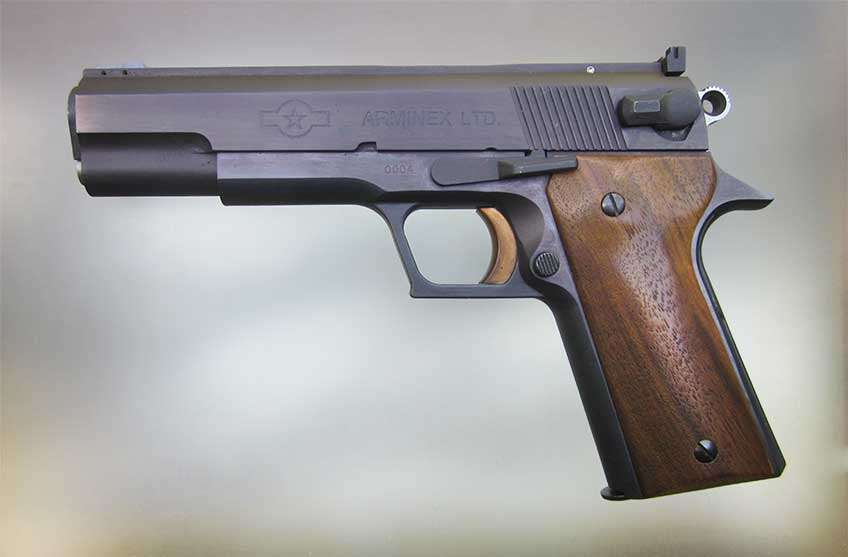
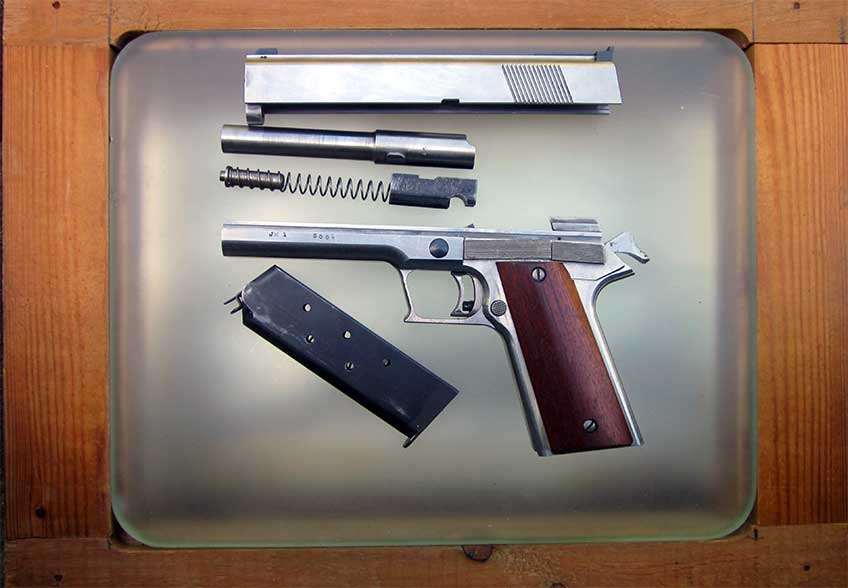
The general appearance of TriFire and some of its mechanical features were of classic G.I. M1911 origin, but there were numerous important differences. There was no grip safety, and gone was the fragile little tube on the left side that contained the spring and plungers for the safety lever and slide latch.
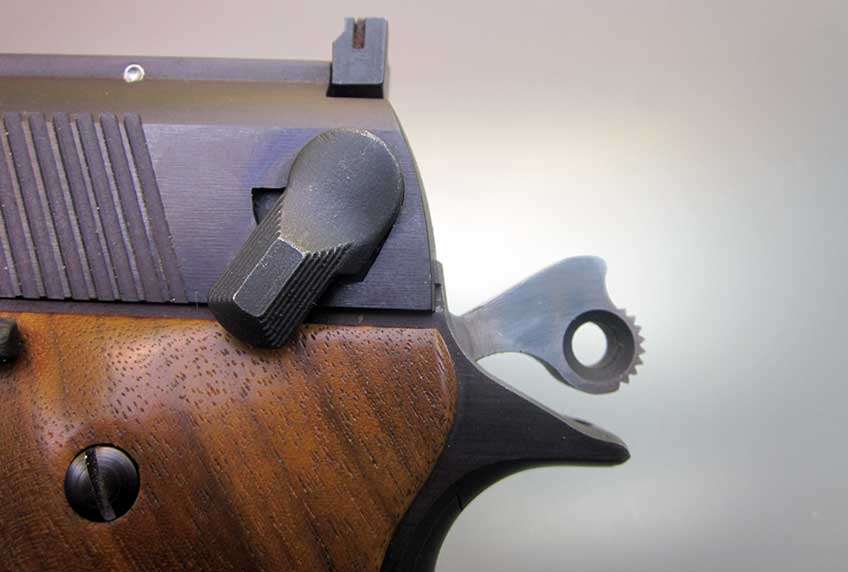
Also gone was the frame-located manual safety, instead, the TriFire had a slide-mounted safety, similar to the ones on the Smith & Wesson Models 39 and 59. Turned down to on-safe position, it locked the firing pin and blocked the hammer. On my suggestion (and perhaps others), it did not drop the hammer at the end of its arc. Thus, cocked-and-locked carry was possible, and far more safely than with the old M1911 system.
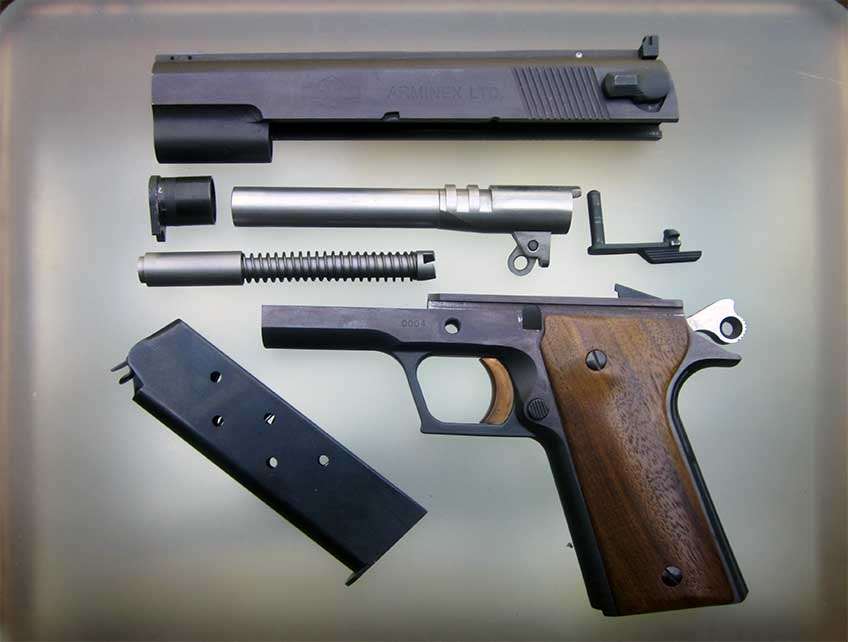
The slide latch was extended into the top front corner of the left grip panel, more accessible to the thumb of the shooting hand. The large and sturdy extractor was external, and was powered by a plunger and coil spring. Once again, in my opinion, far better than the G.I. M1911’s arrangement. The ejector was pivoted and spring-powered, entirely internal.
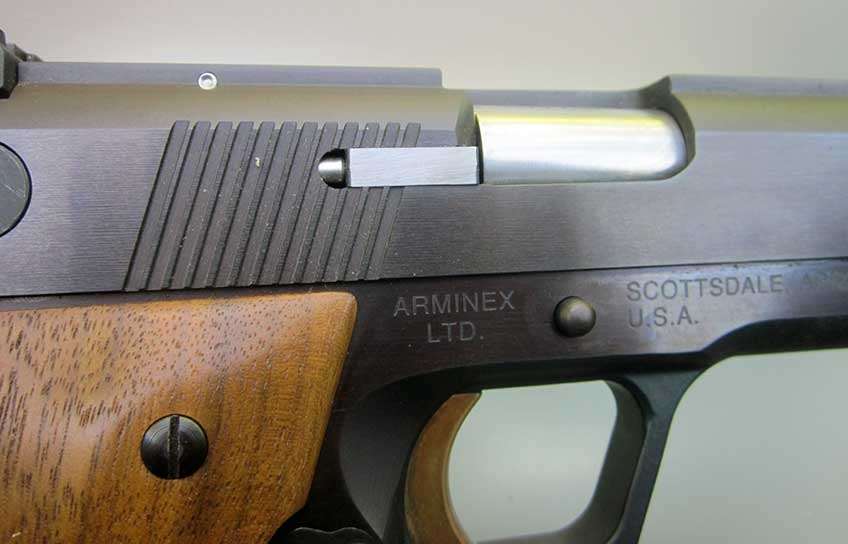
The beautifully- made recoil-spring unit was self-contained,--nothing to fly away during disassembly. The rear tip of its guide was carefully machined to mate with the barrel under-lug and the link. The hammer was a rowel-type, and there was ample beavertail at the frame’s rear to prevent hammer bite.
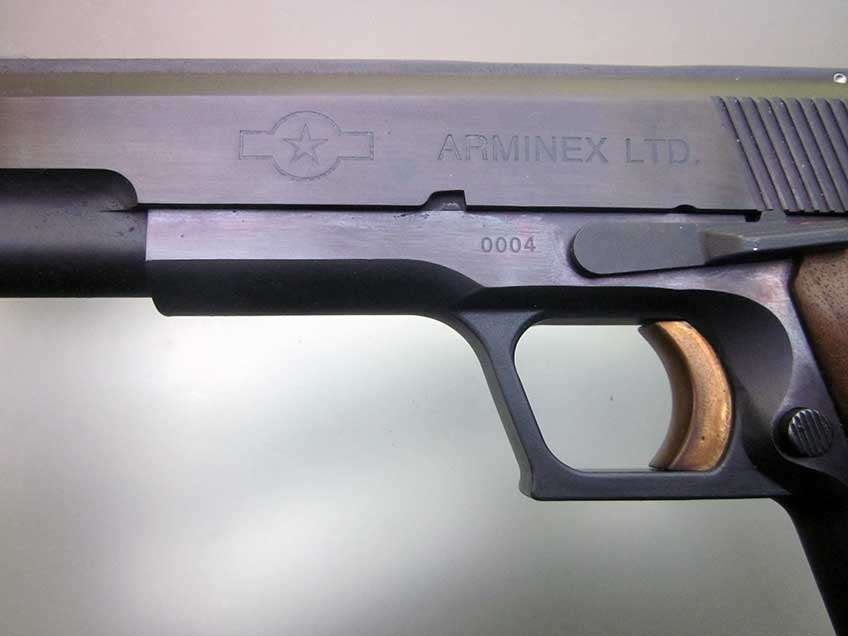
The top of the slide had a full-length and slightly raised rib, grooved to prevent reflection. Sights were square-picture, the tapered front secured to the rib by two cross-pins. The fully adjustable rear sight had a white, frame around the notch. The stocks on my own TriFire, number 0004, are smooth and nicely figured wood, goncalo alves, I think. They were made by Herrett’s.
TriFire was intentionally made to use standard M1911 magazines, and the release button is the usual type in the usual location. In a nod to the goofy version of the two-hand hold that was popular at the time, the lower front of the trigger guard has a small hook. The lower part of the frame back-strap has vertical serrations.
Jim Mongello had always liked the old U.S. Air Force insignia--the circle with square wings and a star in the middle. He adopted it as the logo for Arminex, Ltd., and it is on the left side of the TriFire slide. It is also on several neat accessories, including a bushing wrench, a pin drift and a padded zipper case. There were several other logo-marked items.
Actual fitting and assembly of the brief production of the TriFire pistols was done by master machinist Brian Lamb, his father and his brother. They did an excellent job. As for the total number made, I think we can say “around 250.” The principal Arminex collector, Frank Easton, told me his highest serial number is 224. Frank also said he has seen one TriFire with British proofs. I remember meeting, with Jim Mongello, a British sales agent.
So, why didn’t this magnificent pistol continue in regular production? I personally know that there were occasional problems with parts producers. And, by the time the first TriFire was completed, Jim had invested slightly more than $1 million. James Mongello died on Nov. 1, 2010. We may never know all of the reasons.
In addition to Excalibur and TriFire, there are other Arminex stories to be told. I once re-designed, at Jim’s request, a little .25 Czech vz45 and delivered a prototype. It was to be beefed-up to .32 ACP, to become what he called "Sleeping Beauty", a perfect hide-away pistol. Somewhere, out there, my prototype still exists.
Note: The author thanks Bob Irwin and Frank Easton for providing invaluable information for this story.
Arminex TriFire
Cartridge: .45 ACP
Weight: 40.3 ozs.
Length: 8.37”
Height: 5.25”
Width: 1.25”
Sight radius: 6.37”
Barrel length: 5”
Magazine: seven-round-capacity detachable box
Manufacturer: Arminex, Ltd., Scottsdale, Ariz.