** When you buy products through the links on our site, we may earn a commission that supports NRA's mission to protect, preserve and defend the Second Amendment. **
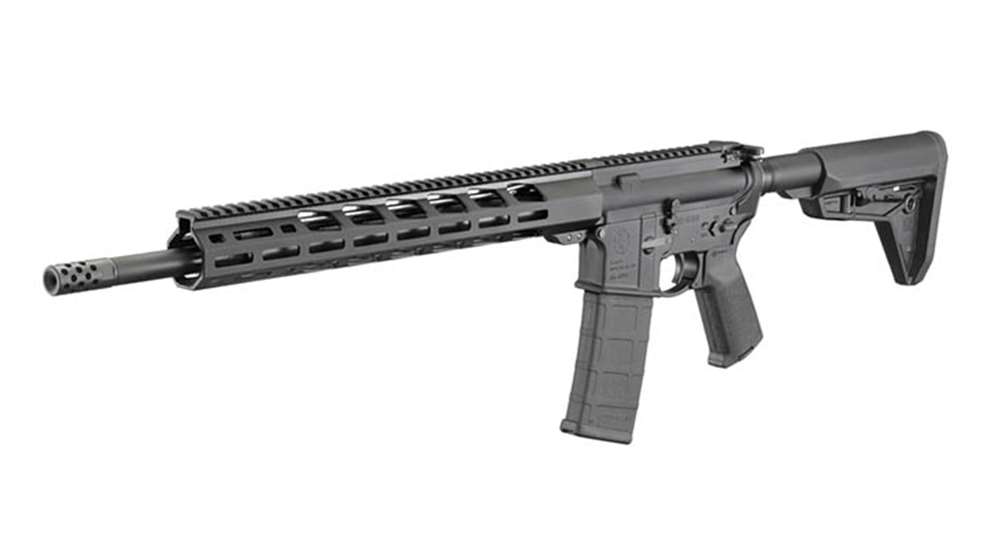
Ruger has a longstanding tradition of producing quality firearms at a fair price. Add performance with the durability enthusiasts expect, and it’s a hard-to-beat combination that lands its guns at or near the top of any annual sales list.
Last year the company’s AR-556 claimed second-place honors among semi-automatic rifles on GunBroker.com. It’s a slight drop in stature from its 2019 finish—when it took first—but the scalding firearm sales pace of 2020 indicates the total number sold was still up, likely by a wide margin.
Ruger’s AR-556 has been in the top-10 list since 2015. MSRP for a standard version comes in at $799—the same price as last year if you’re wondering. There are three versions of this family of rifles, and no shortage of options within each.
Standard models are all chambered in 5.56 NATO. Two ship with 30-round magazines, and another pair have state-compliant versions with a 10-cartridge capacity. Barrel length is 16.10", and one model ships without a flash hider or barrel threading for purchase in more restrictive states. Rifling is 1:8" RH and the most expensive model in this line wears Magpul MOE furniture. MSRP for it is $849. All feature Ruger’s Rapid Deploy foldable rear sight and an A2-style sight up front. With a glass-filled polymer handguard and carbine-length gas block they deliver the nimble handling enthusiasts expect in a modern sporting rifle.
There are more chamberings available in Ruger’s MPR line, which features Ruger’s Elite 452 AR-Trigger. Let-off weight in the two-stage trigger is 4.5 lbs. You can select chamberings of 5.56 NATO, .450 Bushmaster or .350 Legend. Barrel lengths depend on cartridge, but run from 16.1" to 18.63". Standard features include free float handguards, the company’s proprietary radial-port muzzle brake and flat-top receiver with Picatinny for optic mounting. MSRPs run from $899 to $1,099. There’s even a Flag model with stars and stripes motif ($949).
Free-Float models are available in 5.56 NATO and .300 Blackout. They ship with an 11" aluminum handguard with M-LOK slots. The flattop upper receiver makes mounting a scope effortless. Barrel length, regardless of chambering is 16.1", with rate of rifling 1:8" RH in 5.56 and 1:7" RH in .300. A state-complaint version is also available, and MSRPs for all come in at $819.
Last year the company’s AR-556 claimed second-place honors among semi-automatic rifles on GunBroker.com. It’s a slight drop in stature from its 2019 finish—when it took first—but the scalding firearm sales pace of 2020 indicates the total number sold was still up, likely by a wide margin.
Ruger’s AR-556 has been in the top-10 list since 2015. MSRP for a standard version comes in at $799—the same price as last year if you’re wondering. There are three versions of this family of rifles, and no shortage of options within each.
Standard models are all chambered in 5.56 NATO. Two ship with 30-round magazines, and another pair have state-compliant versions with a 10-cartridge capacity. Barrel length is 16.10", and one model ships without a flash hider or barrel threading for purchase in more restrictive states. Rifling is 1:8" RH and the most expensive model in this line wears Magpul MOE furniture. MSRP for it is $849. All feature Ruger’s Rapid Deploy foldable rear sight and an A2-style sight up front. With a glass-filled polymer handguard and carbine-length gas block they deliver the nimble handling enthusiasts expect in a modern sporting rifle.
There are more chamberings available in Ruger’s MPR line, which features Ruger’s Elite 452 AR-Trigger. Let-off weight in the two-stage trigger is 4.5 lbs. You can select chamberings of 5.56 NATO, .450 Bushmaster or .350 Legend. Barrel lengths depend on cartridge, but run from 16.1" to 18.63". Standard features include free float handguards, the company’s proprietary radial-port muzzle brake and flat-top receiver with Picatinny for optic mounting. MSRPs run from $899 to $1,099. There’s even a Flag model with stars and stripes motif ($949).
Free-Float models are available in 5.56 NATO and .300 Blackout. They ship with an 11" aluminum handguard with M-LOK slots. The flattop upper receiver makes mounting a scope effortless. Barrel length, regardless of chambering is 16.1", with rate of rifling 1:8" RH in 5.56 and 1:7" RH in .300. A state-complaint version is also available, and MSRPs for all come in at $819.
Most Popular