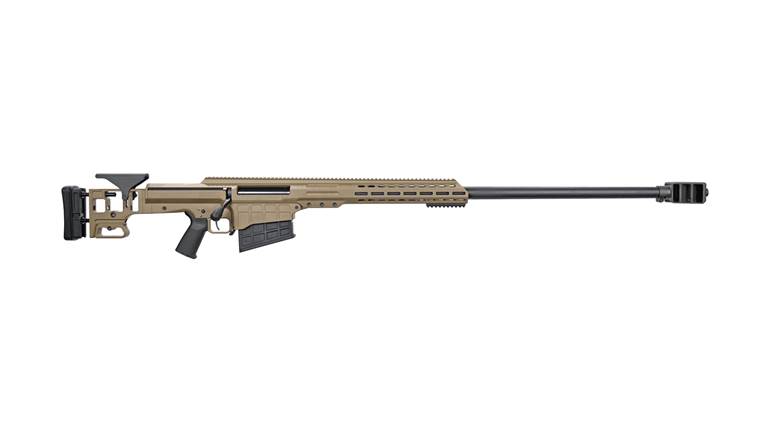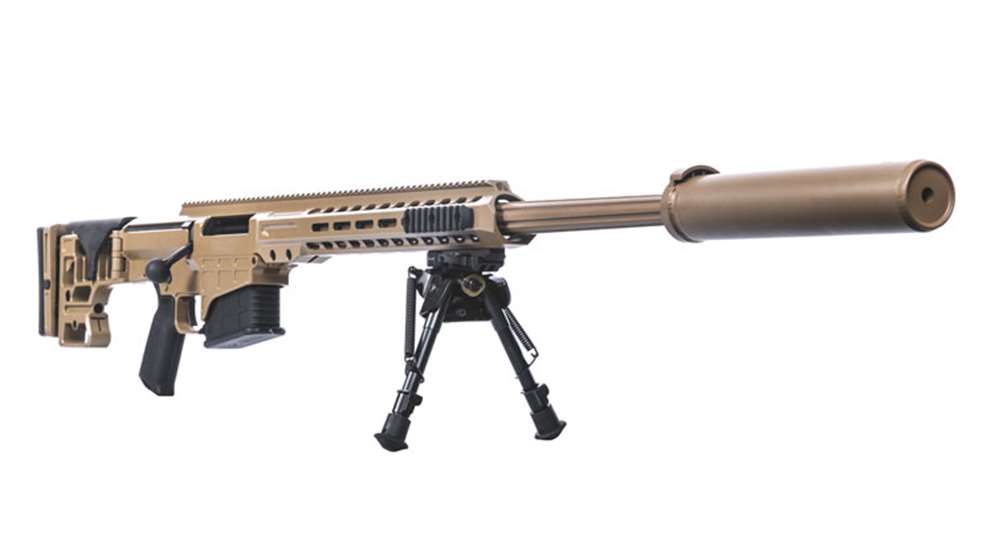
It’s official. Ronnie and Chris Barrett of Barrett Firearms Mfg. have become the first father and son team to have their rifle designs adopted by the U.S. military. Of course, the story of Ronnie Barrett and his U.S. M82 “Big 50” M82A1 and the currently fielded M107 are well known. What was announced on March 12 is that the bolt-action, multi-caliber MRAD (Multi-Role Adaptive Design) as designed by Chris Barrett has been adopted by U.S. Special Operations Command (USSOCOM) as the Mark 21 Advanced Sniper Rifle (ASR). While Ronnie’s designs are type classified with an “M” in front of the Model 82 and Model 107, Chris’ gun is different. Because USSOCOM guns are typically classified with Navy designations, his gun will be the MK 21. According to dod.defense.gov it’s a “$49,936,300, five-year, indefinite-delivery/indefinite-quantity, firm-fixed-price contract (H92403-19-D-0002) for the purchase of advanced sniper rifles in support of U.S. Special Operations Command (USSOCOM).”
It began with an industry day solicitation on Nov. 21, 2017, USSOCOM was looking for an Advanced Sniper Rifle. The operators were after a modular, multi-caliber bolt-action capable of engaging the enemy beyond 1,500 meters. While it was announced, details as to actual requirements in the Request for Proposal were deemed “sensitive,” and there was not a lot of information on the specifics in public sources. What they would let out was that the three chamberings would be 7.62x51 mm NATO, .300 Norma Magnum and .338 Norma Magnum. And SOCOM wanted the individual user—the operator not the armorer—to be able to swap the chamberings.
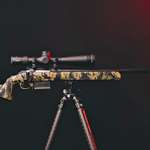
Three chamberings is nothing for the MRAD, as it is currently offered in eight, including Hornady’s .300 PRC. The MRAD itself is based on the 98 Bravo, which we covered in detail. The rifles is fed from an excellent detachable box magazine of Barrett’s design—I have told other maker to make their rifles better by just buying this magazine. The three-lug bolt has interrupted threads in the lugs and the bolt face can be easily swapped out by the user. There is a polymer sleeve on the bolt, which helps its lubricity, keeps grit out and lightens the bolt. The barrel is held in place by two Torx screws passing through the forged aluminum lower receiver, and, again it is easy to change barrels. The stock is fully adjustable, and it folds flat against the receiver’s right side. The extruded aluminum top receiver has a 30-m.o.a. Picatinny rail along its entire top, and there are attachment point at three, six and nine o’clock as well. The paddle-style magazine release is easy to access, and the safety can be reversed for lefties. The pistol grip can be any AR-style you want. And it comes with an excellent trigger.
“This was an eight-year process,” Barrett said. The 98 Bravo was re-designed in response to USSOCOM’s previous Precision Sniper Rifle (PRS) search and evolved into the MRAD. While the MRAD was not chosen, Barrett knew that this was a good rifle, perhaps even a great one. With the ASR win, in Chris’ words, “we finally prevailed.”
The rifle adopted as the MK 21 will be a little different from the standard MRAD. The USSOCOM guns are built specifically to specifications as set out in the RFP. Some of those differences will include a different cheekpiece, a different locknut and, of course, markings. The other of the two entrants at this phase of the ARC are Sako and Accuracy International.
“It’s a lifetime achievement kind of thing," Chris Barrett told me. “We are thrilled.” And Chris is not the only Barrett thrilled. An e-mail from Ronnie came into my friend NRA’s Phil Schreier: “The ASR program has completed. They announced that the Barrett MRAD will be the new MK 21. This is an original rifle designed by my son Chris … Pretty Cool. I think this would make an interesting news item.” We do, too, Ronnie. Hopefully, once the Special Operations troops get theirs, we can get one to put into NRA’s National Firearms Museum next to the M82 used during Operation Desert Storm.
The good news is that the warfighters, the men at the tip of the spear, will have an excellent rifle in the MK 21, well designed, rugged and, in my experience, extremely accurate.
Additional Reading:
The Barrett Model 82a1 Rifle
Barrett 98 Bravo
Barrett Firearms New DOD Contracts Include MRADs in 300 PRC
Barrett Model 82M107 Named Tennessee Official State Rifle