Q: I am puzzled by the fairly recent trend to call all 9 mm pistols and ammunition “9 mm Luger”—even jacketed hollow-point loads. During the last 100 years, Lugers and Walther P.38s would cycle only one 9 mm from a magazine and it was certainly not JHP. Neither gun will chamber a hollow point from its magazine. Such guns are not designed to function with hollow points. In your magazine, Jeff Johnston writes about the new SIG Sauer Legion pistol, listing the ammunition tested as HST HP, JHP and Bonded JHP. The SIG Sauer Legion is clearly marked “9 mm Para” yet Johnston writes “Caliber: 9 mm Luger.” I wish everyone would go back to calling things by their correct name. Even Ruger has called its new American pistol a 9 mm Luger.
A: Demonstrated during the last 150-plus years of breech-loading cartridge manufacture, a system of absolute exactitude does not exist, and likely never will. In the meantime, we must deal with ambiguity as best we can. We have cartridges named for their designers, their manufacturers, their date of introduction, their powder capacity, their intended use, their length, velocity, etc. Then there is the matter of custom and tradition.
If Latin is our choice, we can consider “Parabellum,” which was taken from the phrase Si vis pacem para bellum (If you seek peace, prepare for war). This was actually a trademark granted to Deutsche Waffen Und Munitionsfabriken (DWM), a commercial concern, in Berlin on April 4, 1900, and intended as a telegraphic codename. In relatively short time, that trademark became widely known, at least in Europe, and associated specifically with the Borchardt-Luger pistol and the Heinemann-Maxim machine gun, adopted in 1911/12 for aircraft and Zeppelin service.
Hugo Borchardt’s original pistol design was chambered for the 7.65x25 mm Borchardt. Luger and Borchardt’s redesign utilized a new cartridge which eventually became known as the 7.65 mm Parabellum. Whether that designation had actually been applied when the Borchardt-Luger in that caliber was examined by the Swiss in 1898 is not clear, but inasmuch as DWM was referring to the Borchardt-Luger as the Pistol Parabellum in its promotions, it is likely. Once the success of the 7.65 mm version looked promising, Georg Luger designed the 9 mm cartridge for use in the Borchardt-Luger platform, introduced in the 1902-03 time frame.
So, while Parabellum applies to the pistol that is the subject of discussion, it did not remain an exclusive designation. Nevertheless, as the two cartridges for which that pistol was chambered were exclusive for that firearm at that time, it would seem fitting that they could be, or perhaps should be, referred to as 9 mm and 7.65 mm Parabellum. In 1904, the 9 mm Pistol Parabellum was adopted by the German navy. In 1908, the German army followed suit, but the pistol was the New Model Parabellum utilizing a coil mainspring. The official governmental designation was 9 mm Pistole 1908, otherwise referred to as the P.08, and represents the bulk of the Luger pistols with which we are familiar.
So, it seems that what we’ve been calling the Luger pistol for the last 100-plus years should be referred to as the Parabellum in civilian form, or the German P.08. But Luger it is, and it’s unlikely that will change. The Luger pistol then represented the preponderance of 9 mm firearms available in the United States until the flood of P.38s after World War II and introductions by Colt and Smith & Wesson. I feel that referring to the ammunition appropriate for the Luger as 9 mm Luger was a logical practice. Adding to that logic, a bullet diameter of 9 mm soon became a standard in Europe and, to a degree, in the United States following the turn of the century. As evidence: the Browning/Colt .38 ACP, 1900; 9 mm Parabellum, 1902; 9 mm Browning Long, 1903; 9 mm Mauser, 1908; .380 ACP/9 mm Kurz, 1908; 9 mm Bergman-Bayard/Largo, 1910; 9 mm Glisenti, 1910; 9 mm Steyr, 1912. If you had a Luger pistol, you wanted to make sure you got Luger ammunition. Besides, Parabellum, “for war,” indicates a perceived limitation on its usefulness.
When Georg Luger designed his 9 mm cartridge, autoloading pistol design was in its infancy. One feature that made the pistols successful was jacketed bullets. Jacketed bullets fed from magazine to chamber with greater reliability than lead bullets of the day. Soft- and hollow-points were not a consideration, so no effort was made to design the pistols to utilize them at that point. Though, as it became apparent that hollow-point bullets would greatly contribute to the increased effectiveness of what were once considered strictly full-metal-jacket cartridges, efforts were eventually made by both firearm and ammunition manufacturers to improve designs. It wasn’t until now that we have autoloading pistols in many different calibers that will digest the most effective bullet designs ever, typically hollow-points.
All sorts of FMJ 9 mm Luger ammunition is available on the market and typically functions in all 9 mm Luger firearms. The difference then comes down to the style of projectile in the loaded ammunition. Should cartridges which are otherwise identical except for the design of the projectile be considered sufficiently different to justify a difference in nomenclature? There is no precedent for that as far as I know. That difference is typically indicated on the box label, or end flap, such as, “.357 Magnum 158-gr. SP.”
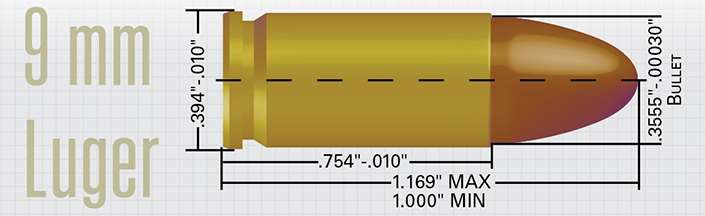
The identity chosen by SAAMI for the cartridge in question is 9 mm Luger. The specifications delineating dimensions and performance characteristics are clearly outlined.
Most Popular








![Aero Precision[72]](/media/21vfqbw0/aero-precision-72.jpg?anchor=center&mode=crop&width=770&height=430&rnd=134334197362730000&quality=60)
![Aero Precision[72]](/media/21vfqbw0/aero-precision-72.jpg?anchor=center&mode=crop&width=150&height=150&rnd=134334197362730000&quality=60)