Manufacturers of firearms, optics and accessories are, for good reason, increasingly modifying existing products to capitalize on the current desire for all things tactical and survival/sustenance-related. Even the Model 1892 lever-action rifle, which is among the most “traditional” of firearm designs, hasn’t escaped an overhaul to satiate the demand. Evaluated here is Taylor’s & Company’s modernization of the Model 1892, the Alaskan Take-Down, which is distributed exclusively by Taylor’s Tactical. The rifle is produced in Italy by Chiappa and imported exclusively for Taylor’s & Co.
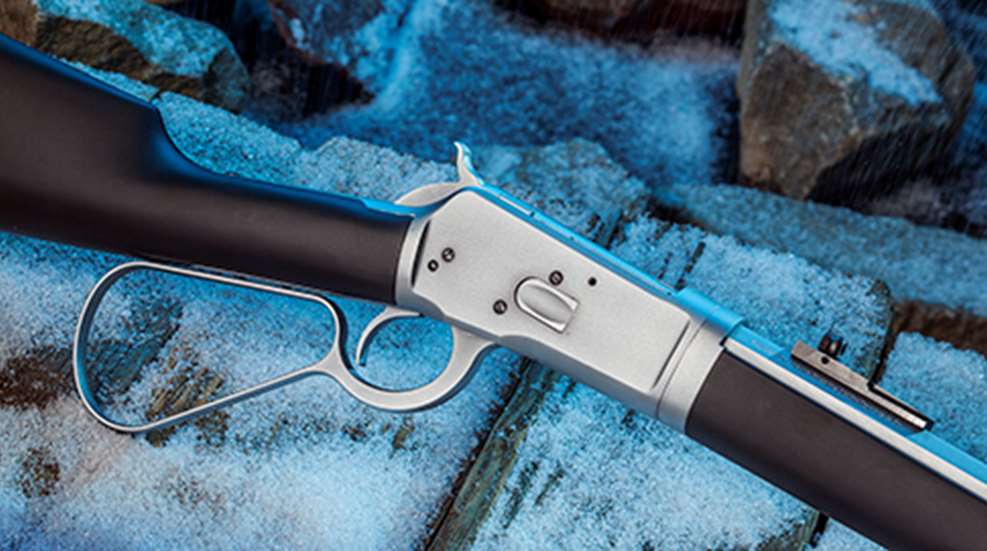
The 1892 Alaskan Take-Down’s aesthetics and features are decidedly different than typically encountered on such rifles. Its receiver, barrel and large loop lever have a matte-chrome finish, while the hardwood stock and fore-end are covered with an overmolded rubber finish the company calls Softouch. Combined, it creates a utilitarian two-tone package that’s far from the time-honored combination of walnut and bluing, and even more durable.
Arguably, its most attractive feature is the fact it can be broken down into two separate parts that measure 20 inches in length or less for easy transport-no small consideration for those heading to the backcountry, regardless if on a bush plane or backpacking in. Thanks to some clever design features, no tools are required for takedown, either.
The procedure is simple. Check and double-check that the rifle is unloaded and leave the action open. Next, locate the 1.3-inch long, flush-fitting magazine-disassembly lever, which is at the front, bottom of the magazine tube. Grasp it on the end toward the receiver and rotate until perpendicular to the magazine. At the same time a lug will retreat from a recess under the barrel, a system that locks everything solidly in place while shooting.
Rotate the lever counter-clockwise to remove the magazine. Once it’s out, you can grasp the fore-end while firmly holding the stock, and turn counter-clockwise 90 degrees to separate the two. This is made possible by the interrupted thread pattern on the barrel and receiver. Damage to the magazine can be prevented by reinstalling it on the fore-end during storage.
Because both the front and rear sights are located on the barrel assembly, there is no point-of-impact shift resulting from the disassembly and reassembly process. The 1892 Alaskan Take-Down ships with windage- and elevation-adjustable Skinner Express sights at the rear. The test rifle had Skinner’s 0.125-inch (large) aperture installed, which is excellent for rapid target acquisition, but precision bullet placement at 100 yards and beyond is compromised. For the intended purposes of the .44 Rem. Mag.-chambered Take-Down-hunting/survival-it’s a fair trade-off; however, smaller apertures can be purchased from Skinner for $11.
The dovetailed front sight has a 0.625-inch long, red fiber-optic pipe anchored in three places. The sight is slightly more than 0.4 inches above the barrel. In testing, target acquisition was fast, intuitive and even in low light the front sight was easy to find. To mount a scout-style optic, removal of the Skinner sight is required. It occupies two of the four threaded holes provided on the rifle designed to accept Weaver 61M mounts.
At the muzzle end, the 20-inch octagonal barrel-also available in a 16-inch version-has a diameter of 0.75 inches and ends with a radius crown. At the receiver the barrel widens to 0.84 inches. Both the barrel and the receiver had an even finish with no blemishes visible.
The buttstock was a different story. A trio of nicks in the Softouch finish resulting from rough handling in transit was deep enough to expose the hardwood underneath. The semi-tacky treatment was extremely effective on the hot, humid day when accuracy and function testing were conducted. Sling swivel studs were absent; however, they can easily be added thanks to the wood buttstock and fore-end.
With the 20-inch barrel, the rifle’s overall length is 38 inches; obviously the 16-inch barreled variant’s overall length is 4" shorter. Capping the buttstock is a generous 1/2-inch thick rubber recoil pad that contributes to the rifle’s 13¾-inch length of pull.
To load the magazine, cartridges are pushed through a gate on the right side of the receiver and empty brass is ejected from the top of the receiver-it’s a system familiar to Model 1892 fans. The oversized loop lever is a handy feature, especially whenever gloves are worn. Regardless of familiarity with lever-action operation, though, no one could miss the fact that this is the kind of trigger dreams are made of-no creep, no grit, and no takeup. All rifles should have one of these, and it broke cleanly and crisply at precisely 3 pounds with regularity.
During testing the only stoppage occurred due to operator error, a failure to work the lever with enough authority when chambering a single Federal cartridge. There were no other malfunctions.
Velocities produced by what is really handgun ammunition make the rifle a viable complement to a .44 Rem. Mag. revolver in bear country or survival situations. The Softouch finish does its job, and proper sight pictures are easy to acquire with that red glow up front. Most shooters will probably agree that nothing needs to be changed.
And our sample was a real shooter. In fact, in multiple instances three out of five holes touched at 50 yards. Moving back to 100 yards to meet American Rifleman protocol, however, the groups increased a bit. That being said, the most accurate load was Hornady’s 300-grain XTP. Its single best five-shot group measured 2.71 inches, and 25 shots averaged 4.32 inches. For 75 shots with three different loads the rifle averaged 4.69 inches. Given the use of open sights and the rifle’s chambering, we found this level of accuracy acceptable.
Anyone looking for a reliable lever gun to beat the brush for big game, backup for the backcountry, or to simply punch paper, won't go wrong with the 1892 Alaskan Take-Down.
Taylor's 1892 Alaskan Take-Down
Manufacturer: Armi Sport di Chiappa, Via Milano 2, Azzano Mella, Italy, 25020; 011390309749065; chiappafirearms.com
Importer: Taylor’s & Co. (Dept. AR), 304 Lenoir Drive, Winchester, VA 22603; (540) 722-2017
Caliber: .357 Mag., .44 Rem. Mag.(tested), .45 Colt
Action Type: lever-action, center-fire repeating rifle
Receiver: matte-chrome steel
Barrel: 16 inches, 20 inches (tested), matte-chrome steel
Rifling: six-groove, 1:20-inch RH twist
Magazine: 10-round tubular
Sights: Skinner Express rear sight, fiber-optic front drift adjustable for windage: drilled and tapped for scope bases
Trigger: single-stage; 3-pound pull
Stock: hardwood with rubber overmolded Softouch finish: length of pull, 13¾ inches; drop at comb, 2 inches; drop at heel, 2 5⁄8 inches
Overall Length: 38 inches (20-inch barreled version)
Weight: 6 pounds, 10 ounces
Accessories: owner’s manual
Suggested Retail Price: $1,324
Most Popular