In the 1960s, American shooters started getting interested in semi-auto pistols. Unfortunately, they had relatively few models from which to choose. Colt made only 1911 style guns, Ruger made none and Smith & Wesson offered a single choice in the Model 39. Exotic double-wide, double-column guns were still a few years off. In fact, the only really viable staggered column pistol was the legendary Browning Hi Power of 1935. A few other guns were available, mostly European imports and often World War II surplus. Into this uneven market came a new 9 mm pistol that makes for a very interesting footnote in handgun history.
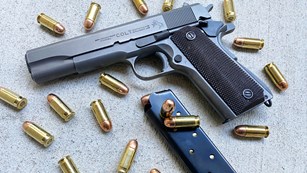
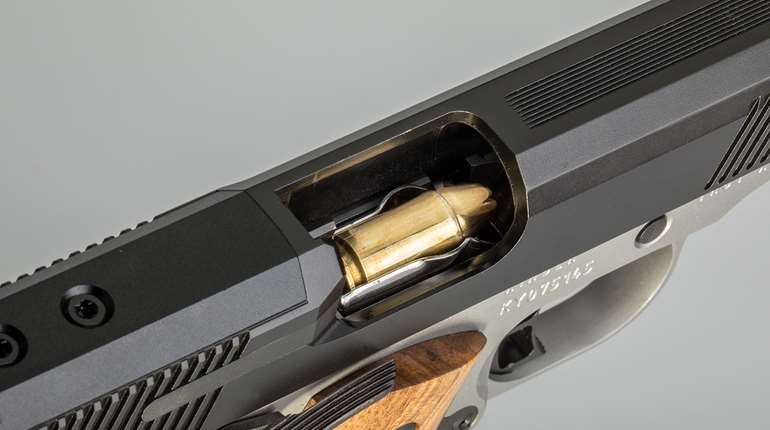
The gun is the MAB P-15. MAB stands for Manufacture de Arms de Bayonne, a plant in southwestern France close to the Spanish border. This firm was well-established by the mid-60s, but most of their product was pocket autos, usually in smaller calibers. A few of these guns have come across my desk over the years, and I remember the excellent quality of the machine work that went into these guns. The P-15 was their first effort at building a service pistol for serious police and military use. It turned out to be a very nice gun—accurate, durable and easy to use. P-15s were all steel with molded plastic grips, fixed sights and a high-polish, blue-steel finish. A big gun—a little bigger than a typical 1911—the better part of the gun’s mass came from a sturdy receiver big enough to take a 15-round magazine. Even though the maker made an obvious effort to keep the butt section as comfortable as possible with thin plastic scales, it’s thick enough to be a bit of a problem. Part of that also comes from the space needed in the gun for the barrel locking mechanism. This is the distinguishing feature of the pistol and it was the first modern gun to use it—a barrel that rotates into a locked breech position.
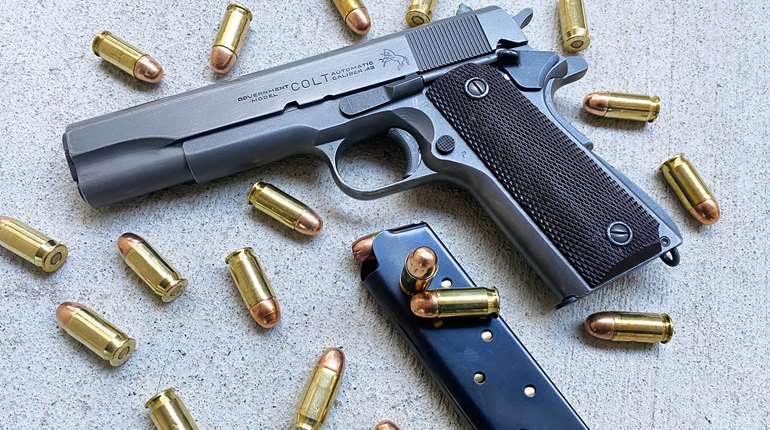
This concept was used on certain Savage pistols and recently on Berettas and the ill-fated Colt 2000. It seems to work quite well on the several guns I have fired that use it and that includes the MAB. The only problem seems to be one of aesthetics and ergonomics—the pistol is rather thick. The MAB did not turn out to be a great commercial success, but that is more likely to be because of the single-action trigger at a time when the world wanted DA/SA and then DAO ones. This was a big, rugged gun that filled the bill very well for police and military service. It handled much like the Colt, with a down-to-fire safety and thumb-operated magazine catch on the left side.
Despite many claims that the P-15 was the French service auto, it was not. Although the French military recognized the gun’s value in competition and bought a relative few for that purpose and (possibly) some for Special Operations, the gun was never made an official service auto. Interestingly, the gun was made in single wide and adjustable-sight variants, but not in quantity. This is one of those fascinating footnotes in the ongoing history of small arms.
Most Popular