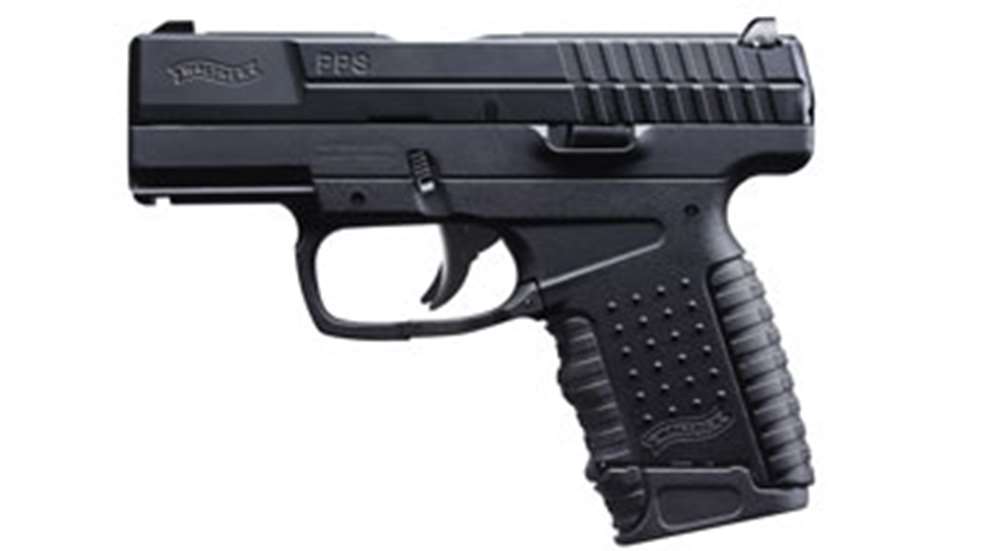
One of the things that stands high on my “to-do” list is shoot and write about a particular pistol that seems to be running under the radar. It is a Walther, sold in the United States by Smith & Wesson under a strategic agreement with the legendary German gunmaker. Most shooters are aware that this agreement has resulted in a number of the very popular Walther pistols becoming available in the United States at competitive prices. The particular pistol to which I refer is the Walther PPS, which stands for Police Pistol, Slim. As a guy that has looked at all of the current genre of small, single column 9 mm Luger pistols in detail, I found the PPS in 9 mm to be a very appealing personal defense package. Best of all, it was reliable.
But another version of the PPS was introduced a year or so back and has received very little attention. It is the PPS .40, a suitably modified version of the original that fires the more powerful .40 S&W cartridge. Almost none of the range of skinny nines can be adapted to the larger cartridge—Kahr is the exception—but I just got delivery of the first PPS in that legendary planet wrecker of a personal defense cartridge, the .40 S&W.
I won't go into another tirade about this cartridge, which was arguably the most immediately successful round ever introduced. A potent medium bore, the Forty sometimes presents problems to less sturdily built guns. It operates at greater pressure than most of its contemporaries and that translates to high slide-velocities. Because of this, it takes a well-designed and strong pistol to run the .40 S&W. The smallest pistol ever chambered for it was the Kahr, with the PPS is in the same size class. The Kahr was a nasty kicker and I anticipate the same from my new Walther. But the various desirable features of the PPS make a little recoil acceptable.
In .40 S&W, the gun comes with 5-, 6- and 7-shot magazines. Each additional round means another little bit of length to the butt section, as the five rounder fits flush. The longer the magazine, the more gun to grip. It really seems that Walther's designers understood the need for minimal dimensions on a concealed carry gun. The pistol's backstrap comes in three sizes to accommodate various hands, all slender in keeping with the gun's design parameters. This little Walther is not particularly expensive, seems to work well, but a further positive commentary on the model in .40 S&W will have to wait for a detailed shooting review, which will appear in the pages of American Rifleman soon.
Most Popular