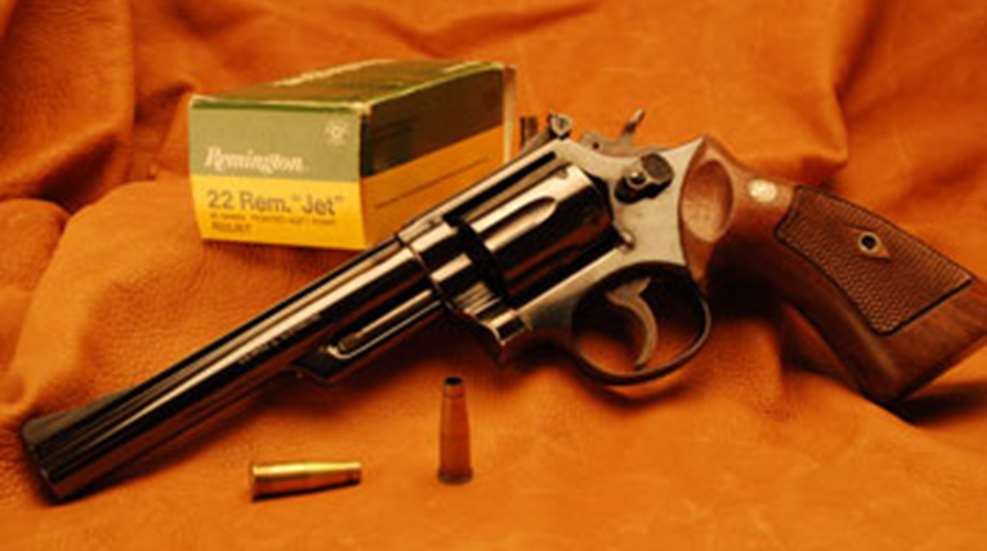
I recall a very pleasant day at my gun club, shooting a handsome old Smith & Wesson revolver that had somehow turned out to be a commercial dud. This was sometime in the early 1980s and the gun in question—called the Model 53—had been officially discontinued in 1974. In fact, it was dead long before that, with leftover specimens languishing on dealer's shelves at pricetags that had to make you wonder. The gun was also called the .22 Centerfire Magnum, a model intended for the handgunning outdoorsman who wanted to engage small-game animals and varmints at ranges well beyond those normally associated with pistols and revolvers. It was, in short, a varminting revolver, useful at distances out to 100 yards or a little more. The thing that made this happen was a hot cartridge called the .22 Remington Jet.
The Jet was based on the familiar .357 Mag. case, necked down to .22 caliber. This required a rather steep taper, so much so that the resulting case resembled a champagne bottle. In the shooting sense, this turned out to be the gun's undoing. If the shooter was less than careful about keeping his chambers clean and dry, firing the round would cause not only normal expansion, but also a tendency to back out of the chamber. This sometimes wedged the case so firmly against the breech face that the cylinder would not turn and could not easily be opened. However, it must be noted that being careful about gun maintenance would deliver perfect performance. Nevertheless, the cartridge developed a bad reputation and the gun-cartridge combination suffered an undeserved early demise.
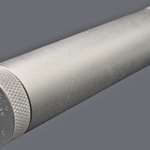
This is not, however, the complete story of the Model 53 revolver. While the gun was designed to fire the centerfire cartridge, S&W engineers could not resist the obvious possibilities of .22 rimfires. The gun was fitted with twin firing pins in the breech face, one of them central and the other offset from the centerline of the bore in order to work with rimfire rounds. To hit the correct firing pin, the gun's hammer had a pivoting nose that let the shooter select either the center-fire or rimfire option. It worked as slick as glass. In order to hold .22 long rifles in position in the chambers, every Model 53 came with six chamber insert that were machined to the same outside dimensions as a .22 Jet case with a centrally cut .22 Long Rifle chamber insert. The shooter slipped a Long Rifle into each insert, then loaded six of them into the cylinder of the revolver and went to work. It worked perfectly, although it was a bit tedious to pick out the empties after firing. Some specimens of the revolver came with a.22 Long Rifle cylinder that interchanged with the .22 Jet one. This is the way to go and these cylinders add to the value of the gun in the second market.
Model 53s command good prices today. As a .22 Long Rifle, with either inserts or a second cylinder, Smith & Wesson's long ago venture into a varminting wheelgun makes an outstanding target or sportsman's rimfire revolver. And devoted experimenters like Hamilton Bowen have managed to rechamber those Long Rifle cylinders to some pretty exotic cartridges.
Most Popular