Weaver Optics was purchased from technology giant ATK by Meade Instruments in 2001. In April 2008 ATK acquired Weaver Optics from Meade, reuniting it with the Weaver scope ring and base division originally retained by ATK. It seems Meade had let the Weaver product line grow stagnant, doing little to bring the 75-year-old company into the new millennium. But ATK is moving Weaver forward, and the new Super Slam riflescope is where they're starting.
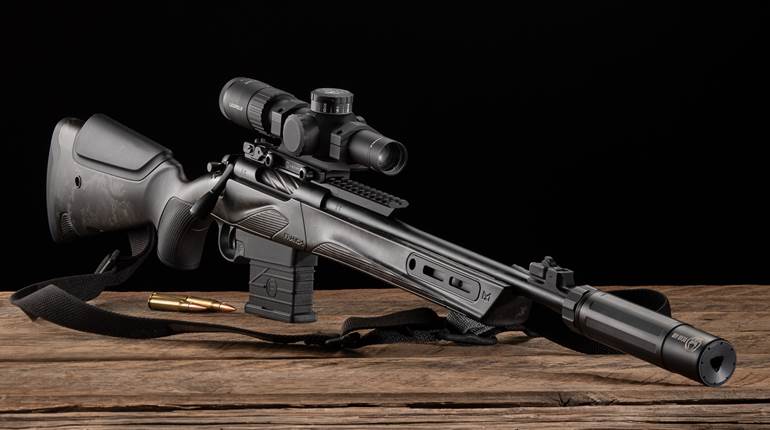
I was introduced to the Super Slam during a prairie dog and coyote hunt in Wyoming. I showed up with Nosler's new Custom Model 48 Varmint rifle in .22-250 Rem. and mounted and zeroed a 3X-15X-42mm Super Slam equipped with the EBX reticle. Over the next three days I fired 275 rounds. There were no malfunctioning issues with the Super Slam and it did not deviate from the original zero.
I generally rely on Kentucky windage when shooting prairie dogs, but for the sake of testing I gave the adjustment knobs an honest try by trying to click my way to hits. To adjust the reticle the user must lift the turret rings to engage them before turning; not once did I have a problem with them inadvertently lifting and rotating, something I feared might happen.
I also worried they might leak. After returning home I submerged the scope in my hot tub and twisted and turned the knobs for several minutes without any indication of a leak.
The EBX reticle is a glass-etched reticle positioned in the second focal plane. All other Super Slam reticles are second-plane reticles, too, but they're made from wire. Eteched reticles are more durable than wire.
An instruction sheet containing ballistic correction data for popular cartridges comes with each EBX-equipped riflescope. The information is also on Weaver's website. To work with the instructions, the scope must be set to maximum magnification. The dots and hash-marks in the EBX reticle were a tad large for prairie dogs beyond 350 yards, but big-game hunters should find them sized just right.
I have one complaint with the EBX reticle—or, actually, with its supporting literature. Weaver should provide the 100-yard subtension measurements for each EBX aiming point. This would help apply the reticle to specific loads and tune the reticle via the magnification setting. I voiced my concerns to Michael Kinn with ATK and he assured me that subtension data will be supplied with each riflescope in 2010. According to the schematic supplied by Kinn, at 100 yards the first dot subtends to 2.25 inches, the second to 4.93 inches and the third to 7.98 inches. You can convert these to any distance by multiplying them by the range in yards and dividing by 100.
Weaver offers five 2X-10X, six 3X-15X and three 4X-20X Super Slam models. There are four reticles available, but only the 3X-15X version can be bought with the illuminated reticle. With the 2X-10x and 3X-15X you can have either a 42mm or 50mm objective. The 4X-20X Super Slam is only available with a 50mm objective.
All 3X-15X and 4X-20X models have a side focus knob mounted on the left side of the adjustment knob saddle, allowing you to fine-tune focus and parallax from 25 yards to infinity. Most of the parallax adjustment knobs or rotating objectives I've tested on other riflescopes are never true to their range indication. In other words, you may find the parallax-free setting for 100 yards at the 75-yard setting. The Super Slam was dead on.
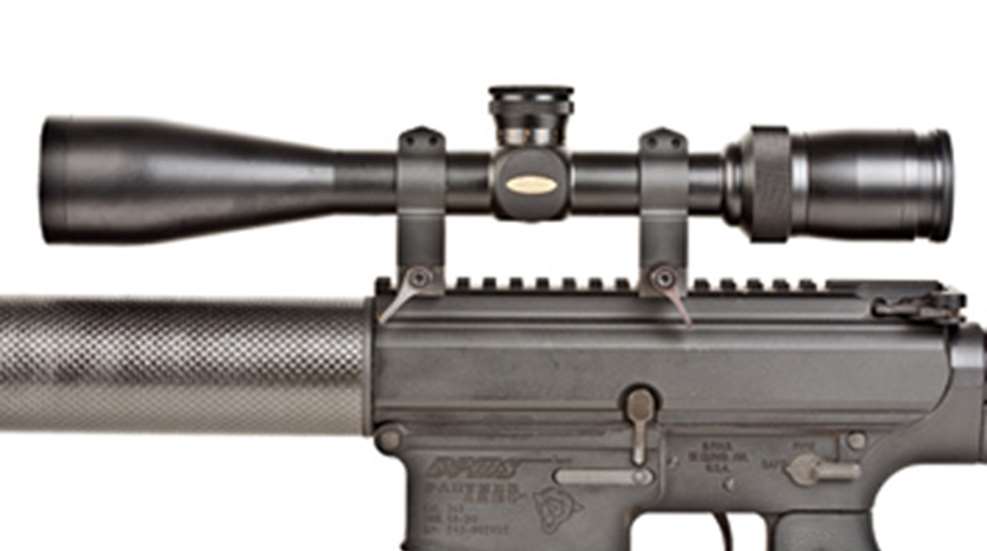
I didn't have a truly hard-kicking rifle on hand to test the recoil tolerance of the Super Slam, but I was working on a hunting handload project for a DPMS Sportical in .308 Winchester. I mounted the Super Slam to the Sportical and fired 90 rounds, making numerous reticle adjustments during the process.
To test repeatability, I fired the customary "box" using targets spaced 7.5 inches or 30, quarter-inch clicks apart. Again, the lift-up adjustment knobs were convenient and they adjusted each group to the center of each target and returned the riflescope to perfect zero. Credit for repeatability has to go to the new three-point erector system, which is a hybrid of the traditional system where a single leaf spring preloads the erector against the two erector screws (adjustments), hence the three points. The leaf spring in the Super Slam benefits from modern design improvements, providing a stable and uniform preload force.
The Super Slam has fully multi-coated optics and was as bright as a similar Leupold VX II. The new three-point erector system provides crisp and repeatable adjustments and the pull-up adjustment knobs are as handy as a toothpick at a Georgia barbecue. Like all Weaver riflescopes, the Super Slam is waterproof, fogproof and shockproof.
Though pricier than the pre-ATK Weaver scopes, the Super Slam performs on par with comparably priced models from the competition. With adjustments so precise and repeatable, I'd recommend it to any hunter. The Super Slam with the EBX reticle seems a perfect match to a pronghorn rifle, which explains why it's now mounted on my Cooper Model 22 in .257 Roberts.
Manufacturer: Weaver Optics; (866) 788-7386 Weaveroptics.com
Type: Variable-magnification riflescope
Magnification: 2X-10X; 3X-15X (tested); 4X-20X
Objective Lens Diameter: 42mm (tested); (50mm)
Body Tube Diameter: 1"
Eye Relief: 3.98" @ 3X - 3.94" @15X
Exit Pupil: 10.5mm @ 3X, 2.34mm @ 15X
Field of View: 33.28' @ 3X, 6.7' @ 15X
Coatings: Fully multi-coated
Length: 13.4"
Mounting Space: 5.7"
Weight: 20.5 ozs.
MSRP: $756.49
Most Popular