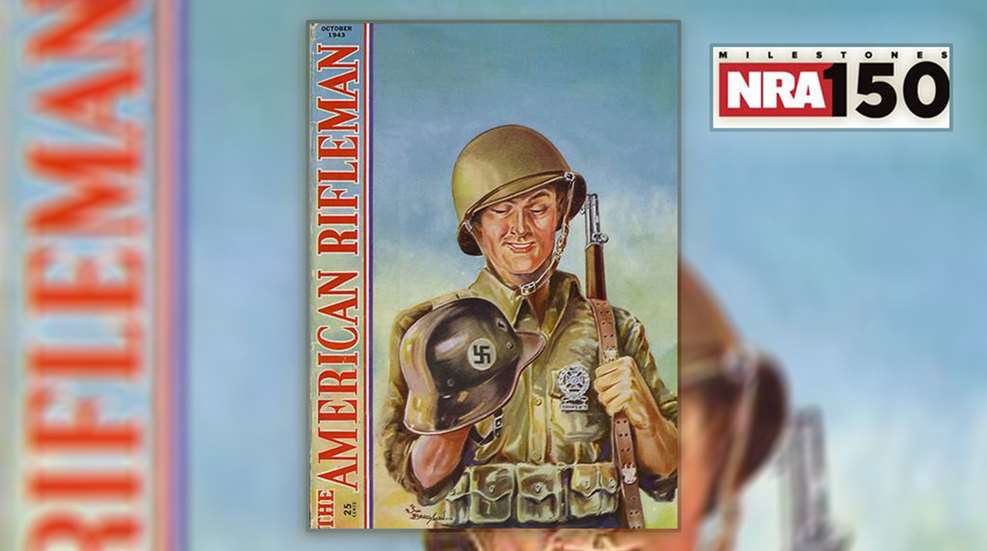
War. It came to Poland in September 1939. This was followed by the fall of France in May 1940, resulting in England standing alone against Germany. The United States would not enter the war until after the attack on Pearl Harbor on Dec. 7, 1941, and before that, isolation was the mood for much of the country. For NRA, the watchwords were preparedness and national defense. In July 1940, NRA and its affiliated clubs offered their services, ranges, equipment and manpower to the governors of the 48 states to, “Aid in training use for the home defense purpose whenever the governor may feel the organization of such a unit is desirable.” In September 1941, NRA laid out a five-point plan for national defense:
1. Serve as marksmanship instructors for the state guard.
2. Serve as marksmanship instructors for local police departments and county sheriffs.
3. Serve as small arms instructors for men of draft age.
4. Serve as special deputies under the local sheriff or local chief of police for the guarding of local transportation, water and power utilities and similar tasks.
5. Relieve hard-pressed government arsenals and commercial ammunition factories in the matter of maintaining adequate supplies of ammunition of various calibers.
Even as Germany had overrun Europe and was enslaving its free peoples, still some American voices called for increased laws restricting the rights of law-abiding Americans—even calling for universal civilian disarmament, which NRA stood firmly against. Unarmed defense is no defense at all.
Once it became clear that war was coming, NRA developed a Basic Small Arms Training program using the .22-cal. rifle to teach marksmanship and gun function. It employed the best training materials available at the time and was standardized so when young men went into the Armed Forces they could transition to the .30-cal. rifle. This program was adopted without changes by the War Dept. as a pre-induction training program, and 1.7 million trainees passed through it during the war—with NRA volunteers serving as the instructors. NRA also developed films on marksmanship training—the film on pistol shooting was the only one of its kind available at the beginning of the war—and they were offered without charge to the military, duplicated and used to train soldiers, sailors, Marines and guardsmen who would go into harm’s way.
NRA created printed training materials, too, including the “ABCs of Pistol Shooting,” and they were offered free to the Armed Forces. With the Army National Guard moving overseas, NRA saw the need to train plant guards in the safe and effective use of small arms, so it created a series of manuals, an instruction curriculum, as well as courses of fire, to get them trained. NRA created the only manual of its type in that era on the tactical use of shotguns.
The cover of the October 1943 issue—by Pulitzer Prize-winning staff artist Jim Berryman—said much of the NRA’s mission: “This month ... a picture of the end toward which we are all working: the end of a Nazi. There’s a sermon in this cover picture, too. Teach our fighting men to shoot, to put their slugs through the other guy’s helmet before he can put a slug through theirs—give them the guns to drive those slugs true to the mark, and armor (better than that used in the Nazi helmet pictured) to protect them while they shoot—and they’ll do the job!”
With the war won, letters of thanks came into NRA from the likes of Army Chief of Staff George C. Marshall and Chief of Naval Operations Ernie King. But another to Managing Editor C.B. Lister came from:
The White House
Washington
November 14, 1945
Dear Mr. Lister:
The tradition of a citizen soldiery is firmly, and properly, imbedded in our national ideals. Initiative, discipline, and skill in the use of small arms are essentials for the development of the finished citizen soldier.
The National Rifle Association, in the periods between our last four wars, has done much to encourage the improvement of small arms and of small-arms marksmanship in the regular services, as well as in the National Guard, reserve units, and the civilian population.
During the war just ended, the contribution of the National Rifle Association in the matter of small-arms training aids, the nation-wide pre-induction training program, the recruiting of experienced small-arms instructors for all branches of the armed services and technical advice and assistance to Government civilian agencies aiding in the prosecution of the war—all contributed freely and without expense to the Government—have materially aided our war effort.
I hope the splendid program which the National Rifle Association has followed during the past three-quarters of a century will be continued. It is a program that is good for a free America.
Sincerely,
Harry S. Truman
Most Popular