** When you buy products through the links on our site, we may earn a commission that supports NRA's mission to protect, preserve and defend the Second Amendment. **
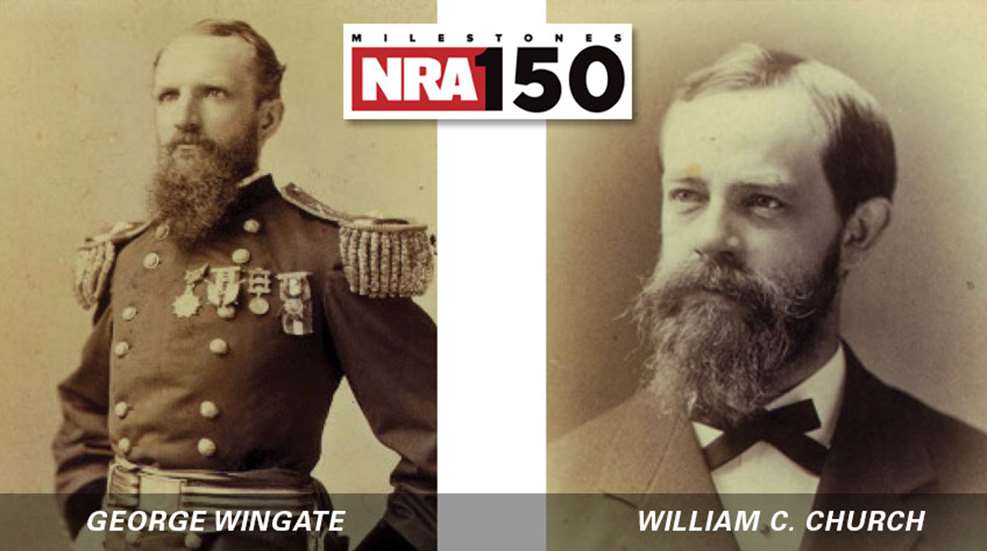
When William C. Church penned a series of articles in 1871 decrying the lack of marksmanship training in America, little did he know that he had struck the spark that would create a world leader in safety training, a service organization, a civil rights organization and a passionate voice for the constitutional freedoms that we hold dear as Americans.
Though America had a self-image as a nation of sturdy, sharpshooting yeomen dating back to the days of the frontier and the Revolution, the truth was that even by the time of the Civil War it had become urbanized. Union troops, city-bred or immigrants, were thought to be second-best to Southerners in terms of marksmanship.
Two Union veterans, Lt. Col. William C. Church and Capt. George Wingate, were the driving forces behind the organization we know today as the National Rifle Association. Church, a prominent newspaperman, became editor of the Army and Navy Journal And Gazette Of The Regular And Volunteer Forces during the war. It became the most respected journal on military science and affairs of its day. From that post, Church condemned the often backward and incomplete marksmanship training in the volunteer forces. Wingate, then a captain in the New York National Guard, had been appalled by the poor marksmanship of Union troops, and after the war sought a textbook from which to teach his men. Finding nothing of value at the War Department, he contacted Church, who suggested that he prepare a manual on target practice for the Army And Navy Journal.
Wingate’s Manual For Rifle Practice appeared in six installments and as a pamphlet. In preparing his manual, Wingate contacted the British National Rifle Association, formed in 1859, “for the encouragement and ... promotion of rifle shooting throughout Great Britain.” Church urged in a Gazette editorial that, “An association should be organized ... to promote and encourage rifle shooting on a scientific basis ... . Let us have our rifle practice association, also a Wimbledon (today’s tennis club was then a rifle range) on American principles.” On Nov. 17, 1871, a charter was granted by the state of New York for the National Rifle Association of America. Civil War Gen. Ambrose Burnside—inventor, former governor of Rhode Island and U.S. Senator—was the fledgling NRA’s first president. Today, he’s better remembered for his facial hair.
With financial help from New York State, a site for the “American Wimbledon” was purchased in late 1872. Located on Long Island, the Creed farm, which resembled an English moor, was dubbed “Creedmoor.” After considerable clearing, development and construction, the range was opened on April 25, 1873, and the first annual matches were held at the new range. NRA’s program began gaining wider acceptance, and even the skeptical Regulars began to change their ideas about marksmanship training, and in the years ahead took steps to adopt systems developed at Creedmoor.
In 1875, the Irish Rifle Team, under the leadership of Maj. Arthur B. Leech, challenged America to a long-range rifle match. The Irish were then the undisputed champions of the British Isles and were considered the best marksmen of their day. The match, fired at Creedmoor, pitted the veteran Irish shooters against a relatively inexperienced American team firing American-made rifles. The Irish used Rigby muzzleloading target rifles, thought to be far more accurate than any breechloader, while the Americans used Remington and Sharps breechloaders specially made for the event.
As a token of international friendship, Maj. Leech, thinking his team would surely win, presented a handsome silver tankard to the Americans. The Americans, against all odds, won the match. The tankard became known as the Leech Cup, and today it remains one of the most coveted trophies in long-range marksmanship.
Though America had a self-image as a nation of sturdy, sharpshooting yeomen dating back to the days of the frontier and the Revolution, the truth was that even by the time of the Civil War it had become urbanized. Union troops, city-bred or immigrants, were thought to be second-best to Southerners in terms of marksmanship.
Two Union veterans, Lt. Col. William C. Church and Capt. George Wingate, were the driving forces behind the organization we know today as the National Rifle Association. Church, a prominent newspaperman, became editor of the Army and Navy Journal And Gazette Of The Regular And Volunteer Forces during the war. It became the most respected journal on military science and affairs of its day. From that post, Church condemned the often backward and incomplete marksmanship training in the volunteer forces. Wingate, then a captain in the New York National Guard, had been appalled by the poor marksmanship of Union troops, and after the war sought a textbook from which to teach his men. Finding nothing of value at the War Department, he contacted Church, who suggested that he prepare a manual on target practice for the Army And Navy Journal.
Wingate’s Manual For Rifle Practice appeared in six installments and as a pamphlet. In preparing his manual, Wingate contacted the British National Rifle Association, formed in 1859, “for the encouragement and ... promotion of rifle shooting throughout Great Britain.” Church urged in a Gazette editorial that, “An association should be organized ... to promote and encourage rifle shooting on a scientific basis ... . Let us have our rifle practice association, also a Wimbledon (today’s tennis club was then a rifle range) on American principles.” On Nov. 17, 1871, a charter was granted by the state of New York for the National Rifle Association of America. Civil War Gen. Ambrose Burnside—inventor, former governor of Rhode Island and U.S. Senator—was the fledgling NRA’s first president. Today, he’s better remembered for his facial hair.
With financial help from New York State, a site for the “American Wimbledon” was purchased in late 1872. Located on Long Island, the Creed farm, which resembled an English moor, was dubbed “Creedmoor.” After considerable clearing, development and construction, the range was opened on April 25, 1873, and the first annual matches were held at the new range. NRA’s program began gaining wider acceptance, and even the skeptical Regulars began to change their ideas about marksmanship training, and in the years ahead took steps to adopt systems developed at Creedmoor.
In 1875, the Irish Rifle Team, under the leadership of Maj. Arthur B. Leech, challenged America to a long-range rifle match. The Irish were then the undisputed champions of the British Isles and were considered the best marksmen of their day. The match, fired at Creedmoor, pitted the veteran Irish shooters against a relatively inexperienced American team firing American-made rifles. The Irish used Rigby muzzleloading target rifles, thought to be far more accurate than any breechloader, while the Americans used Remington and Sharps breechloaders specially made for the event.
As a token of international friendship, Maj. Leech, thinking his team would surely win, presented a handsome silver tankard to the Americans. The Americans, against all odds, won the match. The tankard became known as the Leech Cup, and today it remains one of the most coveted trophies in long-range marksmanship.
Most Popular