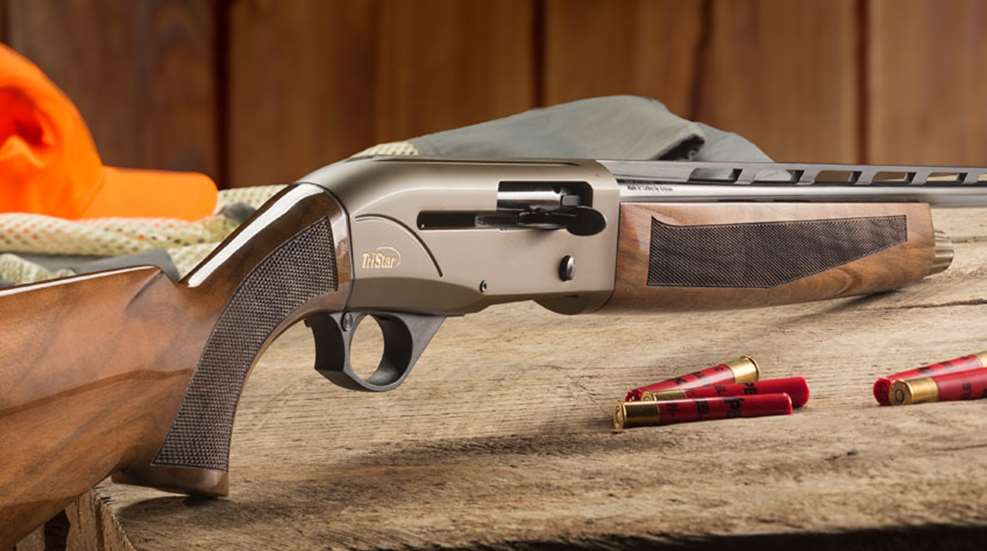
TriStar has a long history with Turkish gunmakers and imports an excellent line of moderately priced shotguns that, most importantly, work well. Among the company’s premier lines, the Viper G2 Bronze is now being offered in .410 bore, and an example of TriStar’s newest sub-gauge is the subject of this review.
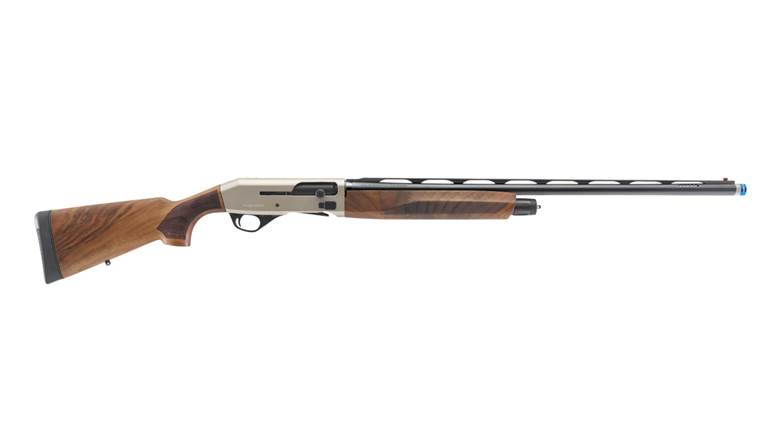
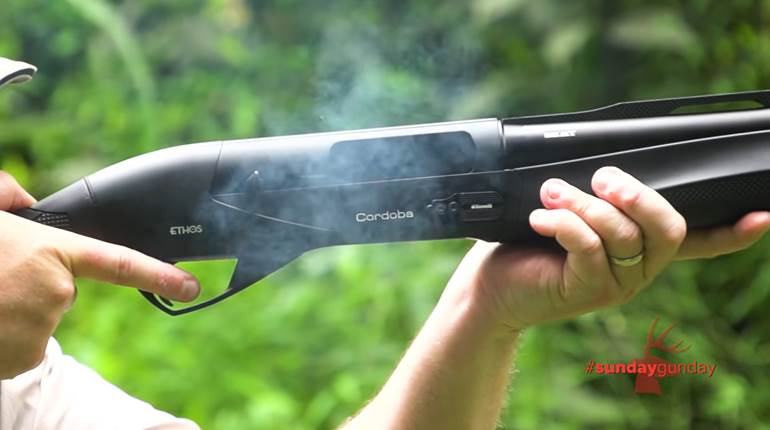
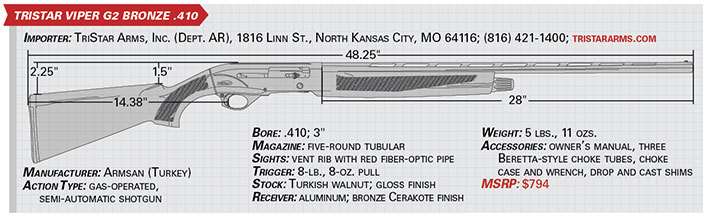
From muzzle to butt, the Turkish-made G2 is a very attractive shotgun with its highly polished, deep-blued barrel, glossy Turkish walnut stock and fore-end (with just a hint of figure in the wood), and bronze-finished Cerakote receiver. The butt has a soft, sporting-clay-style pad with a hard-plastic insert at the top to facilitate a smooth mount. Both the stock and fore-end have 20-l.p.i., sharp-pointed checkering that ensures a solid grip under any conditions. Stock dimensions are made for American shooters, with a length of pull of 14 3⁄8", drop at comb of 1½" and drop at the heel of 2¼". There is a hint of cast off at 1/4". We found the combination to be highly satisfactory when shooting low-gun skeet targets. If the stock doesn’t fit straight from the box, the G2 comes with a set of shims that are easily changed to adjust the drop and cast for both right- and left-handed shooters.
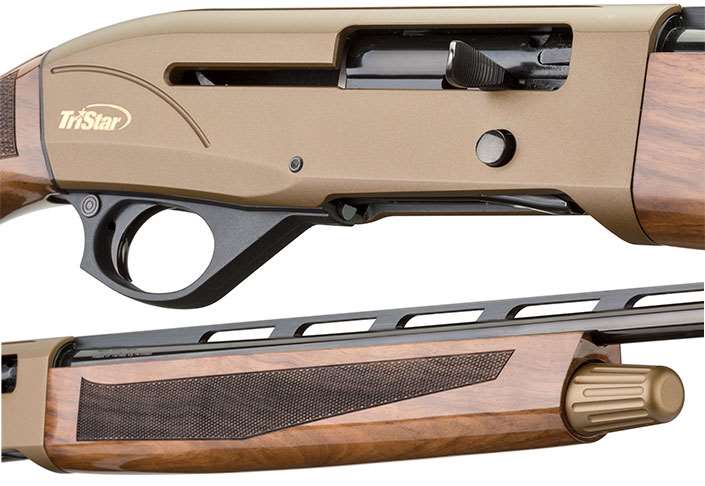
The cross-bolt safety is located behind a large trigger guard that would easily accommodate a gloved hand in cold weather. The trigger, although a bit on the heavy side with an average pull of 8 lbs., 8 ozs., is very crisp with absolutely no preliminary take-up, and it breaks as cleanly as on a fine double.
Moving forward, the bronze Cerakote-finished receiver will resist snow, rain and other corrosive elements, and the action is closed by means of a raised button on the right side of the receiver. It takes a bit of a push to close the action, but from a safety point of view that’s not all bad. The ejection port is large enough for fumble-free insertion of a shell, and the magazine port on the bottom of the action is wide enough to comfortably allow an adult-size thumb to push shells into the five-round tubular magazine.
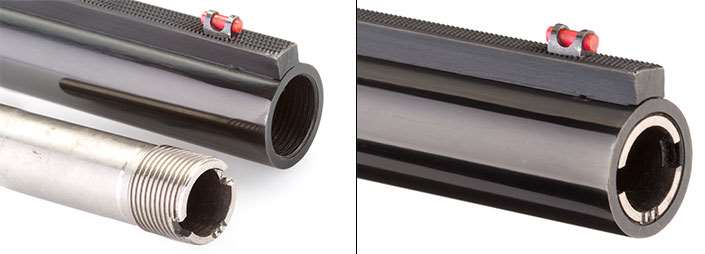
The deeply blued 28" barrel is sufficiently long to encourage a smooth swing on moving targets. For ease of cleaning, durability and corrosion-resistance, the chamber and barrel interiors are chrome-plated. Topped with a 5 mm-wide ventilated rib that mates precisely with the matting atop the receiver, the sighting plane ends with a red fiber-optic front sight. The bore measured a precise 0.410" and is topped with screw-in choke tubes that use Beretta Mobil Choke threads that facilitate the purchase of aftermarket tubes. The Viper came with a tube installed that was marked with three notches and measured 0.016" against the cylinder 0.410" bore. The other two tubes were a four-notched tube measuring 0.014" and a third tube with one notch into which our digital bore micrometer would not fit. We used the installed 0.016" tube in pattern testing and shooting, as there was so little difference between it and the four-notch tube.
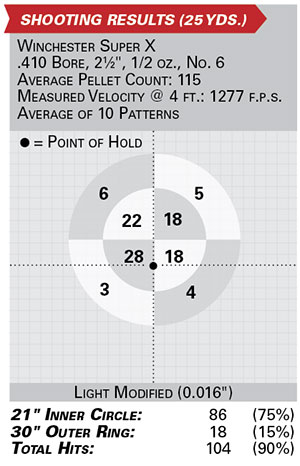 We did find that with the G2’s excellent stocking, good balance and handling, our score on clays was quite good. It handled the lighter shells without a hitch, and the 3" loads we shot cycled equally well. Patterns at 25 yds. showed high center density with Winchester 2½" Super X field loads that contained 115 No. 6 pellets at an average velocity of 1277 f.p.s. measured 4 ft. from the muzzle. Great Canadian skeet champion, B.C. “Barney” Hartman, once said his .410-bore pattern was about the size of a pie plate so, “I either hit them, or I miss them.”
If you’re looking for a fun shotgun for casual shooting, the .410-chambered TriStar Viper G2 semi-automatic is a good choice, just don’t forget that the .410 bore, with its small shot charge, is an expert’s shotgun. With its light recoil, the .410 is often thought of as a beginner’s first shotgun, but since early success spurs interest, new shooters are generally better off starting with either a 20 or 28 gauge.
At $794, the TriStar Viper G2 Bronze .410 isn’t inexpensive, but it’s a lot of shotgun for the money. In the hands of a seasoned shot, it would work well in the dove field—if shooting ranges are kept in check—for quail over dogs, cottontail rabbits and fun with clays.
Most Popular