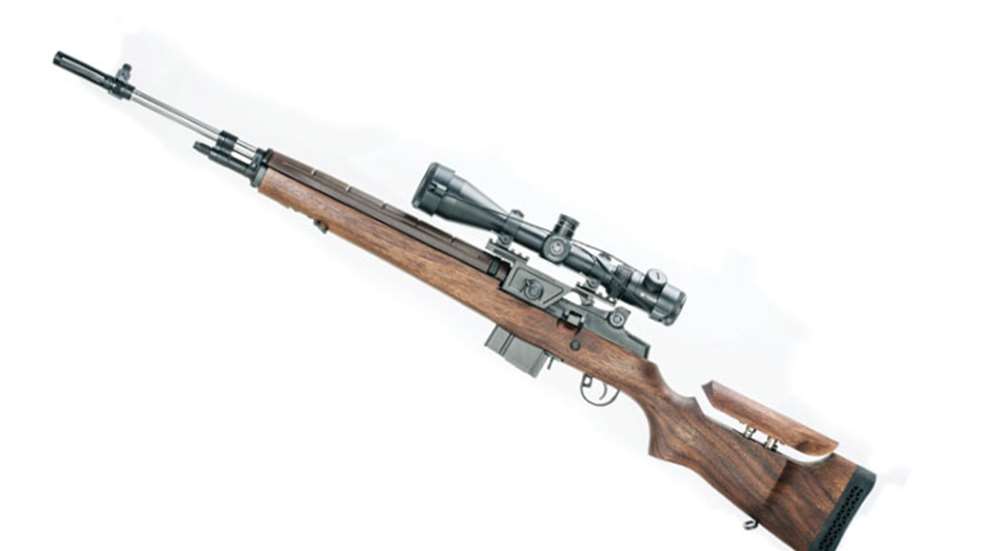
Maintaining the M1A is not especially difficult if you pay close attention to instructions clearly explained in the owner’s manual. If in doubt, simply contact Springfield Armory’s customer service department.
Long ago, I was warned not to separate the barreled action and stock of a National Match, Super Match or M21 for cleaning as doing so can damage the glass bedding and affect accuracy. Washing fouling from the trigger assembly and from around the bolt and inside the receiver with a quick-drying aerosol degreaser will keep the rifle running and won’t damage the bedding when properly applied. Finish the cleanup with a rag and long-handled cotton Q-tips.
A cleaning rod of the proper size, along with powder and copper solvents, .30-cal. bronze brushes and cotton patches keep the bore clean. A Brownells M14/M1A Rod Guide prevents wear on the rifling when cleaning the barrel from its muzzle. Positioning the rifle upside down during bore cleaning will prevent solvent from migrating into the gas port of the barrel and into the bedding around the receiver. The chamber is easily cleaned with a Ratchet Chamber Brush and Chamber Cleaning Tool from Brownells (brownells.com). The Chamber Maid Kit is also quite good.
Gas system maintenance is a snap. Fully retract the operating rod by locking back the bolt, and, while supporting the gas cylinder with a proper wrench, use a 3/8" socket wrench to remove the plug from the front of the gas cylinder. Tilting the muzzle down and lightly tapping on the side of the cylinder will cause the piston to slide out the front. Scrubbing inside the cylinder with a solvent-laden bore brush on a short rod breaks loose carbon fouling; a cotton patch held in a slotted-type cleaning rod tip swabs it clean and dry. Carbon is easily removed from the gas piston with the Gas Piston Drill from Brownells. An additional No. 26 drill is needed for cleaning out the gas piston port.
The gas system is designed to operate dry, so finish up by thoroughly removing all solvent from the piston and cylinder before putting them back together. When inserting the piston into the cylinder, make sure the flat side of its stem is toward the barrel and it is inserted far enough to clear all the threads inside the cylinder. Applying an anti-seize grease to the threads of the cylinder plug prior to screwing it into the cylinder will ease removal for future cleaning.
The M1A requires very little lubrication. Using a Q-tip to apply a light film of grease to the locking lugs and roller of the bolt, its raceways in the receiver, and the operating guide groove in the side of the receiver should suffice. Lubriplate 130A is as good today as it was when the U.S. Military first specified it for the M14 back in the 1960s.
—Layne Simpson
Most Popular