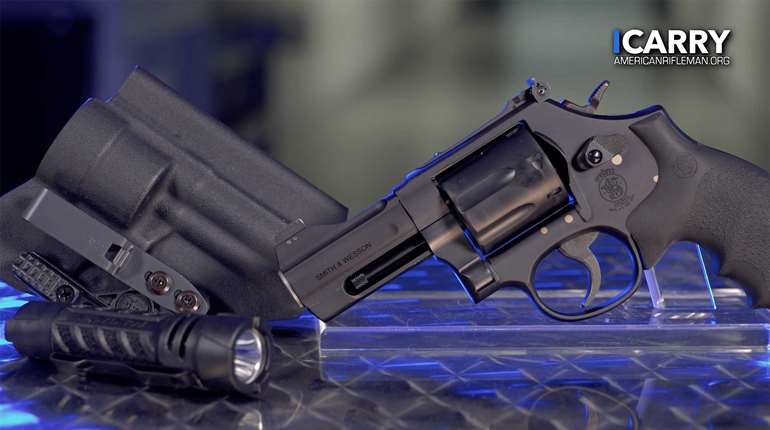
Developed in 1954 and '55 and announced in January of 1956, Smith & Wesson's .44 Mag. has been a consistent favorite of the shooting public for over half a century. It came some 20 years after the company's first Magnum revolver—the .357. This earlier gun and cartridge were enormous trend-setters and got American handgunners thinking about really powerful revolvers because the added power offered two major advantages. The first was increased practical range, while the second advantage was plain smashing power that could harvest the largest game animals at closer ranges. The .357 did all of these things, but it was the .44 Mag. that took hold of the American consciousness and never let go. It was a bread and butter gun for the Massachusetts firm, with a little help from Clint Eastwood's Dirty Harry.
Over the 50-plus years they have made .44 Mags. (called Model 29s after 1957), we have seen these guns in many forms. At first all we had was blue 4- and 6 ½-inch versions, after which they added 8 3/8-inch guns, nickel-finishes, a handful of the exceptionally rare 5-inch models, Lew Horton 3-inchers and even stainless steel. In the late 80s, Smith & Wesson came out with heavy-barreled .44s with a new underlug and improved accuracy. Around this time, the Performance Center was created, which put a new spin on the 29 and 629. When scandium came along, the company's engineers applied themselves and produced a lightweight .44 Mag., which was the hardest-kicking, nastiest handgun of any kind I have ever fired. With real Magnum ammo, it takes the discipline of a Marine fresh out of boot camp to finish a cylinder of six rounds. I would venture a rough guess of somewhere between 50 and a 100 distinct variations of the .44 Mag. have been made.
As a gunwriter specializing in pistols and revolvers, I have had the incredible good fortune—and the cooperation of Smith & Wesson, Inc.—to have received samples of many of these variations for shooting evaluation and writeup. Heck, I once had seven samples of the 7 1/2- inch Classic DX after somebody complained to my editor that I was getting cherry picked samples. I collected seven guns from all over the country and shot them all in the same multi-load protocol. There was about 3/8-inch difference in average 6-shot group size. On maybe two dozen occasions, I have headed for the range with a new S&W .44 Mag., a big box of assorted loads, Oehler chronograph and a Ransom Rest. I have never had one that was plainly inaccurate and there have been many that would shoot one-hole groups with several loads, going twice around the cylinder for twelve rounds. But the one gun that is my odds-on favorite is a Classic DX with the 5-inch barrel option. This one came along some 20 years back. It isn't the most accurate .44 I have ever fired, but it is very smooth on the trigger, rides easy in several different Milt Sparks and Lawrence holsters and will deliver one hole groups with three or four loads. Its handiness, balance, sight interchangeability and accuracy, along with a set of Herrett's Jordan Trooper stocks make for a hell of a fine field revolver and that's why I kept it.
Most Popular