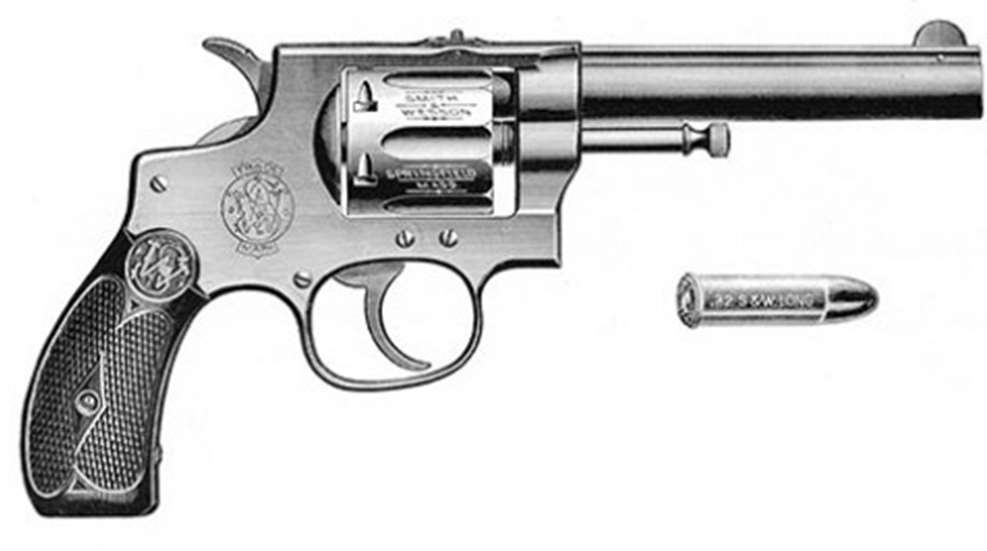
Q. I recently purchased a small six-shot Smith & Wesson revolver. It appears to be .32 caliber; the barrel is 3 1⁄4" long. It has a swing-out cylinder. The revolver is unique in my experience in that the cylinder is locked in place for firing by a lever on top of the frame. This lever is lifted when the hammer is drawn back, allowing the cylinder to rotate for the next shot.
“Smith & Wesson Springfield, Mass., USA, patented July 1, ’84, April 9, ’89, March 27, ’94, May 29, ’94, May 21, ’95, July 16, ’95” is stamped on the cylinder. I cannot find this revolver in any of my books or in “Smith & Wesson: The First 150 Years” that appeared in the December 2002 American Rifleman. What can you tell me about this gun?
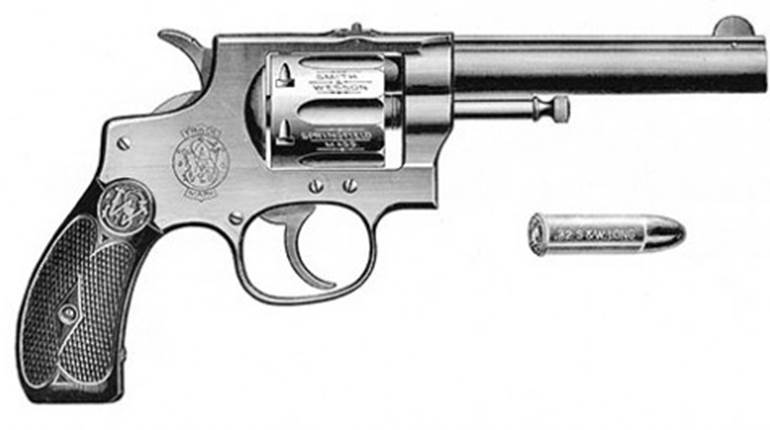
A. From the excellent description you have given, it appears that you have a Smith & Wesson .32 Hand Ejector 1st Model, which is sometimes called the Model I (phonetically, “model eye”). This was S&W’s first side-swing cylinder revolver or, as they called it, a “Hand Ejector.” It was manufactured from 1896 to 1903, when it was replaced by the Model 1903 that was the early version of the .32 Hand Ejector revolver with which most people are familiar. The Model I was the forerunner of the whole .32 Hand Ejector series of revolvers that later became the “J” frame series, i.e., the Model 36 or Chief’s Special, etc., that is still in production today.
Smith & Wesson manufactured 19,712 of these revolvers, and they were chambered in .32 S&W Long, a cartridge designed specifically for this revolver. The .32 Hand Ejector 1st Model was made with 3¼", 4¼" and 6" barrels and was available in either blue or nickel finish. Standard grips were checkered, black hard rubber with a round butt.
This model was unique and unlike later S&W Hand Ejector revolvers, because it had the cylinder stop mounted outside the mechanism on top of the lock frame in a fashion similar to the much earlier S&W Tip-Up revolvers of pre-Civil War design. As you have noted, an enlarged “spur” made as part of the hammer nose or firing pin actuated the cylinder stop. The revolver is also unique because it is the only S&W Hand Ejector to have the maker’s name and address, as well as the patent information, stamped on the cylinder sides between the flutes.
-David R. Chicoine
Originally published October, 2006
Most Popular