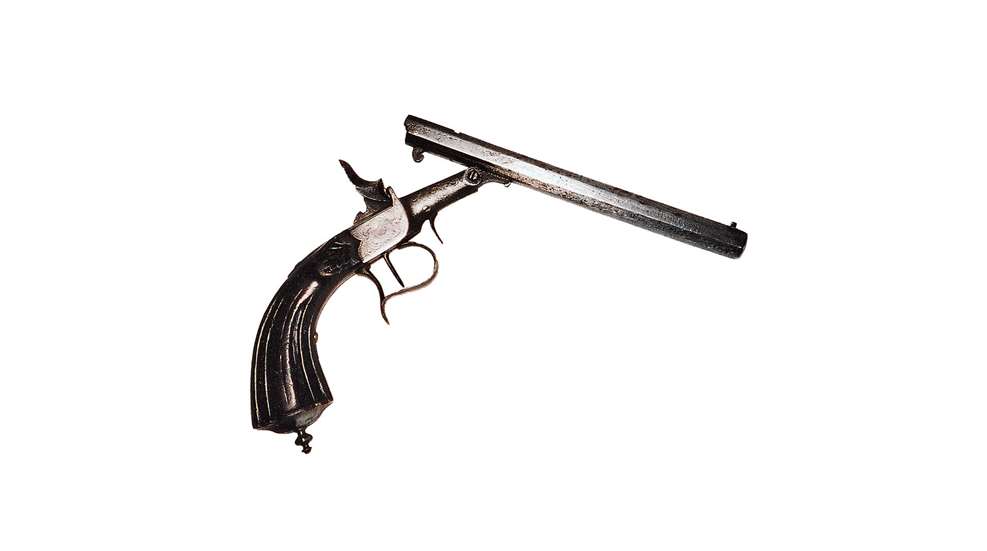
Q. Can you help identify the antique .22-cal. single-shot pistol shown in the enclosed photo? The barrel length is 8", and overall length is 13". One fellow collector thought it to be a “bar-room target” gun. The only clear identifying marks are located on the underside of the barrel between the hinge and locking lug. One is the number 41. Above this is a letter, either “M” or “K.” These are stamped markings. Other symbols and scrolls are located on both sides of the receiver. A second engraving located on top of the barrel before and after the rear sight slot could be a name, but is not legible.
A. I think your single-shot, top-break, smallbore target pistol with the fluted stock is in the style of French or Belgian target guns and was intended for what 19th century European nobles referred to as a Zimmerschützen or “room-shooter” for indoor plinking. It obviously once had a rear sight for precision shooting as evidenced by the empty dovetail near the breech end of the top flat of the octagonal barrel. Targets were set up in the fireplace for casual indoor plinking matches. This is just a guess. However, the general style is of the late 19th century when the minor European nobility kept such smallbore target guns at their estates for indoor amusement during inclement weather. Since you have been unable to discover either a maker’s name or any proofmarks, I cannot tell you much more with any certainty.
While the caliber appears to be .22 rimfire—very possibly BB Cap—it could also be a small European rimfire. The number you quote, “41,” is probably an assembly number. Some Spanish-made guns avoided getting proofmarks, but most other European cartridge guns were almost invariably proofed. If you can find any small marks, with or without crowns or other symbols, then we might be able to tell you where, and approximately when, it was made.
—Angus Laidlaw
This “Questions & Answers” was featured in the October 2005 issue of American Rifleman. At time of publication, "Questions & Answers" was compiled by Staff, Ballistics Editor William C. Davis, Jr., and Contributing Editors: David Andrews, Hugh C. Birnbaum, Bruce N. Canfield, O. Reid Coffield, Charles Q. Cutshaw, Charles M. Fagg, Angus Laidlaw, Evan P. Marshall, Charles E. Petty, Robert B. Pomeranz, O.D., Jon R. Sundra, Jim Supica, A.W.F. Taylerson, John M. Taylor and John W. Treakle.
To subscribe to the magazine, visit the NRA membership page and select American Rifleman as your member magazine.
Most Popular