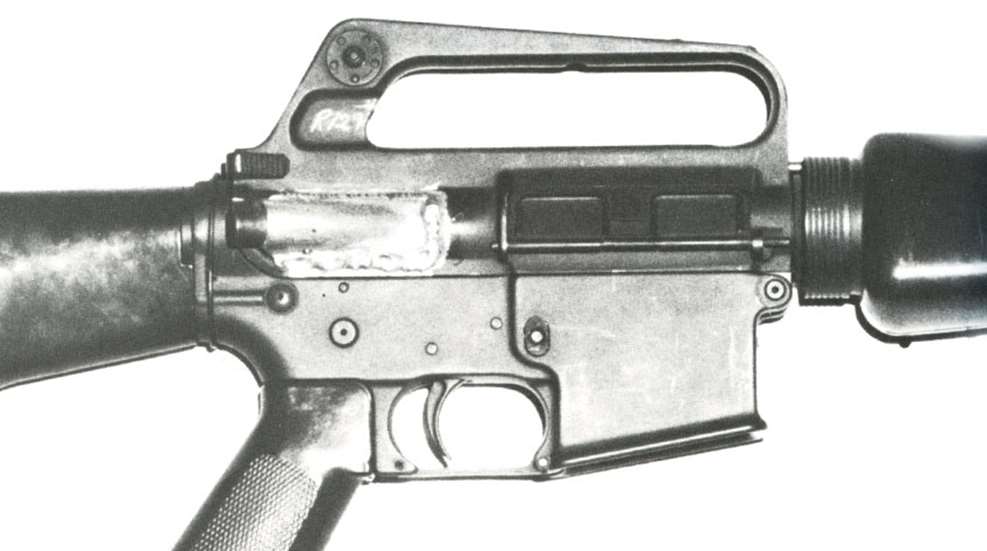
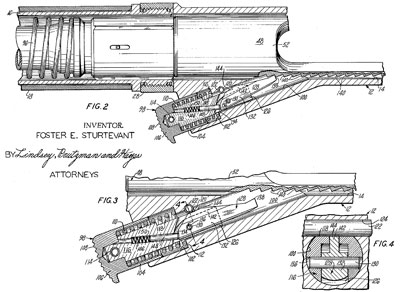
An experimental AR-15 model 01 shows a welded prototype of a forward assist.
Q: Back in 1968 I was a recently graduated engineer assigned to the M16 Rifle Group at Rock Island Arsenal. It was tasked with getting the M16 rifle into production at Colt Industries, along with addressing the bombardment of technical issues associated with the rifle coming out of Vietnam. At that time, problems were being addressed by Robert McNamara’s Technical Coordinating Committee. One of the recommendations that came out of the committee was the introduction of a forward assist mechanism. I was told that the Air Force and Marine Corps representatives were not in favor of this device. Most technical engineers, including those at Colt, Eugene Stoner and Col. Harold Yount were not in favor of it, as well. However, the Army brass got its way, and now we have the forward assist mechanism as part of the upper receiver. In due time, a process for chrome lining the chamber and bore was developed and became a standard-production design change. This, I believe, corrected the initial problem associated with cartridge jamming and preventing the bolt from locking. What mystifies me is how this forward assist mechanism has followed the design throughout the many years, even to show up on most all the commercial versions of the AR-15. My question: Is there still a need for a forward assist mechanism on commercial sporting rifles patterned after the AR-15, or is this an appendage that has long lost its original benefit?
A: As you point out, the forward assist (FA) feature was an attempt to correct an unforeseen problem. Viewed in another way, the lack of the assist could be considered as a design oversight; maybe it should have been there all the time. Prior to the AR’s introduction, U.S. military self-loading rifles featured a reciprocating “handle” that could be manipulated if necessary to better ensure the complete closure of the bolt. The force available to the AR user to accomplish this action is limited entirely by a spring. To say the AR design was not influenced in some degree by the FN FAL would not be honest, but the FAL does not sport an FA, so why does the AR? Perhaps because the FAL did not experience its baptism in a steamy jungle using inappropriate ammunition. Truly valid comparisons are hard to come by. I suppose it comes down to a consideration of pros and cons, as voiced by the constituency. The FA ensures that the bolt is locked and, correspondingly, that the extractor has snapped over the cartridge rim.
 Occasionally, during range firing while in basic training, I would pull the trigger to no effect. Pulling the charging handle rearward and releasing it had the effect of delivering another cartridge into a wedged position behind the one that remained in the chamber. That required re-engaging the charging handle, locking the bolt carrier to the rear, dropping the magazine, clearing the misfeed, releasing the bolt, inserting the magazine and then re-engaging the target, assuming that the original round in the chamber hadn’t fallen out. The worst case was two live rounds at your feet, which translated into two misses. It didn’t take me long to figure out that giving the FA a little bump immediately after chambering the first round, or when pulling the trigger with no effect, would pretty much eliminate all that drama.
Fortunately, I never experienced combat, but I can assure you that there are times when a soldier, or a civilian, would like to quietly chamber a cartridge. Verifying a loaded chamber in such a situation requires that the bolt be retracted sufficiently to visually confirm the chamber condition. Easing the bolt forward, via the charging handle, seldom results in total closure. Neither of these functions are possible without the FA.
All guns get “dirty” to a greater or lesser degree when fired and/or subjected to extremes of weather or other environmental conditions. Whether utilization of the FA is incorporated into the standard loading procedure or limited to acute situations, I am convinced its continued use is defensible.
On the con side, it is a fact that the FA system can fail. Should it become stuck or jammed in the forward position, the rifle may become inoperable. If the rifle is fired with the FA stuck in the forward position, it may become permanently disabled. It is ironic that the FA exists in part to overcome lack of, or inadequate, maintenance, but that the same maintenance shortcomings can result in it becoming a liability. The FA can also be an indicator that maintenance or other attention is required before the rifle is put to serious use. Personally, I don’t see the inclusion of it as a subject of contention.
In the end, I’d much rather have the forward assist available, and not need it, than need it and not have it.
Most Popular