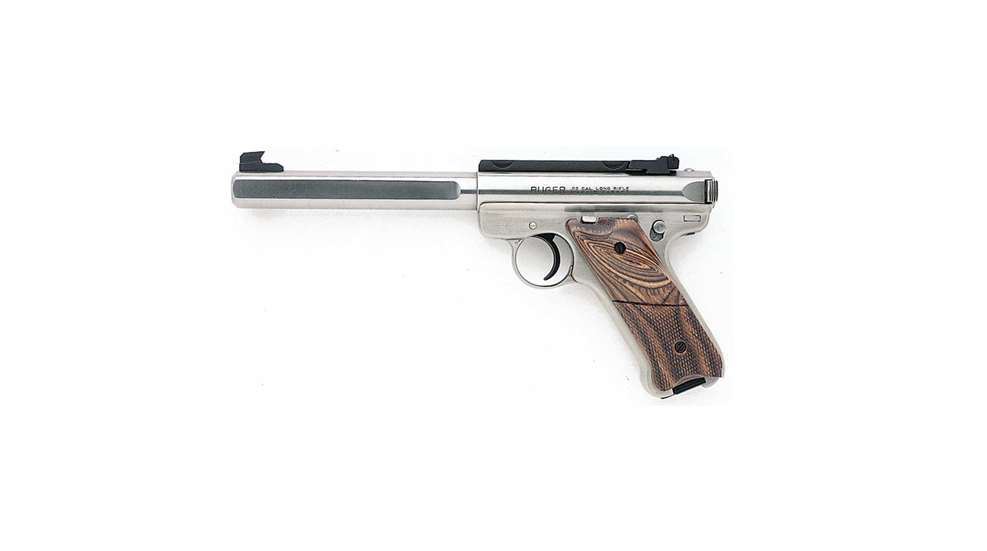
Q. I own a Ruger Mark II semi-auto with a 5 1⁄2" bull barrel. I would like to convert it to the new .17 Mach 2 caliber. I have looked for gunsmiths on the internet, but have had very little luck. Can you help?
A. Such a pistol would certainly appeal to a great many shooters and should give excellent results in the field. While I suspect such a conversion will be available on the market in time, it will be more complicated than it would immediately appear.
The problem is that the unlocked breech system used in the design of practically every .22 autoloader ever built must be made to be very sensitive to the features and characteristics of the ammo to be fired. So-called “blowback” systems must balance the energy produced by the ammunition as it is fired with the weight of the breechblock (or bolt), the strength of the recoil spring or springs, and even the strength of the hammer spring.
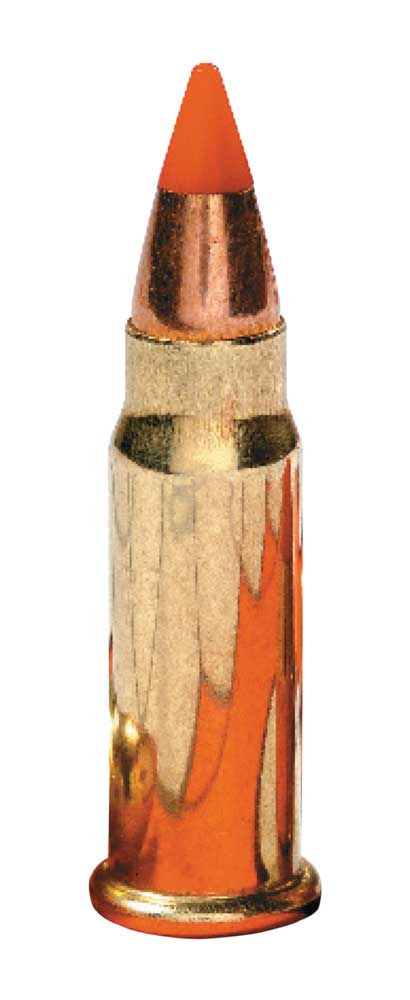
The rimfire cartridge case essentially acts like a piston as it is fired, overcoming the inertia of the bolt and the spring or springs that hold the bolt forward. In addition, the bolt and the springs must offer sufficient resistance to movement to allow the bullet to exit the barrel before the breech opens. The resistance offered is a function of the characteristics of the two components.
For any given weight of bolt, a certain compression strength of spring must be utilized. If the bolt is reduced in weight, a stronger spring must be substituted, and vice versa. The strength of the hammer spring also adds its effect, as the rearward movement of the bolt must compress it in order to store the energy required to fire the succeeding shot. There must be a certain minimum amount of energy produced by the ammo in order to cause the system to cycle. That is why most semi-automatic firearms chambered for .22 Long Rifle cartridge will not function with either .22 Longs or Shorts.
Substituting a .17-cal. barrel into the equation without regard to the reciprocating components will disrupt this necessary balance. While it would seem that the lighter weight of the .17-cal. cartridge would necessitate a reduction in the weight of the bolt, or a lighter recoil spring, in actuality, the opposite is true. The .17 Mach 2 requires greater resistance to hold the breechblock closed at the instant of firing. At any rate, until the physics are worked out, there will be no commercial conversion system available for the Ruger Mark II.
Another issue with the Ruger is its barrel design. The Mk II barrel features an extended integral feed ramp that is difficult to fabricate and then must be indexed for proper alignment. Offering a barrel/receiver combination is not a quick and easy solution, as the receiver must be treated as a firearm. I suspect that the first “conversions” to be offered will be comprised of a barrel/receiver unit along with an appropriate weight bolt and recoil spring.
—John W. Treakle, Contributing Editor
This “Questions & Answers” was featured in the September 2005 issue of American Rifleman. At time of publication, "Questions & Answers" was compiled by Staff, Ballistics Editor William C. Davis, Jr., and Contributing Editors: David Andrews, Hugh C. Birnbaum, Bruce N. Canfield, O. Reid Coffield, Charles Q. Cutshaw, Charles M. Fagg, Angus Laidlaw, Evan P. Marshall, Charles E. Petty, Robert B. Pomeranz, O.D., Jon R. Sundra, Jim Supica, A.W.F. Taylerson, John M. Taylor and John W. Treakle.
Most Popular