Q: Is the .450 Marlin cartridge available chambered in any rifles other than lever-actions?
A: The Marlin cartridge was a joint effort undertaken by Marlin and Hornady in 2000 that “would allow factory ammunition to take advantage of the potential of the .45-70 Gov’t. without loading it to pressures in excess of SAAMI maximums.” The rifle was the Model 1895, the same model that chambered the .45-70.
Without going into great detail, .450 Marlin is essentially a .45-70 with a wide belt, similar to Frank Barnes’ 1962 wildcat, the .458x2" American. The .458 was envisioned as a short-range cartridge for large game in heavy cover. In essence, an African cartridge scaled-down for North America.
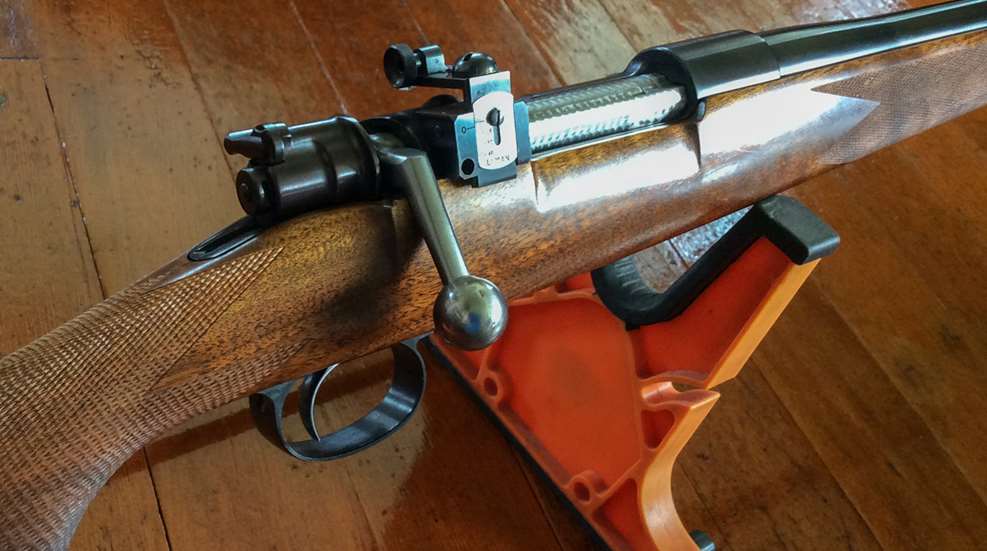
The .450 Marlin cartridge is not restricted to the M1895 and is adaptable to other action designs. Besides the original Marlin model, the cartridge has found its way into lever guns by Winchester and Browning, plus the Ruger No. 1 single-shot and a bolt gun by Steyr. Several specialty firms in the U.S. offer custom bolt-actions chambered for the cartridge. I built mine on a Czech vz. 24.
The rifle/cartridge combination met the performance goals of its designers, however, the market did not respond as expected. For the non-handloader, the performance level of the Marlin cartridge was just too much for casual shooting; in its factory loading, it remains a serious hunting cartridge. The .45-70 Gov’t.-chambered Marlins at least offered some variety in the availability of commercially loaded cartridges. There is also, at least at some level, a romance that accompanies the shooting of the .45-70 that .450 Marlin lacks.
A .450 Marlin rifle can be built on short- or standard-length bolt-actions, the overall weight and length tailored to fit the situation or the need. One great advantage of the bolt gun over the lever-action is the opportunity to load “unconventional” bullets featuring streamlined profiles, along with being able to adjust the overall length and crimp without the constraints of the lever’s tubular magazine.
—John W. Treakle, Contributing Editor
Most Popular