Rifleman Q&A: How Do I Avoid 'M1 Thumb?'

posted on March 24, 2021
** When you buy products through the links on our site, we may earn a commission that supports NRA's mission to protect, preserve and defend the Second Amendment. **
thumb.jpg

Q: I remember hearing the term “M1 thumb” used by my uncle, who carried an M1 Garand during the Korean War. More recently, I’ve seen it mentioned in the pages of this magazine. What exactly does this term mean?

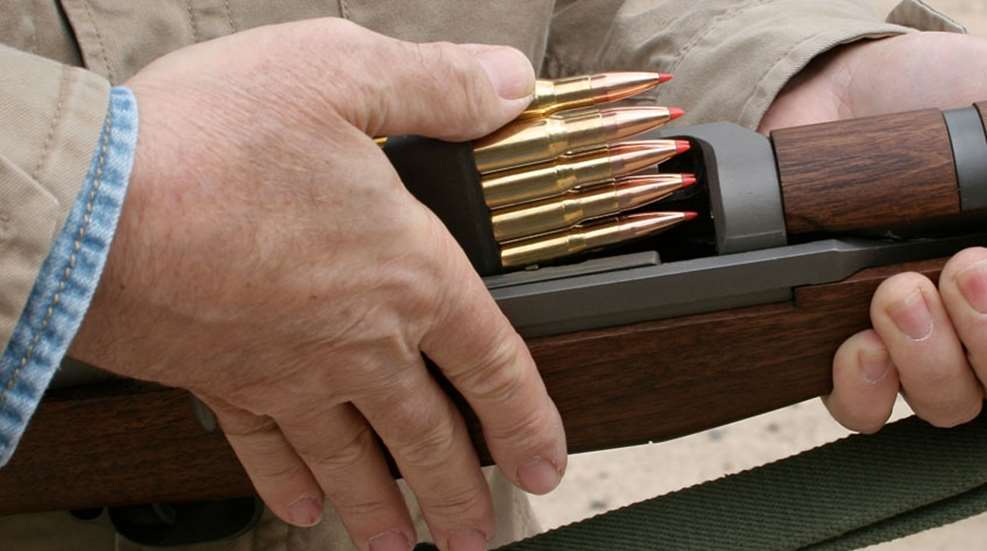
A: After firing the last round from an M1 Garand, the empty en bloc clip is automatically ejected and the bolt locks back, exposing the open receiver. To properly reload the Garand, another eight-round clip is pushed down into the receiver using the thumb of the shooting hand, while the outside edge of that same hand is pressed back against the operating rod handle to keep it from flying forward.

Once the clip is fully inserted, the spring-driven bolt unlocks but is prevented from moving forward because it is still being held back by pressure from the hand. The thumb—and, in fact, the entire hand—is then quickly raised up out of the way, and the bolt is allowed to slam forward, chambering a round in the process.

But sometimes a shooter does not move the thumb fast enough before releasing the bolt, which happened in training or even combat to some G.I.s, or the bolt does not lock completely open, and it slams forward prematurely.

Either way, the bolt can smash into the thumb, resulting in what has become known as  “M1 thumb,” which is not only painful, but embarrassing, and can result in a blood-blackened or shattered thumbnail. In recent years, the term “Garand thumb” has also been used to describe this unpleasant situation. No matter what it’s called, Garand shooters and collectors should obviously try to avoid it.

Note: The latest device designed to alleviate “M1 thumb” is made by Mountain Aerospace Machining and is available at m1thumbsavers.square.site—The Eds.

Latest

Proof Research
Proof Research

The PROOF Research PXT: A New Approach to Barrel Rifling

PROOF Research has introduced PROOF eXponential Twist (PXT)—an advancement in rifling that improves durability, accuracy and shootability—to the commercial market.

Review: Springfield Armory Model 2020 Heatseeker

Back when American Rifleman reviewed Springfield's Model 2020 Waypoint, we noted that we ...couldn’t help but wonder if a tactical-version Model 2020 rifle might be a logical future offshoot of the Waypoint hunting rifle." With the Model 2020 Heatseeker, that version is finally here.

Marlin Goes Mad: The Marlin Mad Pig Customs Model 1894

Marlin’s latest Model 1894 lever-action rifle, a collaboration with Mad Pig Customs that is a far cry from traditional, delivers “modern, factory‑installed features previously found only on custom builds.”

The Jewish Community Is Embracing Our 2A Freedom

In this episode of the NRA’s The Armed Citizen Podcast, we interview Gayle Pearlstein, COO and co-founder of Lox & Loaded, a Jewish-owned and -operated gun club that now—after being launched only a year ago—has 50 chapters around the United States.

I Have This Old Gun: The Southerner Derringer

People carrying small firearms for personal protection is not a new concept, and in the middle of the 19th century, many pocket pistols were designed with self-defense in mind. One such gun, the Brown Manufacturing Southerner Derringer, was among the earliest cartridge-firing self-defense guns.

Affordable & Feature-Rich: The Springfield Armory Echelon Alpha 4.0C

Springfield Armory entered the world of modular, striker-fired handguns in 2023 with its Echelon line of pistols, and for 2026, Springfield is introducing an entry-level Echelon model with the Alpha 4.0C.

Interests


Get the best of American Rifleman delivered to your inbox.