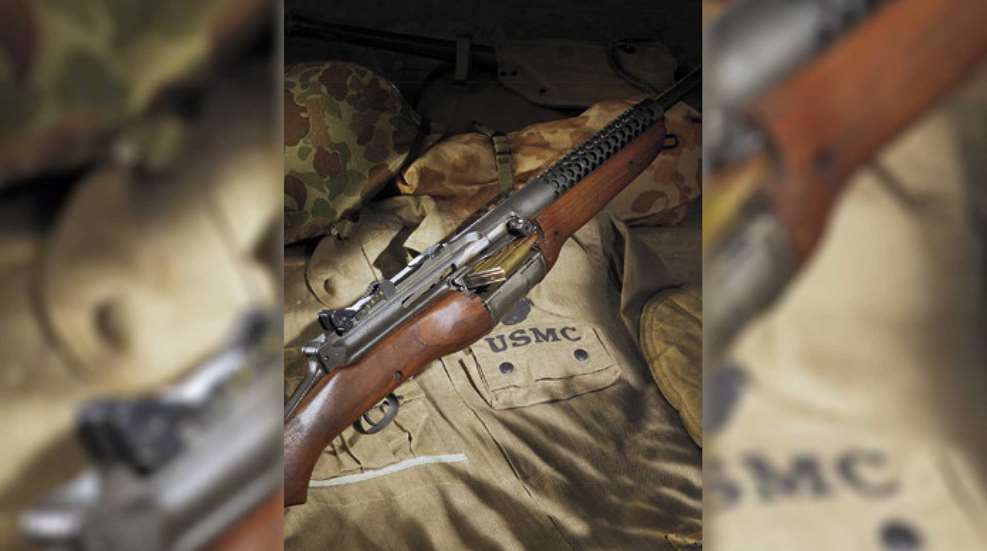
Q. I am interested in purchasing a Model 1941 Johnson rifle, but want to be sure I am buying one that was made for the U.S. Marine Corps. How can I be certain I am getting a USMC Johnson rifle?
A. In virtually all cases, you're going to be out of luck. There were no Johnson rifles made for the U.S. Marine Corps. All Model 1941 Johnson rifles were originally manufactured under contract by Johnson Automatics, Inc., for the Dutch government under the auspices of the Netherlands Purchasing Commission (NPC). The Dutch wanted the rifles to arm their colonial troops protecting the Dutch East Indies from the Japanese. After deliveries of Model 1941 Johnson rifles commenced, the East Indies fell to the Japanese, and the balance of Johnson rifle deliveries were embargoed.
The U.S. Marine Corps purchased a relatively small number of M1941 Johnson rifles from the NPC to arm Marine paratrooper units. The Johnson rifles procured by the U.S. Marines were standard Dutch production rifles with no special distinguishing features and were in no particular serial number range. There is no known comprehensive roster of USMC parachute unit Johnson rifle serial numbers available. Therefore, in the absence of some sort of convincing documentation (which rarely exists), it is not possible to ascertain a Marine Corps provenance for a Johnson rifle. Since only some three percent of total Johnson rifle production was diverted to the Marine Corps, the odds are greatly against any specimen encountered today being one of the rare and desirable USMC Johnson rifles.
— Bruce N. Canfield
This “Questions & Answers” was featured in the September 2004 issue of American Rifleman. At time of publication, "Questions & Answers" was compiled by Staff, Ballistics Editor William C. Davis, Jr., and Contributing Editors: David Andrews, Hugh C. Birnbaum, Bruce N. Canfield, O. Reid Coffield, Charles Q. Cutshaw, Charles M. Fagg, Angus Laidlaw, Evan P. Marshall, Charles E. Petty, Robert B. Pomeranz, O.D., Jon R. Sundra, Jim Supica, A.W.F. Taylerson, John M. Taylor and John Treakle.
To subscribe to the magazine, visit NRA membership page here and select American Rifleman as your member magazine.