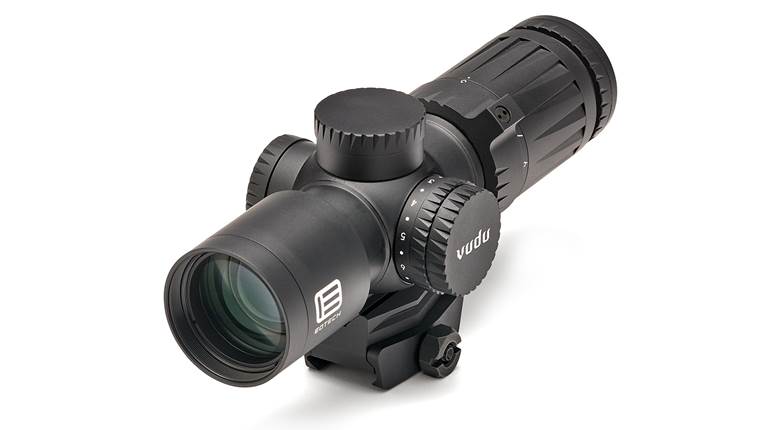
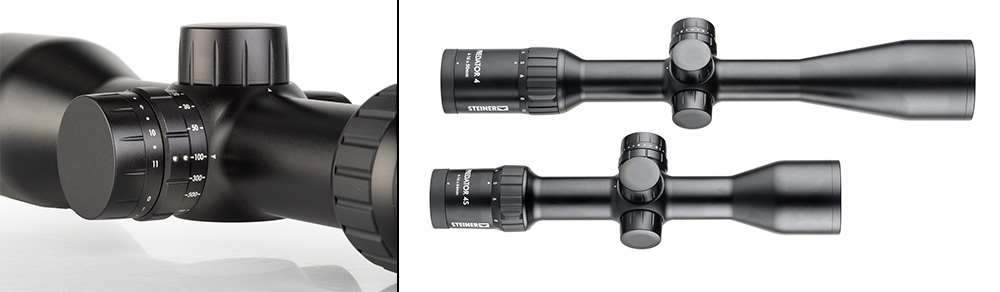
The benefit of a lightweight rifle is lost the moment you top it with a clunky, overweight optic, particularly a lengthy one. To that end, we are starting to see an emphasis on riflescopes that are less cumbersome when mounted, such as Steiner’s Predator 4S. As the name suggests, the 4S is a line extension to the company’s hit Predator series, with the “S” indicating it is a shorter version of the series’s existing 4-16X scope. Unlike its longer brother, it features a smaller 44 mm objective lens and has a paltry overall length of just 10.9". Moreover, the entire package weighs only 18.1 ozs., making it the lightest 4-16X scope in its class.
A 30 mm one-piece aluminum main tube serves as the base, permitting enough elevation adjustment for zeroing and dialing at conventional hunting distances. It is fitted with the company’s top-grade glass, which is finished with a proprietary coating system to maximize light transmission and clarity. A cursory look through our test sample at last light enthusiastically substantiated these claims, as the environment appeared brighter through the scope than it did with just the naked eye.
The 4S houses an illuminated E3 reticle, offering holdover points for common non-magnum hunting cartridges. Below the detached crosshair are stadia lines for 200, 300 and 400 yards, or 1.49, 4.31 and 7.18 m.o.a., respectively. As this is a second-focal-plane scope, these values only hold true at the maximum power setting. The edge of each line represents a hold point for a 5-m.p.h. full-value crosswind and is bookmarked by dots to provide 10-m.p.h. holdovers. Illumination is powered by a single CR2032 lithium battery and is controlled by a knob located on the left side of the optic; there are 11 brightness settings with an “off” position between each.
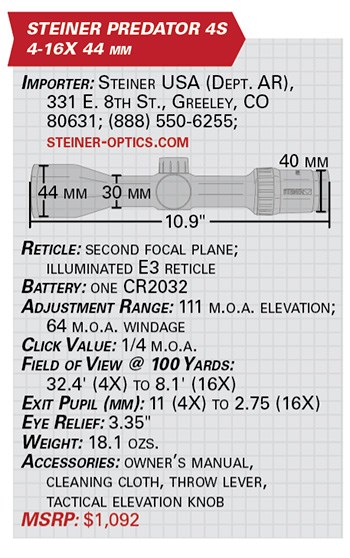 This optic includes an option to add a throw lever or switch the capped elevation turret to an exposed tactical-style knob. Either style of elevation cap can be returned to zero by removing the central screw, which allows it to rotate freely of the mechanism; the same holds true for the windage cap. Positioned next to the illumination dial is the parallax adjustment, which can be set from 20 yards out to infinity.
We mounted our scope to a mid-length rifle chambered in .308 Win. for live-fire testing. When loaded with Federal’s 175-grain Terminal Ascent ammunition, this rifle is capable of sub-m.o.a. accuracy, which would help us rule out any erroneous impacts. We began our test procedure by zeroing at 100 yards, which left us with an impressive 60 m.o.a. of additional adjustment—despite the absence of canted mounting hardware. Next, we “shot the square” and confirmed that the optic tracked properly, as evidenced by the one-hole groups on the corresponding corners of our target. From here, we tested the holdovers at their corresponding distances and found them all to leave us with hits that were between 1" and 3" low. This is acceptable and, more importantly, correctable; if we had zeroed an inch higher at 100 yards, impacts at farther distances would have been nearly perfect. This confirmation routine is the best practice for each user, as every rifle and ammunition combination will produce different results.
We wrapped our range day by using the rifle in traditional field positions. Each tester remarked on the forgiving eye box, which is uncharacteristic of most shortened scope packages. Every shooter also enjoyed how unassuming it felt mounted to the rifle. Such makes for an easy recommendation for the hunter trying to maximize his or her rifle investment or anybody else who has grown weary of carrying top-heavy firearms.
Most Popular