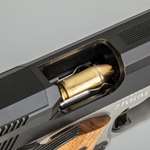
Various systems exist by which handgun barrels have holes cut into them that run from the top outside surface all the way through to the rifled bore. It’s called porting and it’s done for specific reasons. In the process of firing a shot, some of the propellant gas that is working so hard to drive the bullet down the barrel takes a shortcut through the ports, flowing upwards and in so doing, tends to drive the gun down. This partially reduces the tendency of the handgun to twist back and up in your hand, which is distracting and sometimes uncomfortable. Porting is most commonly used on high-speed “race” guns used in action shooting games. It is common to hear people say that the ports reduce recoil. Close, but no cigar.
Barrel ports do not reduce recoil─that’s impossible. One of Newton’s laws of motion is that for every action, there is an equal and opposite reaction. In a handgun, the reaction (recoil) is a function of the weight of the bullet at a given velocity matched against the weight of the gun from which it is fired. It makes no difference whatsoever how many or what size ports may be cut in the barrel. This does not mean that the ports have no value. In some situations, a good porting system can be very valuable. Look at the way you hold a revolver. Your shooting hand is grasping the butt, well below and behind the greatest mass of the handgun. When fired, the muzzle wants to come back, but it also turns up, following the path of least resistance. This twisting or pivoting action drives the rear of the frame into the tender web of your shooting hand. With hard-kicking loads, it can be painful. It’s usually a little easier to shoot an automatic pistol, because of its shape.
This is where porting can be very helpful in controlling the movement of the gun. When the expanding propellant gas jets out the barrel ports, it tends to drive the barrel downward. This partially counteracts the tendency of the barrel to rise. The recoil impulse is the same as though there were no ports, but it is re-directed in a more straight-to-the-rear direction. This is much easier for most shooters to handle. Of course, there is more at stake here than simple comfort. In some of today’s action shooting games, your time is factored into your score. The quicker you can get back on the target after firing a shot, the quicker you get off the next one. Ports can really help, particularly when you are using a gun and caliber that doesn’t really kick that much to start with. There’s more to porting than drilling a couple of holes in your barrel. The size, shape, angle and number of holes involved are all a matter of considerable interest, as is the use of the mystical expansion chamber. But ports have no ability to lesson recoil.
Most Popular