This year marks the 100th anniversary of America’s entry into “The War To End All Wars,” as it was dramatically called. But rather than end wars, it changed them—armored vehicles were employed and aerial warfare literally took battle tactics to new heights. The Great War also transformed one of the most popular shotguns in America from a sporting arm into a formidable force for close-in fighting, specifically in the confines of trench warfare.
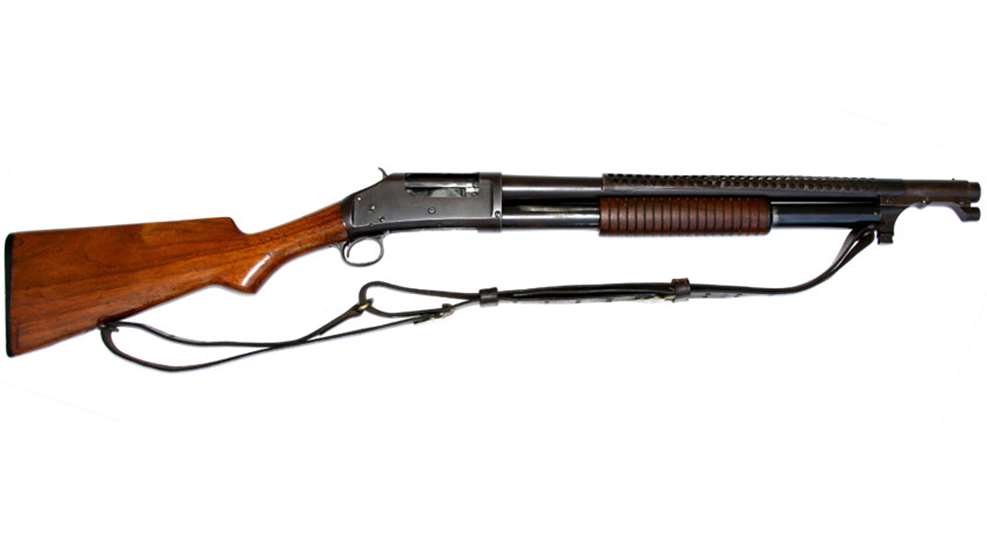
An atypical hero emerged, the militarized Winchester Model 97 Riot Gun, a 20"-barrel, 12-ga., cylinder-bore version of John Browning’s Model 1897 exposed-hammer, pump-action shotgun that held five rounds in its under-barrel, tubular magazine.
After America’s declaration of war, the Winchester Riot Gun was pressed into service, but it quickly morphed into the U.S.-issue “Trench Gun, Model of 1917,” sporting sling swivels, a lug attachment for the U.S. M1917 bayonet and a perforated steel heat shield to guard against burned hands during rapid-fire. Lacking a disconnector, the Trench Gun, with its trigger held back, could be slam-fired as fast as the slide could be worked. Nicknamed the “Trench Sweeper,” it became so feared that Germany tried unsuccessfully to get trench shotguns outlawed.
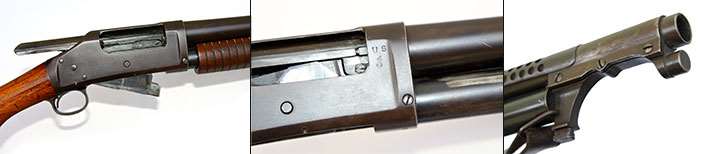
Unlike World War II Trench Guns, World War I versions were solid-frame, had no inspector’s stamp on the stock and most were not military-marked, although some were hand-stamped with a “U.S.” and an ordnance bomb on the upper right hand side of the receiver. Many of those were re-issued for use during World War II.
Many published Model 97 Trench Gun serial number manufacturing dates are incorrect; the guns were issued in three blocks of numbers, of which this gun represents the third and final issuance by the government—E613303 to E697066—according to Field Editor Bruce Canfield’s U.S. Infantry Weapons of the First World War.
The 70-percent-condition Trench Gun shown has an interesting history, as it was issued to a “Dr. Johnson” from Peabody, Kan., who went into the U.S. Army during World War I and served as an officer in the Quartermaster Corps. After the Armistice, Dr. Johnson brought his Model 97 home and, years later, sold it to the son of a man with whom he had served. It was last fired in 1971 on a dove hunt and has been hanging on a wall until acquired from the family by the present owner. Time and the elements have dulled the original bluing, and the stock sports a coat of varnish, but having never been altered, it is easily worth $2,750 to $3,250. Were its finish original, it would be worth quite a bit more.
Gun: Winchester Model 1897 “Trench Gun”
Gauge: 12 Gauge
Serial: E669XXX
Manufactured: 1918
Condition: 70 percent—NRA Good (Modern Gun Standards)
Value: $2,750 to $3,250
Additional Reading:
A Look Back at the Winchester Model 1897
Most Popular