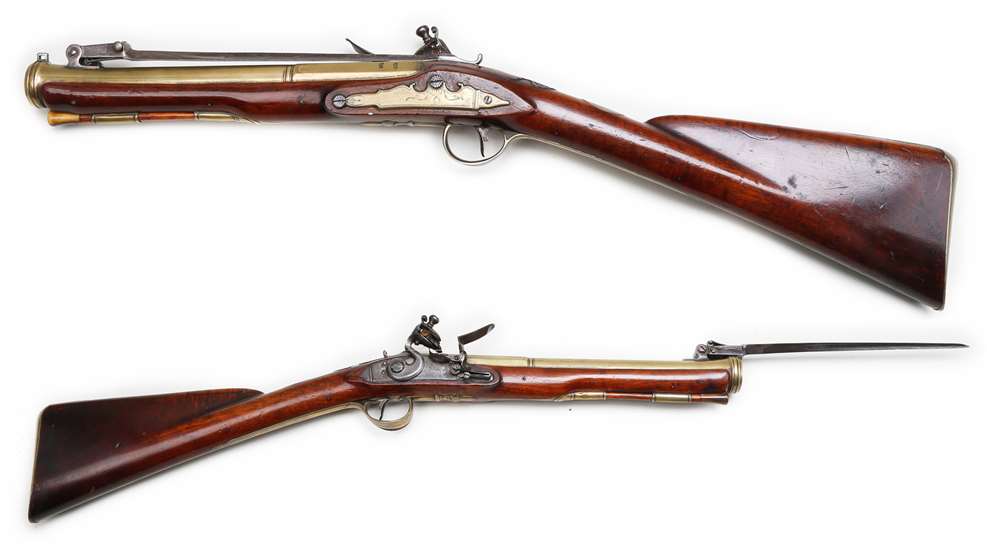
Gun: Flintlock Blunderbuss
Manufacturer: John Probin
Caliber: .675
Manufactured: c. 1780
Condition: NRA Fine (Antique Gun Standards)
Value: $4,250
The blunderbuss, with its risible name and bell-mouthed barrel, is, not uncommonly, regarded as a sidebar in firearm history. This is a mistake. These purpose-built defensive shotguns, within their limitations, were deadly, efficient and widely employed by civilians, the military and law enforcement.
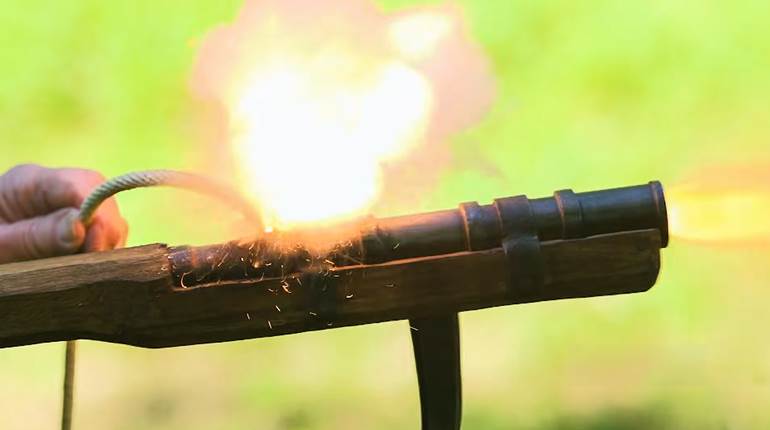
The origin of the name “blunderbuss” likely arises from a corruption of the Dutch word donderbus (thunder box), the firearm itself likely premiering in Holland or Germany in the late 1500s. The purpose of the gun’s gaping maw is often misinterpreted as allowing a rapid pattern expansion of the gun’s load of buckshot. In actuality, projectiles maintained a tight cluster following the diameter of the smaller, unflared portion of the bore and did not really begin any appreciable dispersion until well clear of the barrel.
The real purpose of the muzzle bell was simply to allow easier loading of the arm in a conveyance or on horseback with a dozen or so .25- to .35-cal. projectiles. The powder charge, previously poured down the barrel, was secured with a card or fiber wad. Shot was traditionally held in place by topping it with strands of hemp or flax tow.
Blunderbusses enjoyed worldwide distribution, particularly in Turkey and the Arab countries, where they achieved a popularity probably exceeding that enjoyed by their Western contemporaries. In Europe, the guns were made in several countries, though British “Golden Age” flintlock blunderbusses of the late 18th and early 19th centuries have achieved particular distinction among collectors. Manufactured by numerous makers in a variety of styles, steel and brass barrels were both used, though the latter, especially in civilian arms, was seemingly the most popular.
Many were fitted with backup spring bayonets—a practice that was also seen in bell-barreled handguns of the period. As blunderbusses were commonly adopted by coachmen who found them useful in discouraging the attentions of the infamous “highwaymen,” robbers who plied their trade in Georgian England’s many highways and byways. Sometimes, a coach’s name would be engraved on the flat end of a gun’s muzzle. Blunderbusses are occasionally seen decorated in the same place with such daunting legends as, “HAPPY HE THAT ESCAPES ME” or “FLY OR DIE.” The fact that it was assumed a potential “customer” might be able to read such mottos shows just how close-up and personal a blunderbuss encounter could be.
 Despite the cartoonishly belled concoctions one commonly encounters on Thanksgiving greeting cards or in movies and advertisements, members of the Plymouth Colony did not bring any blunderbusses with them to America on the Mayflower. The primary arms employed by the Pilgrims were matchlocks, reinforced with a smaller number of flint-ignition arms and possibly a wheellock or two.
Today, flintlock blunderbusses garner the greater degree of collectors’ interest, but percussion models are also encountered—though less frequently. In the mid-1800s, with their role being usurped by short, double-barreled shotguns, blunderbusses simply fell out of fashion and became extinct.
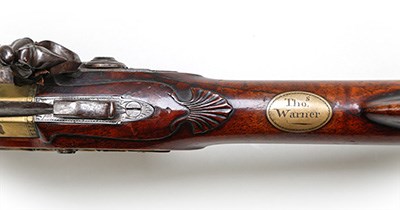
The blunderbuss here is a handsome, brass-cannon-barreled arm built by the esteemed Birmingham craftsman John Probin (“Gunmaker to H.R.H. The Prince of Wales”) around 1780. Measuring a handy 27½" overall, its 12" barrel has a muzzle bell with an inner diameter of 1.188" tapering down internally to 0.675" for the majority of the length of the bore. The lock exhibits such niceties as a waterproof flash pan and roller bearing steel (frizzen) spring. Other refinements include a stylish acorn-shaped trigger guard finial, 11¼" spring bayonet, scallop stock carving behind the barrel tang and brass thumbpiece featuring the owner’s name, “Tho’s Warner.” Engraving on the lockplate, butt and brass sideplate is discreet and tasteful.
As the gun is in fine condition, well-appointed, the product of a respected maker and was produced during a particularly revered time in English gunmaking, its value would be a solid $4,250.
Most Popular