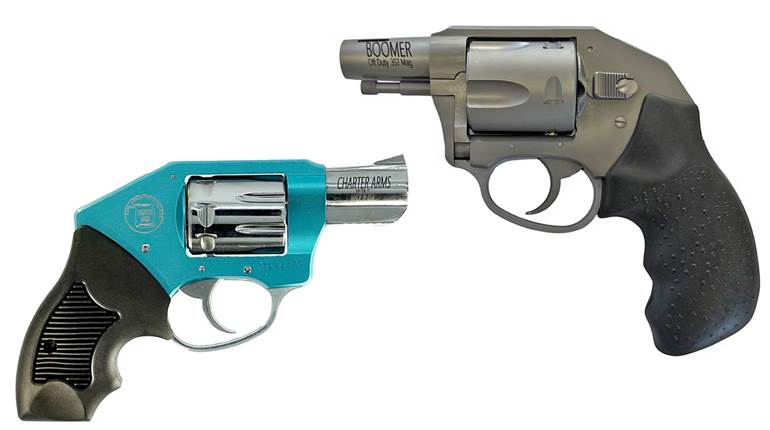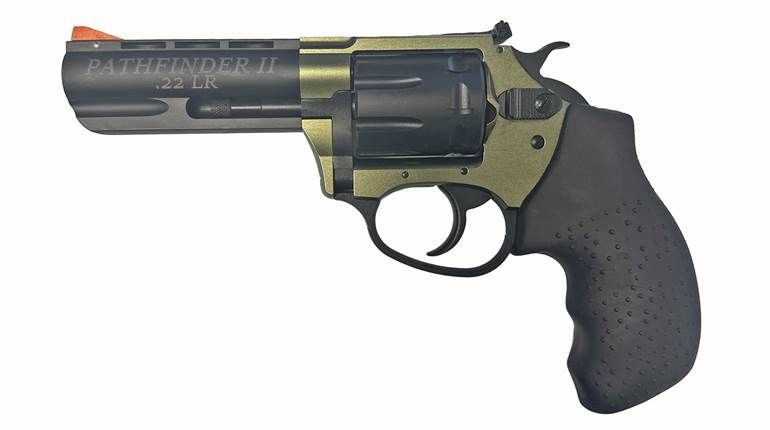
Charter Arms has been making firearms for almost 50 years. The company was founded in Connecticut by Douglas McClenahan, who had previously worked for Sturm, Ruger & Co., High Standard and Colt.
McClenahan’s goal was to produce a quality handgun that was also affordable. Charter Arms, which is American-owned and uses U.S.-made parts to produce handguns in its New England facility, has maintained that mantra since its inception.
Whether or not a handgun in .22 WMR is suitable for personal protection is a question you must determine on your own. What it does bring to the table is controllable recoil and minimal muzzle blast, and for some shooters that’s a deciding factor. The Charter Arms Pathfinder is among the very few .22 WMR-chambered revolvers that are appropriate in size for concealed carry. Similarly, it would be a viable candidate for a survival pack as well.
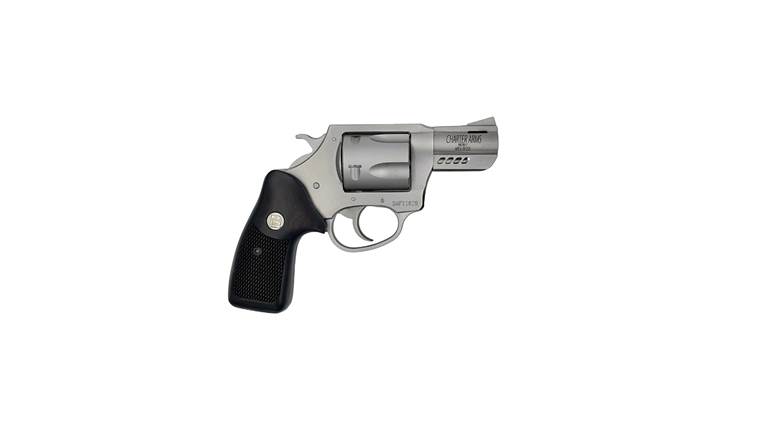
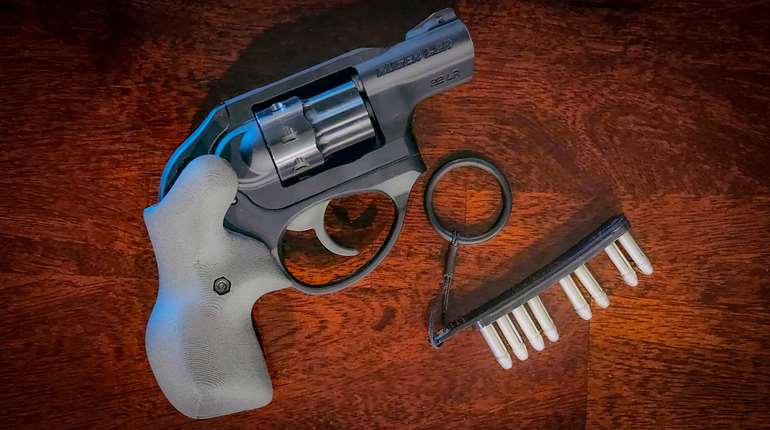
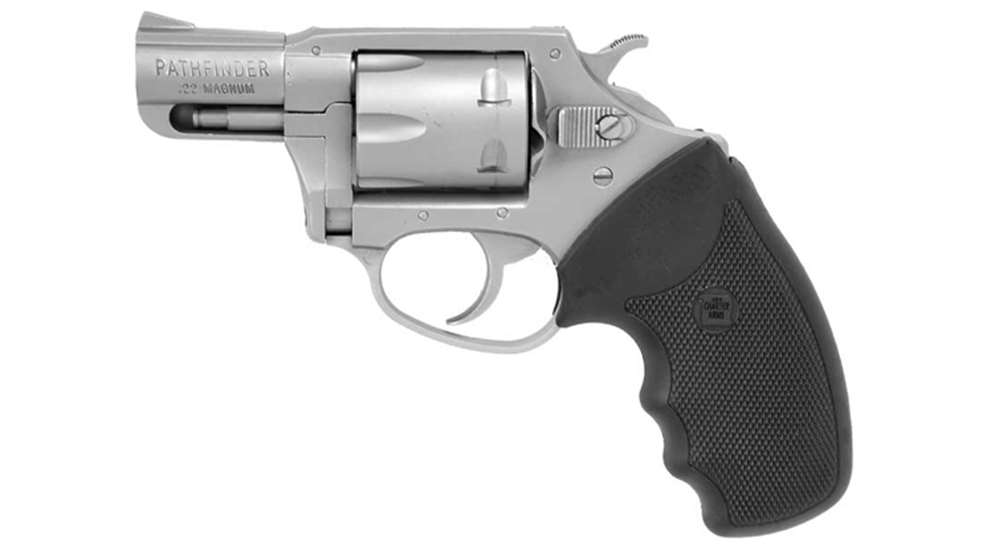
The Pathfinder’s frame is made from stainless steel and exhibits a smooth matte finish. Depressing a grooved, sliding thumb button on the frame’s left side allows the six-round cylinder to swing out to the left for loading and unloading. Unlike some revolvers, the Pathfinder has no side plate. The frame consists of two pieces; the grip and trigger guard are combined in one assembly, while the action frame around the cylinder is the other. The grip frame houses a coiled mainspring and slips inside the action frame. It is held in place by screws and pins. The rubber stock panels are attached to the grip frame with a single screw and a stud at the bottom of the frame.
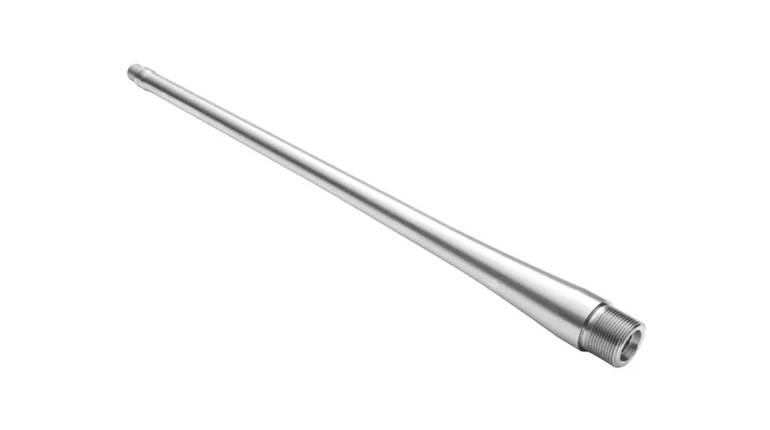
The barrel, underlug and front sight are one piece of stainless steel. It is machined, button-rifled and then threaded directly into the frame. The rear sight is a long trough that runs the length of the frame, but at the rear the notch is square. The sights are, in snub-nose revolver fashion, small, but they are effective. The revolver was zeroed at 7 yards right out of the box.
The Pathfinder incorporates a hammer-block safety system that was patented by the company in the 1960s. This system works well because the hammer has an extension at the top that rests against the frame when the hammer is forward. This prevents the hammer from hitting the firing pin. When the trigger is pulled, however, a plate rises up over the firing pin and when impacted by the hammer forces the firing pin forward.
Although it has a single-stage trigger, it feels more like a two-stage because of the stacking mid-pull. That being said, the action is relatively smooth, even though the double-action pull weight is 12 pounds. The single-action pull weight is decidedly crisp, breaking consistently at about 4 pounds.
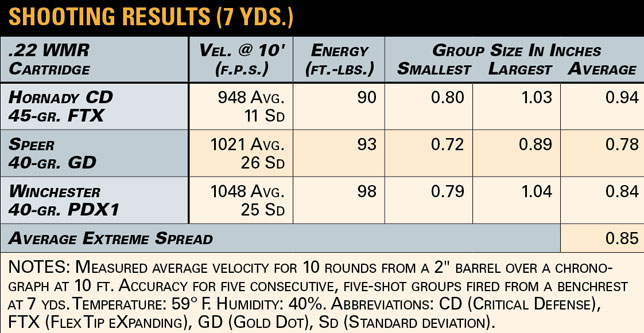
As we envisioned the revolver primarily employed for personal defense, we conducted accuracy testing at 7 yards. Additionally, all of the ammunition used in the Pathfinder during evaluation was purpose-built for personal protection, with those loads being Hornady’s Critical Defense, Speer’s Gold Dot and Winchester’s PDX 1. Of those, Speer’s 40-grain Gold Dot proved to be the most accurate, averaging 0.78 inches for five consecutive, five-shot groups. The other loads, however, produced groups only slightly larger in size.
Aside from accuracy testing, we also ran the revolver through defensive-type drills at distances between three and 15 yards using Action Target’s new Rimfire Tactical Hostage target. This 10x 16-inch torso-shaped target has a 4-inch swinging head plate and a 3.5x 4.5-inch bullseye. Between 7 yards and 10 yards scoring hits proved simple, and even at 25 yards we averaged five hits out of every six shots fired when slow fire was practiced.
Next, we stepped off 5 yards from a silhouette target and, with the aid of a shot timer, found out how fast we could place six shots within an 8-inch circle. Our best time was 1.89 seconds, and the average was around two seconds. Recoil was negligible, and the revolver was easy to keep on target while shooting quickly.
In all, we fired more than 300 rounds through the Pathfinder, and there were no malfunctions. The only issue we encountered emerged once the revolver became overly dirty, at which point the fired .22 WMR cases became difficult to remove. The ejector rod seemed a bit short. With authoritative force, however, the cases would come free. Frequent cleanings are recommended. Additionally, the double-action trigger pull might be too heavy for some shooters.
We found the Pathfinder to have ample accuracy for close-range defensive work, and it appeared that the revolver is plenty reliable. It would serve the purpose of a trail gun quite well in most locations and, for personal-defense practitioners, backpackers and campers, it offers lightweight peace of mind.
Manufacturer: Charter Arms; (203) 922-1652; charterfirearms.com
Cartridge: .22 WMR
Action Type: single-action/double-action rimfire revolver
Frame: stainless steel
Barrel: 2"
Rifling: six-groove, 1:18" RH twist
Cylinder Capacity: six
Sights: fixed ramp front, notch rear
Trigger: single-action, 4-lb., 1-oz. pull; double-action, 12-lb. pull
Overall Length: 6.8"
Width: 15⁄16"
Height: 415⁄16"
Weight: 19 ozs.
Suggested Retail Price: $410
Most Popular