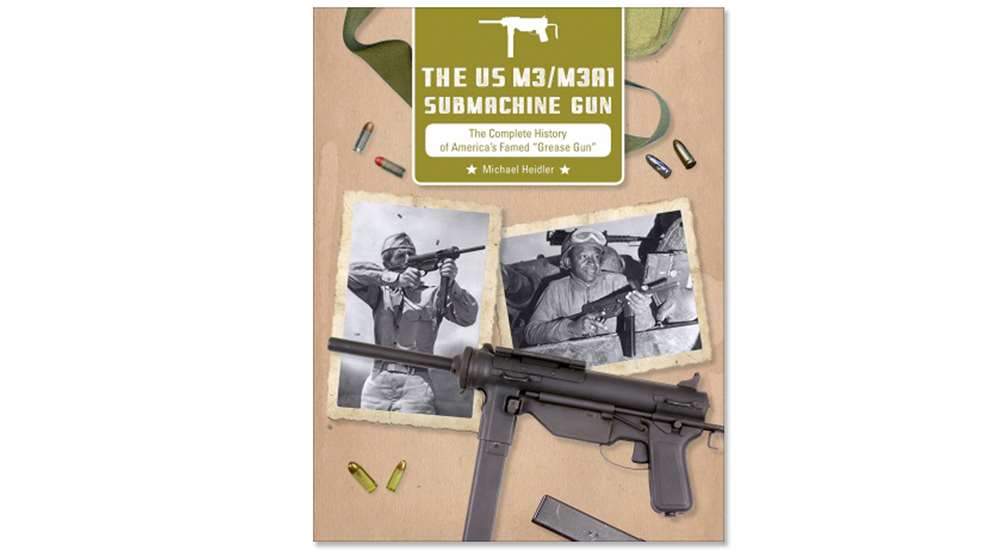
Until now, if you wanted to read anything in depth on the M3 “grease gun,” there was only one standalone publication available, Frank Iannamico’s The U.S. M3-3A1 Submachine Gun, a 166-page paperback published in 1999. Other than that fine tome, to find any useful information on the M3 you would have to wade through a multitude of books on the Thompson or other compilation compendiums.
Michael Heidler, no stranger to writing about firearm history, has produced a most impressive volume on one of this author’s favorite World War II firearms, the M3 “grease gun.” This new book is very impressive and informative, belonging on your shelf if you have even the slightest interest in World War II firearms, their development and use.
Heidler starts off with an enlightening chapter on the state of affairs within the U.S. Army Ordnance Dept.’s inventory of submachine guns (SMGs) prior to World War II. That is to say, up until 1939, there were Thompsons, and only 15,000 of them, to be exact. With the war in Europe starting in 1939, some effort was made by various private designers and firms to market a new SMG. Reising, Hyde-Inland, S&W, Star and High Standard, among others, all had potential contributions, but it was the M3 from the Inland Division of General Motors that found favor with the Ordnance Board and was adopted in January 1943. At a cost to the government of only $15 compared to the Thompson that cost $120, the M3 and its successor, the M3A1, were initially intended to replace the Thompson, but manufacturing delays contributed to only 650,000 “grease guns” being manufactured compared to 1.5 million Thompsons.
Heidler’s book is breathtaking in its scope. From copies of the various patents to the technical and field manuals issued with the gun, it is resplendent with up-close color photographs of remarkable clarity and detail. While collecting M3s is out of the price range of most of us, this is still a great reference for identifying the many variants and accessories that were issued with this workhorse of our armed forces for more than 50 years. This book will definitely be a reference that will be consulted for years to come. Retail price from Schiffer Publishing comes to $45.
To learn more, please visit schifferbooks.com.
Most Popular