For more than a century, Iver Johnson was a prolific manufacturer of revolvers that claimed a large share of the lower- to mid-priced market. From assembly lines in Massachusetts, New Jersey and Arkansas, the company produced scores of different models that ranged from crude, spur-trigger pocket pistols to full-size double-action revolvers whose fit, finish and features rivaled name-brand wheelguns. Shooter perception varied accordingly. Some considered “Owlheads” (so-called for the grip embellishment seen on many models) nothing more than cheap marginal revolvers, while others appreciated a relatively inexpensive alternative that was also solid and reliable.
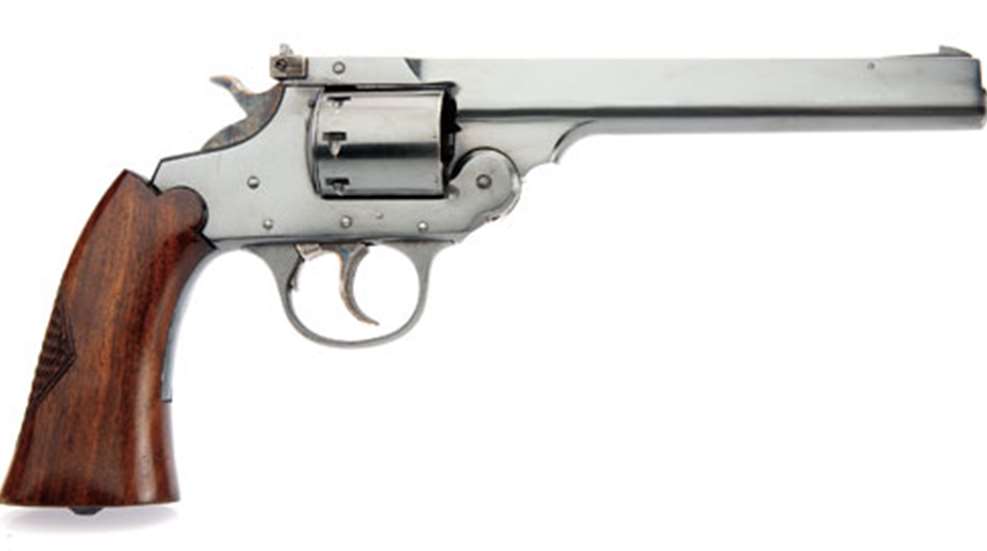
Among Iver Johnson’s finest work was the Supershot Sealed Eight, a series of large-frame, top-break .22 rimfires produced in three production stages between 1932 and 1958. Its lines and blued finish mimicked costlier revolvers, and it had the heft and balance of a high-end match gun. The oval-shaped, single-piece “Hi-Hold” walnut stock added further to the gun’s appearance and handling characteristics. Sealed Eight stocks typically sported a diamond-shape checkering field over the backstrap, and attached to the frame via a single screw through the butt.
The Sealed Eight name came from a unique safety feature, in that all eight chambers were counterbored into the cylinder face so that the shooter was shielded in the event of a ruptured case head. Inner surfaces were correspondingly machined to allow the star extractor to fit flush as well. Variants with 2½- and 4-inch barrels were offered for short periods, but by far the most common Sealed Eights came equipped with a 6-inch barrel. With the longer barrel, the overall length was 10¾ inches and the weight was 24 ounces, with beefy dimensions that complemented the gun’s smooth operation and aided the shooter’s ability to hold it steady.
This lightly used Sealed Eight, whose serial number is simply “A 7”, is an early example from the line’s final production stage. At this point the barrel incorporated the top rib to assume a robust, pear-shaped configuration. The rear sight—which doubles as the top-break release—is in the Patridge style and is adjustable for both windage and elevation.
The gun has been fitted with an updated Flash Control cylinder (introduced in 1955), now unfluted and bearing an extended front rim to guard against sideways powder flare. Minor wear can be seen where the cylinder face rubbed the frame upon closing, but the exterior bluing, markings and grip finish are in such nice condition that this pistol retains 96 percent original condition with a value around $250—some five times greater than its original selling price.
Gun: Iver Johnson .22 Supershot Sealed Eight
Serial No.: A 7
Caliber: .22 Long Rifle
Condition: NRA Excellent
Manufactured: 1956 (circa)
Value: $250