Support NRA American Rifleman
DONATE
** When you buy products through the links on our site, we may earn a commission that supports NRA's mission to protect, preserve and defend the Second Amendment. **
Heritage Manufacturing Inc. is one of three brands under the Taurus Holdings name and known for its single-action .22-cal. rimfire revolvers. Heritage makes these revolvers in a number of different themes around the same single-action receiver design. The revolvers are manufactured at the Taurus plant located in Miami, Fla., and made mostly in-house.
Heritage Manufacturing was acquired by Taurus in 2012, and very little has changed with the design of the Heritage rimfire revolvers made at the Taurus plant since then. Because of the plant's massive production capacity, the revolvers are made in a large number of different finishes, colors and grip styles that continue to grow and change with different lines. Despite the variety, the revolvers all start from the same basic components.
Heritage uses a number of different manufacturing processes in the construction of the revolver parts, with some components being made of simple stampings while others are precision cut by CNC machines. The barrel, cylinder and frame are the three major metal components of the revolvers that are made from start to finish at the Taurus factory and involve in-depth machining. Barrels start off as blanks that are drilled, cut and rifled before being finished and paired with a receiver.
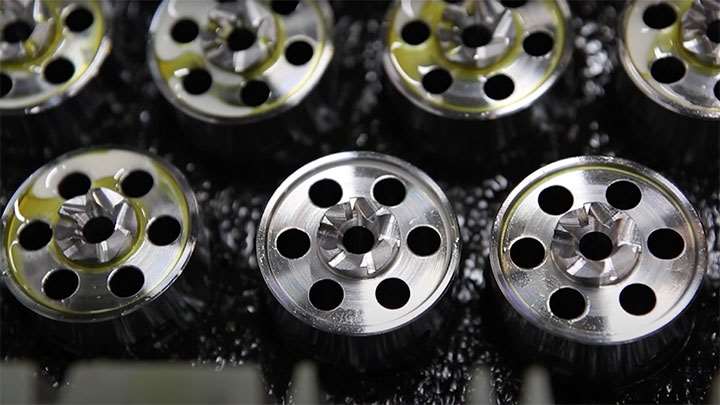
The process in which the cylinders are made is very similar, starting as a featureless steel blank. Several different cuts are made on the cylinder blanks by CNC lathes and mills to cut the chambers and interface surfaces with several quality checks along the way. The cylinders are then finished once the final machining checks are complete. The frames of the revolvers start out as raw castings in the basic shape of a finished frame.
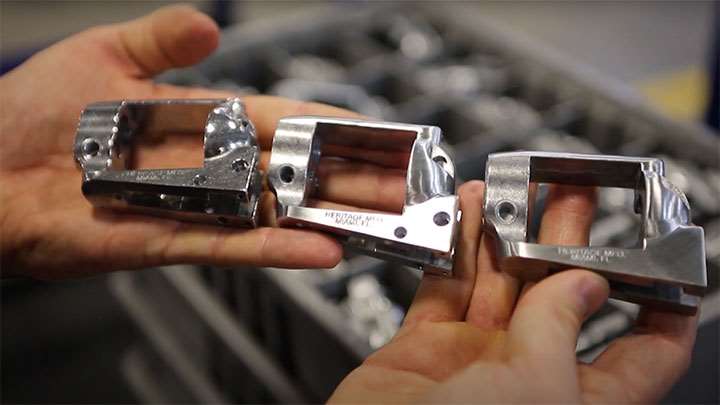
The frames also go through a number of different machining processes involving CNC mills and laths in which the frames are cut and threaded for the smaller components. After the machining process, the frames are then tumble polished before being finished and used in assembly. The Heritage revolvers are unique partly due to the addition of a safety tab located on the left side of the hammer on the frame. When the safety is in the up position, a hammer block prevents the hammer from making contact with the firing pin.
The majority of all the Heritage single-action revolvers are chambered for .22 LR, with a few that are chambered for multiple .22-cal. rimfire cartridges. Heritage offers these revolvers in several different lines with various grip themes and color options available. For more information on the various Heritage Manufacturing Inc. revolvers available visit heritagemfg.com.
To watch complete segments of past episodes of American Rifleman TV, go to americanrifleman.org/artv. For all-new episodes of ARTV, tune in Wednesday nights to Outdoor Channel 8:30 p.m. and 11:30 p.m. EST.
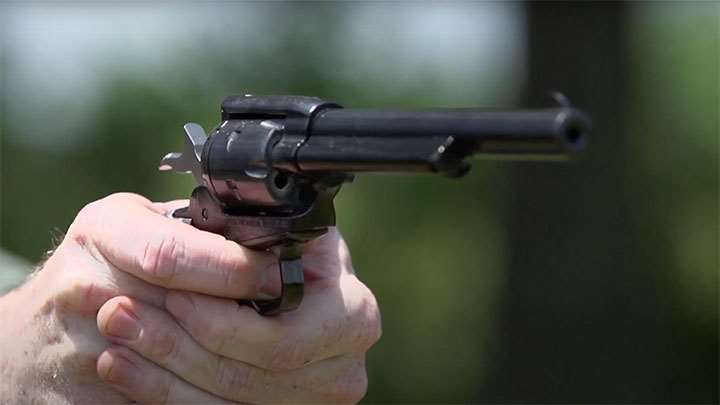
Firing a Heritage single-action rimfire revolver.
Heritage Manufacturing was acquired by Taurus in 2012, and very little has changed with the design of the Heritage rimfire revolvers made at the Taurus plant since then. Because of the plant's massive production capacity, the revolvers are made in a large number of different finishes, colors and grip styles that continue to grow and change with different lines. Despite the variety, the revolvers all start from the same basic components.
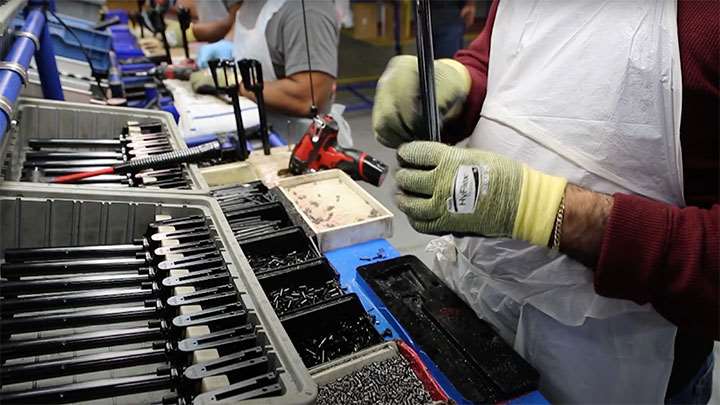
A worker assembling a Heritage revolver at the factory.
Heritage uses a number of different manufacturing processes in the construction of the revolver parts, with some components being made of simple stampings while others are precision cut by CNC machines. The barrel, cylinder and frame are the three major metal components of the revolvers that are made from start to finish at the Taurus factory and involve in-depth machining. Barrels start off as blanks that are drilled, cut and rifled before being finished and paired with a receiver.
Cylinders after being cut by CNC.
The process in which the cylinders are made is very similar, starting as a featureless steel blank. Several different cuts are made on the cylinder blanks by CNC lathes and mills to cut the chambers and interface surfaces with several quality checks along the way. The cylinders are then finished once the final machining checks are complete. The frames of the revolvers start out as raw castings in the basic shape of a finished frame.
A lineup of three receivers representing the work done during the machining and polishing process.
The frames also go through a number of different machining processes involving CNC mills and laths in which the frames are cut and threaded for the smaller components. After the machining process, the frames are then tumble polished before being finished and used in assembly. The Heritage revolvers are unique partly due to the addition of a safety tab located on the left side of the hammer on the frame. When the safety is in the up position, a hammer block prevents the hammer from making contact with the firing pin.
The majority of all the Heritage single-action revolvers are chambered for .22 LR, with a few that are chambered for multiple .22-cal. rimfire cartridges. Heritage offers these revolvers in several different lines with various grip themes and color options available. For more information on the various Heritage Manufacturing Inc. revolvers available visit heritagemfg.com.
To watch complete segments of past episodes of American Rifleman TV, go to americanrifleman.org/artv. For all-new episodes of ARTV, tune in Wednesday nights to Outdoor Channel 8:30 p.m. and 11:30 p.m. EST.