by
Support NRA American Rifleman
DONATE
** When you buy products through the links on our site, we may earn a commission that supports NRA's mission to protect, preserve and defend the Second Amendment. **
In this week's episode of American Rifleman TV, we begin going through our picks for the top 10 machine guns of all time. We start with number ten, the FN MAG belt-fed, and number nine, the BAR magazine-fed light machine guns. On "Rifleman Review," we take a look at the Colt Gold Cup Trophy 1911 handgun chambered in .45 ACP. On "I Have This Old Gun," we examine the early breech-loading rifles and carbines designed by the brilliant American inventor John Hall.

Starting off with American Rifleman top 10 machine guns of all time, at number 10 is the Fabrique Nationale 'Mitrailleuse d'Appui Général' or FN MAG. The MAG is an air-cooled, belt-fed general-purpose machine gun that is operated by a long-stroke, gas-piston system. Designed in the early 1950s, the FN MAG incorporates many design features from earlier proven machine guns, including the locking mechanism of the M1918 BAR along with the feed system and the trigger group of the MG-42.
The FN MAG also features a built-in folding bipod, as well as a quick-change barrel that is removed by the attached carry handle. Chambered in 7.62x51 mm NATO, The FN MAG has been widely use by NATO and other western nations around the world in conflicts from Vietnam, the Falklands to today. The FN MAG is widely used by the United States as the M240 family as well as by the British as the L7 family for infantry, ground vehicles and aircraft.

At number nine is the American classic and brainchild of John Moses Browning, the Browning Automatic Rifle or BAR. The BAR is an air-cooled, select-fire automatic rifle that is operated by a long-stroke, gas-piston system and uses a rising block to lock the bolt. Presented to the United States Military in 1917 by John Moses Browning, the BAR is chambered in .30-'06 Sprg. and feeds from a detachable 20-round box magazine.
The BAR was adopted by the United States as the M1918 as a replacement for the few aging domestically produced machine guns being used by the American Expeditionary Force during World War I, which was relying on British and French machine guns to fill the gap. It was used in large numbers as a Squad Automatic Rifle during World War II and the Korean War and was produced my many manufactures with several different models.
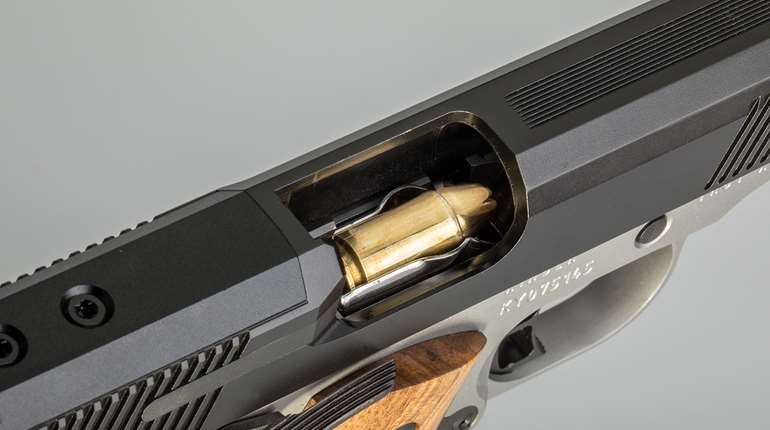
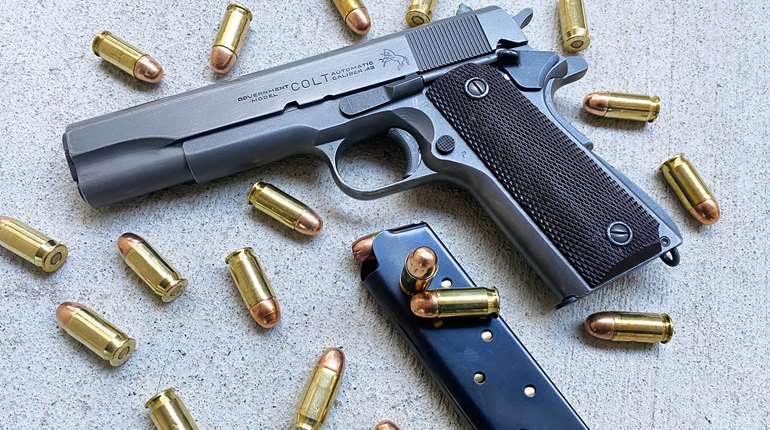
Colt has resurrected one of its classic 1911 pistol models geared specifically for competition, the Colt Gold Cup Trophy. It started off as the National Match, before becoming the Gold Cup in 1957. The New Colt Gold Cup 1911s are chambered in .45 ACP and are geared for most all pistol competitions.
John Hall patented his design for a breech-loading rifle in 1811 that was unique at the time not only for its design, but for its inventor's production process. Adopted by the United States Army in 1819 as the M1819 Hall Rifle, the design used a tilting breech block behind the barrel the could be raised and loaded easier than the standard muskets of the time, which required loading from the muzzle.
This design allowed faster reloading, incorporation of a rifled barrel and for the user to reload without standing upright. John Hall built the rifles in works erected at the Harpers Ferry Arsenal using a new production method in which water-powered machine tools, many of his own design, shaped the parts uniformly compared the the old hand-fitted method used to produce arms at the time.
As a result, the breech block and other mechanical parts were uniform enough to allow for parts interchangeability, which John Hall demonstrated by swapping 100 blocks to 100 different rifles without malfunction. The Hall Rifles and later Hall Carbines were produced at Harpers Ferry and by Simeon North from the 1820s to the 1840s as flintlock and later primer-fired arms. The rifles and carbines were used in the Indian and Mexican American Wars and some were even used in the Civil War, though not in large numbers at that point as many had worn out with use.
To watch complete segments of past episodes of American Rifleman TV, go to americanrifleman.org/artv. For all-new episodes of ARTV, tune in Wednesday nights to Outdoor Channel 8:30 p.m. and 11:30 p.m. EST.
Shooting the American version of the FN MAG, the M240.
Starting off with American Rifleman top 10 machine guns of all time, at number 10 is the Fabrique Nationale 'Mitrailleuse d'Appui Général' or FN MAG. The MAG is an air-cooled, belt-fed general-purpose machine gun that is operated by a long-stroke, gas-piston system. Designed in the early 1950s, the FN MAG incorporates many design features from earlier proven machine guns, including the locking mechanism of the M1918 BAR along with the feed system and the trigger group of the MG-42.
The FN MAG also features a built-in folding bipod, as well as a quick-change barrel that is removed by the attached carry handle. Chambered in 7.62x51 mm NATO, The FN MAG has been widely use by NATO and other western nations around the world in conflicts from Vietnam, the Falklands to today. The FN MAG is widely used by the United States as the M240 family as well as by the British as the L7 family for infantry, ground vehicles and aircraft.
Shooting a M1918 Browning Automatic Rifle.
At number nine is the American classic and brainchild of John Moses Browning, the Browning Automatic Rifle or BAR. The BAR is an air-cooled, select-fire automatic rifle that is operated by a long-stroke, gas-piston system and uses a rising block to lock the bolt. Presented to the United States Military in 1917 by John Moses Browning, the BAR is chambered in .30-'06 Sprg. and feeds from a detachable 20-round box magazine.
The BAR was adopted by the United States as the M1918 as a replacement for the few aging domestically produced machine guns being used by the American Expeditionary Force during World War I, which was relying on British and French machine guns to fill the gap. It was used in large numbers as a Squad Automatic Rifle during World War II and the Korean War and was produced my many manufactures with several different models.
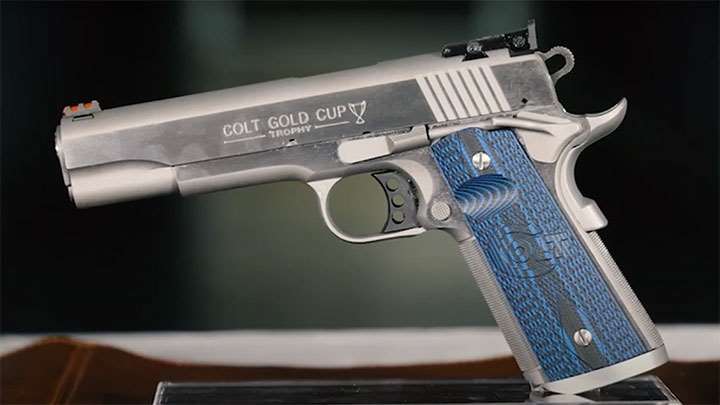
The reworked Colt Gold Cup Trophy competition 1911.
Colt has resurrected one of its classic 1911 pistol models geared specifically for competition, the Colt Gold Cup Trophy. It started off as the National Match, before becoming the Gold Cup in 1957. The New Colt Gold Cup 1911s are chambered in .45 ACP and are geared for most all pistol competitions.
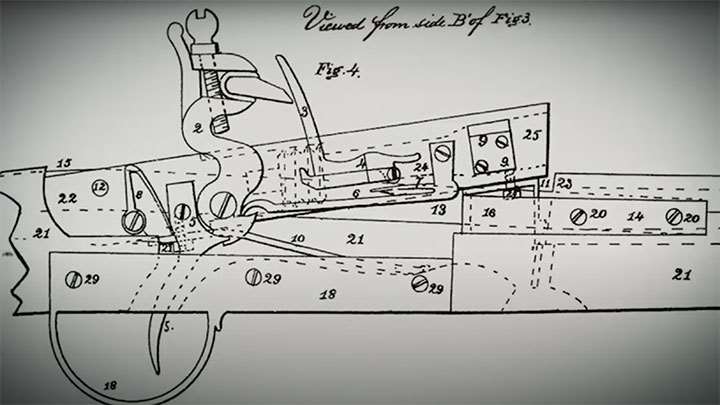
A diagram illustrating the raising breech block designed by John Hall and used in his rifles and carbines.
John Hall patented his design for a breech-loading rifle in 1811 that was unique at the time not only for its design, but for its inventor's production process. Adopted by the United States Army in 1819 as the M1819 Hall Rifle, the design used a tilting breech block behind the barrel the could be raised and loaded easier than the standard muskets of the time, which required loading from the muzzle.
This design allowed faster reloading, incorporation of a rifled barrel and for the user to reload without standing upright. John Hall built the rifles in works erected at the Harpers Ferry Arsenal using a new production method in which water-powered machine tools, many of his own design, shaped the parts uniformly compared the the old hand-fitted method used to produce arms at the time.
As a result, the breech block and other mechanical parts were uniform enough to allow for parts interchangeability, which John Hall demonstrated by swapping 100 blocks to 100 different rifles without malfunction. The Hall Rifles and later Hall Carbines were produced at Harpers Ferry and by Simeon North from the 1820s to the 1840s as flintlock and later primer-fired arms. The rifles and carbines were used in the Indian and Mexican American Wars and some were even used in the Civil War, though not in large numbers at that point as many had worn out with use.
To watch complete segments of past episodes of American Rifleman TV, go to americanrifleman.org/artv. For all-new episodes of ARTV, tune in Wednesday nights to Outdoor Channel 8:30 p.m. and 11:30 p.m. EST.