The Army announced in late August that it had selected three finalists in its search for firearms that will replace the M16/M4 and M249 Squad Automatic Weapons that have served U.S. frontline Soldiers for decades. Some of the defense and firearm industry’s finest submitted prototypes for the competition—with SIG Sauer, General Dynamics Ordnance and Tactical Systems and AII Corporation Textron Systems still in the running—and at least one of the designs, a semi-automatic version from Cobalt Kinetics/MARS Inc., will be available to consumers next year.
The search for new guns is known officially as the Next-Generation Squad Weapon program (NGSW), and one of the Army’s requirements for submission is that the guns must chamber an all-new 6.8 mm cartridge. The change is an effort to increase terminal performance and effective distance of an Infantryman’s small arms fire when compared to the currently fielded 5.56 NATO and 7.62 NATO ammo.
In addition, the guns must maintain the same fire-control and handling characteristics of the branch’s current small arms. 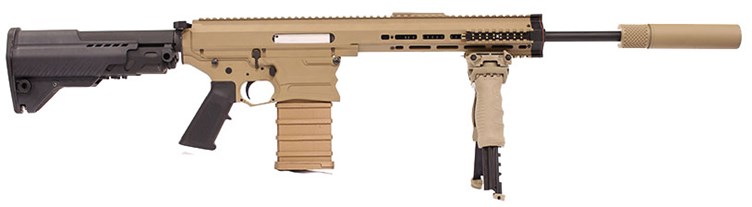
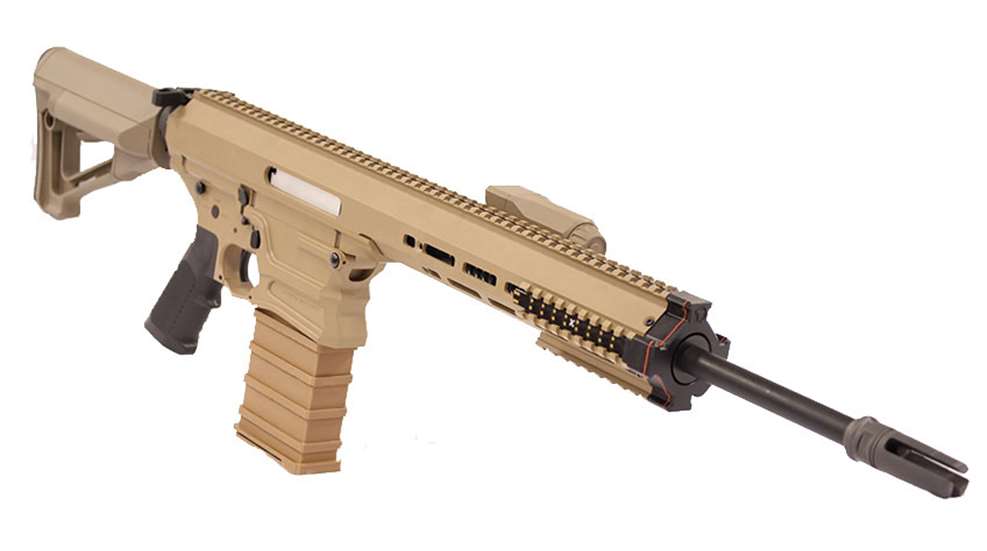
MARS Inc. teamed up with Cobalt Kinetics of Utah in early 2019 to create a design that fulfilled the task, and the resulting firearm is a large-framed AR-pattern rifle with a magazine well big enough to accommodate the new cartridge. A recoil spring wrapped around the barrel is under the handguard—a configuration used by the Browning Auto-5 shotgun and an essential part of any long-recoil system.
The visual similarity to the decades-old operating systems is deceiving, though. The bolt and barrel in the new design, while locked, are allowed to travel freely within the action under the recoil impulse generated by the 6.8 mm short magnum cartridge. The guns fire 140-gr. .270-cal. bullets at 3,200 fps. The system effectively dissipates a great deal of recoil energy before it transmits to a shooter’s shoulder. 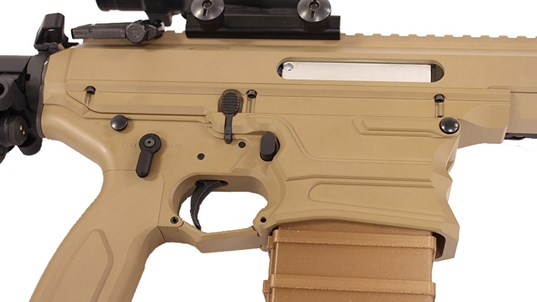
The operation is labeled “shift pulse recoil,” an approach that distributes recoil energy over time and reduces its speed by a spring and buffer system, prior to stroke completion. The result is a slower and softer impulse to the shooter, making it more controllable and comfortable to shoot—despite doubling effective distance and energy. Similar systems have been employed in some Soviet rifle and machine gun designs.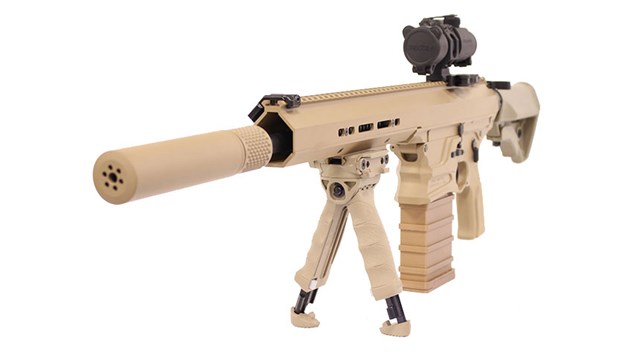 Other advantages of long-recoil semi-automatic operation include no gas escaping from the barrel into the action. The Cobalt Kinetics press release announcing the gun’s upcoming commercially availability explained it, “runs as clean as any bolt action. When operating with a suppressor, the long-recoil system actually runs more reliably and with less recoil than unsuppressed. Of course, the added mass slows down the barrel/bolt assembly, but that extra mass and resultant momentum to the recoiling assembly help the system power through dirt and particulates that can foul other semi-auto mechanisms.”
MARS Inc. and Cobalt developed two versions for the NGSW competition, a 13-inch-barreled lightweight carbine and 18-inch-barreled light machine gun. Both are capable of semi- and full-auto fire and fed from proprietary 20- and 70-round magazines. They are also designed to incorporate the newest “smart” battlefield technology, including a central power supply source to keep peripherals running in combat and more.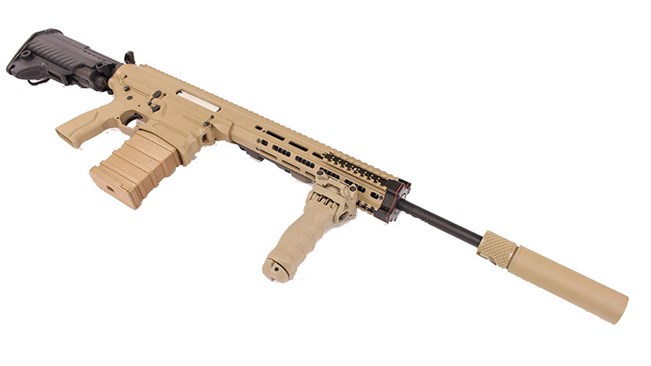
“I can’t think of a better collaboration in this industry,” said Michael Merino, president and CEO of MARS Inc. “Our MARS rifle design, coupled with the innovative approach to rifle manufacturing of the Cobalt Kinetics team, has been incredible. We believe that we have a rifle design that meets the requirements of the Army’s ambitious NGSW program. We are excited to be part of the evolution of military effectiveness. We also plan to release a commercially available version of this rifle in the first few months of 2020.”
Most Popular