Many collectors have an affinity for firearms with a connection to Texas, such as Smith & Wesson’s Third Model Hand Ejector revolver, also called the Wolf & Klar Model. Although now long gone, Wolf & Klar (W&K) was a Fort Worth pawn shop started by German immigrants Alex Wolf and Jacob Klar that became a prominent hardware, jewelry and gun store during the late 19th and early 20th centuries.
Located near the stockyards, at 1505 Main St., Wolf & Klar was a favorite destination for cattlemen and lawmen. The store was also one of Smith & Wesson’s biggest customers, often embellishing factory guns with aftermarket engraving and carved pearl stocks (sometimes using local artisans with questionable skills).
Smith & Wesson introduced its Second Model Hand Ejector in 1914 and discontinued its First Model Hand Ejector (the Triple Lock) the following year, as the Second Model was basically the same gun, but without the Triple Lock’s costly third cylinder yoke lock-up or extractor shroud.
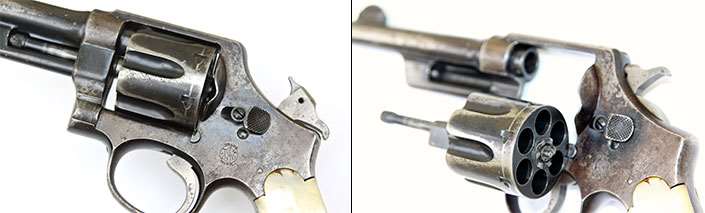
Although many customers wanted the extractor-protecting shroud back, Smith & Wesson refused. That is, until Wolf & Klar ordered 3,500 Second Model Hand Ejectors with the shroud. That got S&W’s attention. Thus, in 1926, the Hand Ejector Third Model was born as an uncataloged Wolf & Klar exclusive. Available blued or nickel-finished, with checkered walnut stocks, adjustable or fixed sights, and barrel lengths of 4", 5" and 6½" (rare), most W&K guns were chambered for .44 Spl., with a few rarities in .44-40 Win. and .45 Colt.
Ironically, because the guns could be special-ordered from the factory, only 1,000 Third Models were actually shipped to W&K between 1926 and 1936. In total, just 4,976 Third Models were made between 1926 and 1940, when World War II halted production. Consequently, the relatively few guns shipped to Wolf & Klar carry a premium.
“It has become a collecting genre in itself,” said NRA Life member and noted S&W collector David Carroll. “Their guns are more in demand today than ever before.”
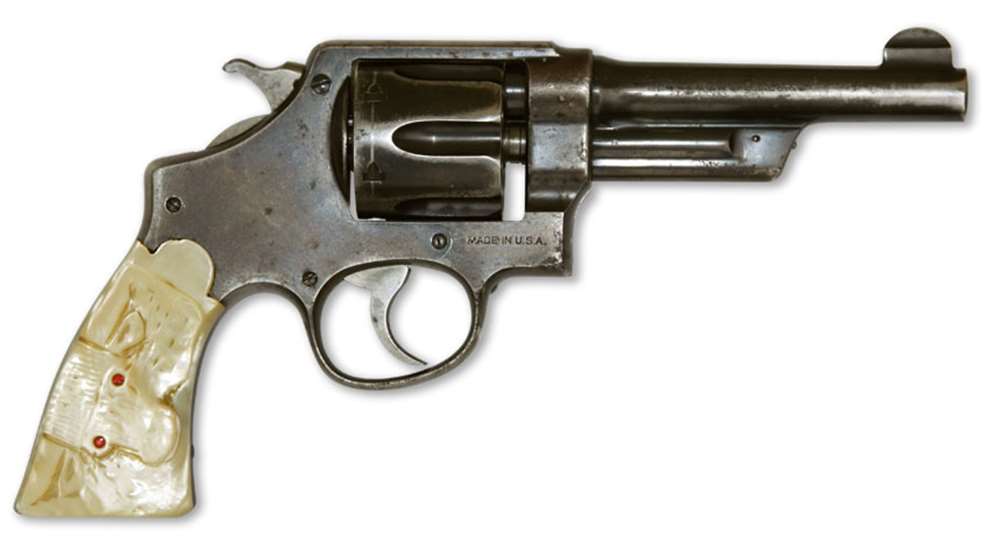
The 60 percent gun shown was shipped on June 29, 1928, to Wolf & Klar. The wholesale price was $21.90, and it retailed for $36.50. The W&K-carved steer head stocks with ruby eyes set the buyer back another $12 (gold horns and nose rings cost more). In 2017, this well-used revolver was sold by Lock, Stock & Barrel internet auction (lsbauctions.com) for $1,245.78. Today it is easily worth $1,750 to $2,250.
Gun: Smith & Wesson “Wolf & Klar” .44 Hand Ejector, Third Model
Chambering: .44 Spl.
Serial Number: 318XX
Manufactured: 1928
Barrel: 5" (most commonly encountered; 6½" barrels bring a premium)
Condition: NRA Very Good (Modern Gun Standards)
Value: $1,750 to $2,250
Note: This gun letters to Wolf & Klar and is fitted with W&K-carved pearl stocks. Both features bring premiums.
Most Popular