The lever-action rifle stands tall within America’s gun culture. Much of this esteem stems from the days of westward expansion, when the lever-action repeater was the gun of choice. Even long after the frontiers were conquered, the appeal of the slim, tube-magazine repeaters from Marlin and Winchester remained strong. Of all the various models of that late-19th-century era, none are better remembered than the Winchesters, whose origins can be traced back to the fertile imagination of John Browning. While the later Models 94 and 95 were highly regarded for their marriage of smokeless powder and traditional operation, the earlier Winchester lever guns were appreciated for their smooth operation. Browning’s first Winchester repeater was the 1886, built for the longer blackpowder cartridges of the day, and six years later he scaled and shortened the Model 86 to produce the Model 92 for short blackpowder cartridges. Both guns were successful in their day and have been replicated in modern times.
In those days, the variety of cartridges available was not as broad as it is now. At present, we have an amazing array of cartridges, a few of which are intended for revolvers. Some are powerful enough to require special long-cylinder wheelguns—such as the .500 and .460 S&W magnums. Both of those cartridges are rimmed and would be right at home in a lever-action rifle. And while the Browning-designed Winchester Models 86 and 92 would seem to be interesting mates for such cartridges, their actions are not of appropriate length, the slick little 92 being too short and the 86 being too long.
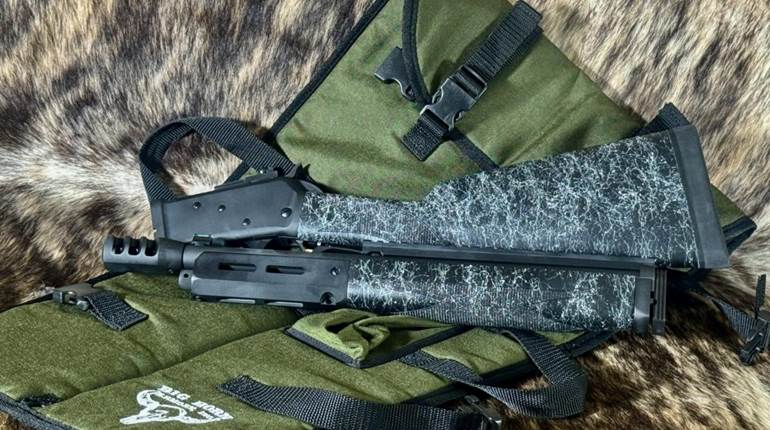
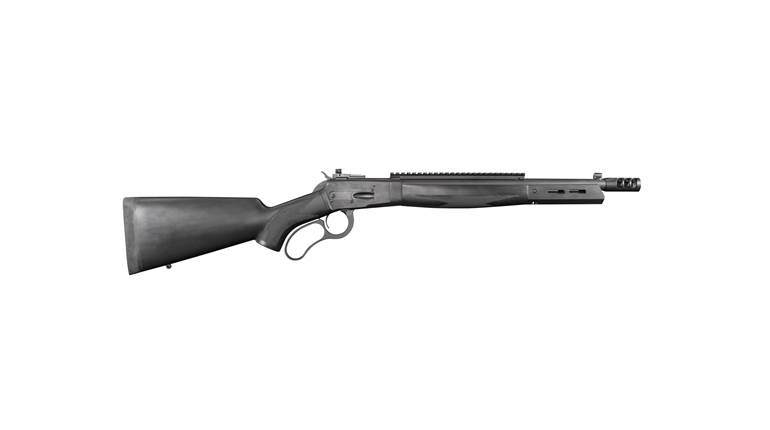
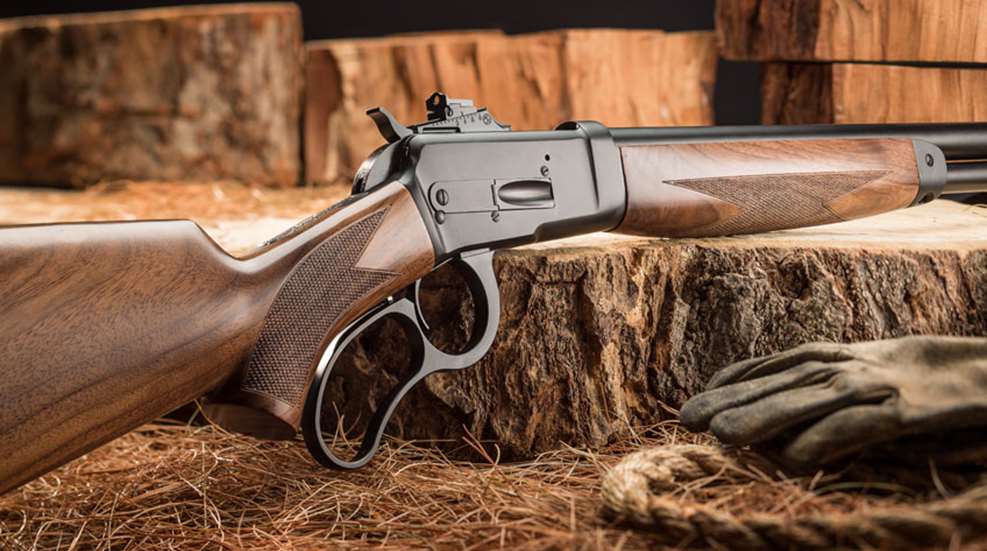
Enter a completely new version of a timeless design, made by a new firm in Cody, Wyo., Big Horn Armory, and called the Model 89—which denotes the mathematical difference between 86 and 92. The BHA 89’s action is intermediate in size, although it retains all the same contours, manner of operation and locking system of its predecessors. Big Horn Armory makes the gun in its Wyoming plant using modern CNC-machining techniques. There are no cast or forged parts in the gun, and, except for the black walnut buttstock and fore-end, BHA rifles and carbine components are cut from stainless steel bar stock. The test sample, an 89 Carbine, was finished in the company’s Hunter Black, appropriately matte and non-reflective for hard use afield.
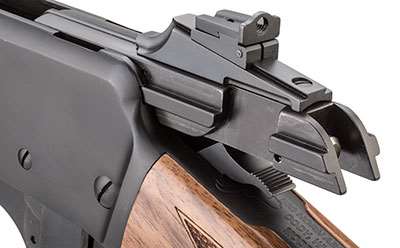
In addition to the physical resemblance of the BHA 89 to the Winchester 86 and 92, the operating system is also essentially the same. This is a manually operated rifle that cycles by the shooter’s operation of a lever that also serves as the trigger guard. An open-top design that ejects fired cartridges straight up, the BHA 89 has a bolt that reciprocates on rails machined into the inner walls of the receiver. When the action is closed, locking blocks at both sides of the receiver engage mortise cuts in the bolt as well as matching recesses in the receiver walls. In this system, the blocks serve to lock the bolt firmly in place against the rearward thrust of a fired cartridge. When the shooter strokes the lever downward and forward, the first bit of motion pulls those blocks downward and out of contact with the bolt. Further movement of the lever retracts the bolt to the rear to extract the fired case from the chamber and eject it out the top of the gun. At this point, a fresh round feeds rearward from the tube magazine under the barrel and onto the cartridge carrier. When the shooter strokes the lever back and up, the carrier moves the cartridge up into the path of the bolt. When the bolt closes, the round feeds into the chamber and the locking blocks slide into place. The BHA rendering of this classic design seemed initially a bit stiff, but smoothed out with firing and handling—which is exactly how original 86s and 92s behaved.
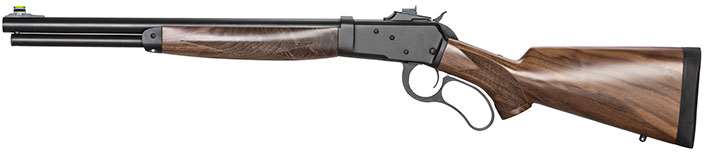
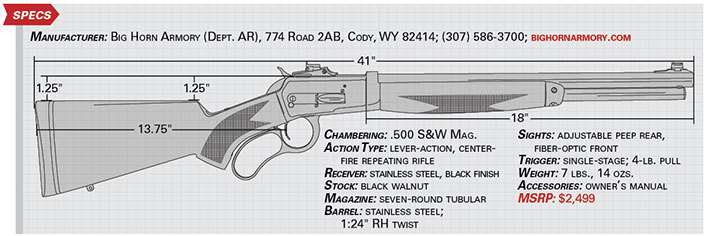
Our test gun was an 18"-barreled carbine with a pistol grip buttstock and a full magazine tube. There are no traditional carbine barrel bands, which never did anything worthwhile for the accuracy of the original carbines anyway. Instead, the magazine tube is attached to the underside of the barrel by means of a dovetailed lug.
In essence, the gun is a marriage of traditional rifle and carbine features. Since it is a modern sporting firearm, there are several points on the gun that reflect a respect for the traditional, but not at the expense of practicality. The sights, for example, combine a front unit of modern green fiber-optic material on a ramped post with a rear comprised of a large aperture on a period-correct angled ramp, and both are shaped to resist snags on kit or brush. An optional forward rail for the mounting of a scout scope is also available. Traditional stock design would not well serve a little brush buster like this, so the stock is a bit thicker in the butt and fuller in the fore-end. Checkering on the sample was well-executed 20 l.p.i., and there is a thick Pachmayr recoil pad to help with the .500 S&W Mag.’s substantial recoil.
The BHA 89 is intended for taking large animals at close range. The .500 S&W Mag. is a rimmed revolver cartridge powerful enough that many shooters could not tolerate it in the revolvers for which it was designed, but it adapts well to this longer and heavier firearm. Available in several options, all made of stainless steel, the BHA 89 Carbine has an offspring in the BHA 90. It’s the same gun in Smith & Wesson’s other long magnum cartridge, the .460 S&W Mag.
Everywhere you look on BHA’s products, you see strong, heavy, well-made and carefully fitted components. Big Horn Armory may be a relatively new gunmaker, but it builds for rough use—with an obvious respect for tradition.
Most Popular