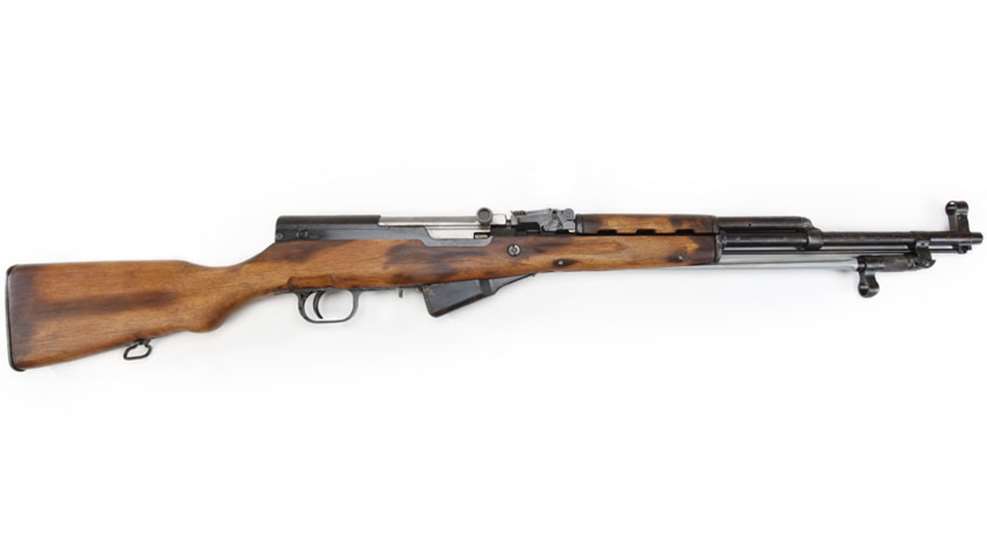
The SKS is somewhat unusual in that, despite being widely encountered in the United States today, it had a relatively short and uneventful service life in Russia where it originated. Named Samozaryadnyj Karabin Simonova, or Simonov self-loading carbine, the SKS was designed by Sergei Simonov. It was adapted from his previous work with the AVS-36 semi-automatic rifle and the PTRS-41 anti-tank rifle. While the first trials were conducted late in World War II, it continued to undergo design changes until 1949, when it was ultimately adopted with the retroactive designation of Model 1945.
Production ran only until 1958, as the iconic Kalashnikov AK-47 was developed during the same period. The AK quickly proved that, despite being adopted in the guise of a submachine gun, it could do everything the SKS could do, so Simonov’s design was rendered redundant and obsolete. Russian production stopped, and the SKS saw minimal combat use with Russian troops.
It did, however, find welcome homes across the Warsaw Pact and in China. In the 1950s, the SKS would be adopted and put into production by Yugoslavia, Romania, China, Albania, North Korea, East Germany and, to a small extent, North Vietnam. Chinese production dwarfed the rest, with millions made for both the People’s Liberation Army and for export or foreign military aid. A great many Chinese SKS carbines have come into the United States, along with many from the other nations that adopted them.
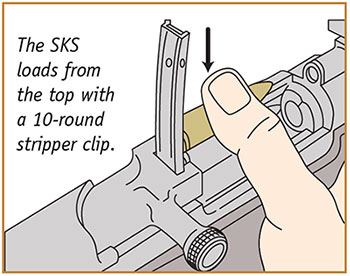 The SKS is a semi-automatic-only design chambered for the 7.62x39 mm cartridge. Its fixed box magazine is reloaded via a 10-round stripper clip. The locking system uses a tilting-bolt operated by a short-stroke gas piston. Folding bayonets of both the blade and spike types were used depending on the specific model, although in many cases they were removed for importation into the United States. Variations are relatively few in the SKS, with some short-barreled and AK-magazine-fitted versions made commercially in China (as well as a stamped-receiver version), and a grenade-launching version made by Yugoslavia. Other variations differ in markings and aesthetic details only.
While many may turn their noses up at the SKS because of its low cost and perceived status as cheap foreign junk, it is actually a well-designed and well-made Cold War workhorse with more in common with the American M14 than many would like to admit.
 Disassembly
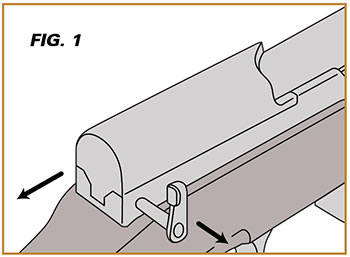
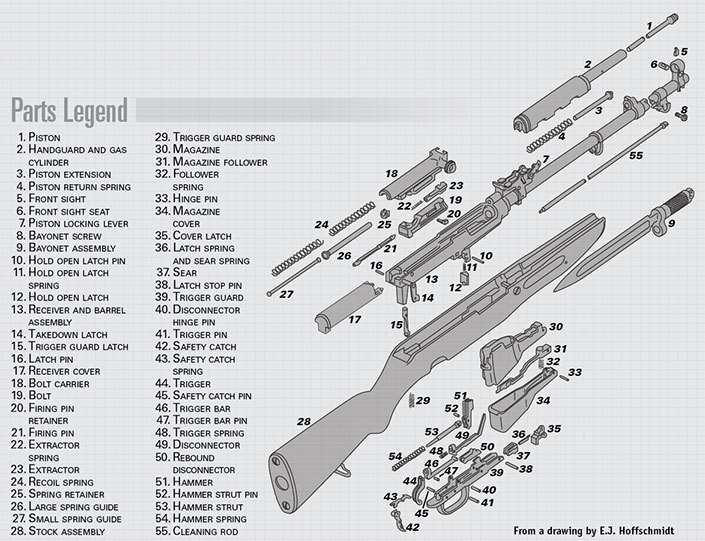
First, confirm the gun is unloaded. To remove the rear receiver cover (17), rotate the takedown latch (14) upward 90 degrees, and pull it out the right side of the receiver cover (FIG. 1).
Next, remove the recoil springs (24) and bolt (19) and carrier (18) assembly. The dual recoil-spring assembly is captive on its guide rod (26), and may be pulled out of the bolt carrier (18). Then pull the bolt handle back until the bolt carrier can be lifted up and out of the receiver (13). The bolt may lift up with the bolt carrier or it may fall out.
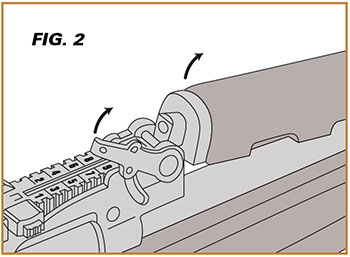 To remove the gas piston (1), first rotate the gas piston locking lever (7) upward 45 degrees (to its upper detent). The gas cylinder (2) may now be lifted out, rear end first (FIG. 2). The gas piston will slide out the front of the gas tube once it is free of the gun.
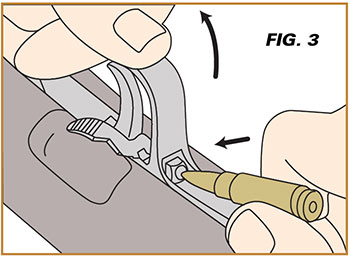
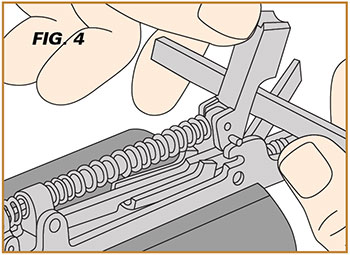
Removing the trigger assembly begins with the safety (42) engaged (horizontal). Use the tip of a cartridge or a pointed tool to depress the catch (15) at the rear base of the trigger guard (39) (FIG. 3). The trigger group will pop out under spring pressure. The magazine assembly may now also be lifted out of the stock (28). To strip the trigger guard, hold it in a padded vise. Push down on the disconnector (49) and pull the trigger (44) to release the hammer. (Caution: Be careful as the hammer is under heavy spring pressure.) Use a metal bar as shown (FIG. 4) to force the hammer out. Remaining parts can be disassembled by driving out pins.
 Reassembly
Note that reinstallation of the trigger assembly can be difficult. To replace the trigger assembly, first set the magazine back into the stock, if you removed it. Ensure that the front of the magazine is secured under the lip on the bottom of the receiver. Then fit the two pins at the front of the trigger frame into their matching notches at the rear of the magazine. That will lock the trigger and magazine into the receiver. Then press the trigger guard firmly into the stock, which may require substantial force if the spring and catch are new and stiff.
With the gas piston in the tube, ensure that the gas piston locking lever is in its upward position before replacing the gas piston assembly. Then place the front end of the gas tube over the boss on the rifle’s gas block. Drop the rear end of the gas tube into its slot in the rear sight block and rotate the gas tube locking lever to its downward position.
 Hook the bolt and bolt carrier together, and carefully set the assembly into the rear of the receiver. Pushing downward lightly to overcome pressure from the hammer, slide the bolt carrier forward in the receiver rails. Remember to open the magazine cover or depress the follower to allow the bolt to move forward.
Replace the receiver cover. First insert the recoil spring back into the bolt carrier from the rear, with the curly section (the end with the small-diameter guide rod) in the bolt carrier. Slide the receiver cover into place, and, while holding it fully forward, push the locking pin through the receiver and rotate it downward until it is horizontal.
Safety note: Many SKS rifles were packed with cosmoline or other preservative grease when imported. It is important to ensure that the firing pin moves freely in the bolt when the gun is disassembled. The gun’s design does not include a firing pin spring, and excessive grease in the firing pin channel can cause the pin to stick in the forward position and fire unexpectedly when a cartridge is chambered. If necessary, consult a gunsmith before firing your SKS.
Most Popular