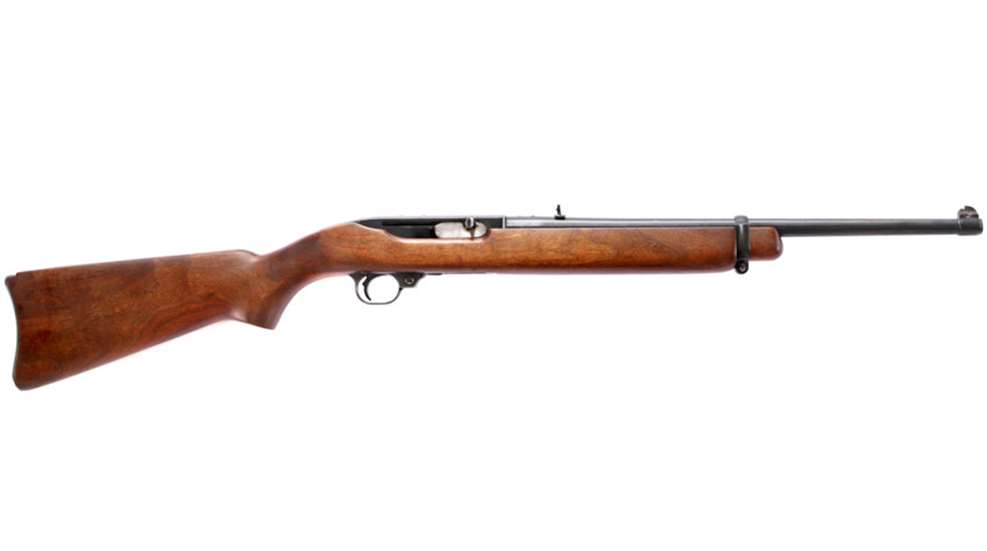
No, it’s not a 10/22. It’s a 44 Carbine, the design that fathered not only the 10/22, but Ruger’s entire line of rifles. Sturm, Ruger & Co. got its start making handguns, and was close behind Smith & Wesson when it added a .44 Magnum revolver to its lineup in 1956. A fan of the big magnum, founder Bill Ruger was among the first to see the cartridge’s potential as a rifle round.
In 1959, the company started work on a rifle that would chamber the .44 Mag. The semi-automatic design would feature a square receiver with a side ejection port that fully enclosed the bolt. Concealed completely within the stock was a tubular magazine that held four rounds that were loaded shotgun–style underneath the action just forward of the trigger guard.
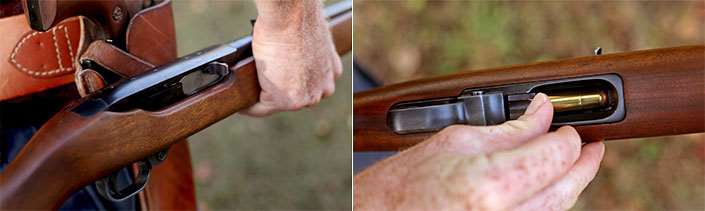
Though Ruger was a pioneer in the use of investment castings for the manufacture of firearms, he decided that it would take old-school machined steel to handle the power of the .44 Mag. Though a “pistol” cartridge, the .44 Mag. required a locked action in such a compact and lightweight package. The receiver of the 44 Carbine started as a solid block of steel that was machined into its final form into which the three lugs of the bolt locked. A short-stroke piston tapped gas off the barrel and pushed an action slide to the rear, which unlocked the bolt through a camming action. A recoil spring wrapped around the magazine tube closed the action. The finished product weighed only 6 lbs., and its 18.5" barrel kept its overall length to 37".
When the rifle was introduced in 1961, the company called it the “Deerstalker,” stamping the name on the receiver. The first factory-produced .44 Mag. rifle, it retailed for $108. Due to Ithaca using a similar name for one of its shotguns, the name was dropped and the rifle simply became the “Ruger Carbine.” As Ruger’s line of rifles expanded, collectors began to call it the “44 Carbine” or “Model 44.”
Ruger quickly expanded the 44 Carbine line. The “RS” model came equipped from the factory with an aperture rear sight and sling swivels, the “Sporter” featured a fancy Monte Carlo stock and the “International” established the Ruger tradition of making a rifle stocked to the muzzle in the Mannlicher style. In 1964, Ruger introduced a .22 version of the big .44, which it called the 10/22.
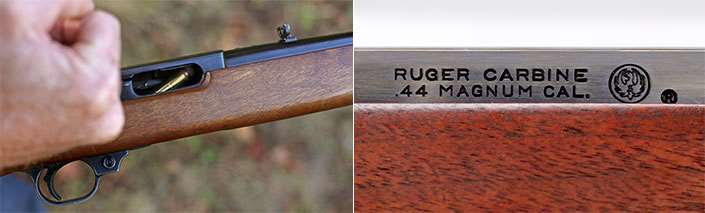
In 1985, the Ruger 44 Carbine was discontinued due to its high production cost after nearly a quarter million of the rifles had been made. When it comes to collectability, the earliest Deerstalker-marked carbines bring the highest premiums. Of the variants of the basic rifle the International version is the rarest, followed by the Sporter and the RS.
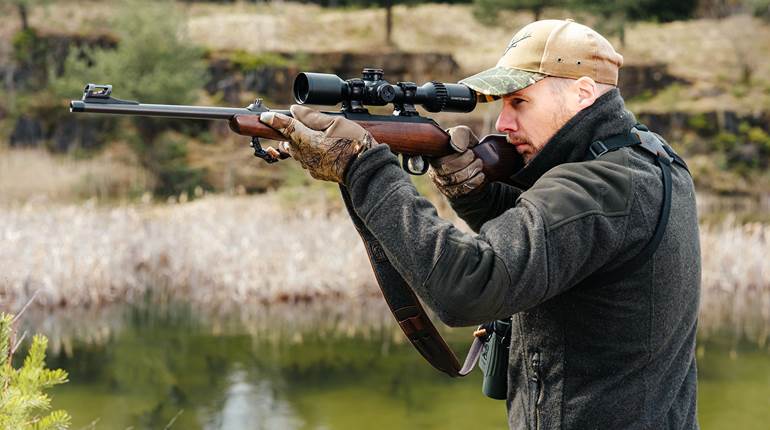
The example pictured is a standard 44 Carbine whose serial number indicates it was manufactured in 1963. It is in original condition, with the exception of a sling swivel hole added to the rear of the stock, and would be valued at around $600.
Fifty-six years after the 44 Carbine hit the market as Ruger’s first rifle, the company is the top firearm manufacturer in the country by volume and the nation’s second largest producer of rifles. That success was kicked off, in no small way, by the 44 Carbine. For collectors, it’s a piece of Sturm, Ruger & Co. history. For hunters looking for a light and handy carbine for medium-sized game at short to moderate ranges, the Ruger 44 Carbine is still hard to beat.
Gun: Ruger 44 Carbine
Manufacturer: Sturm, Ruger & Co.
Chambering: .44 Mag.
Manufactured: 1963
Condition: NRA Good (Modern Gun Standards)
Value: $600
Most Popular