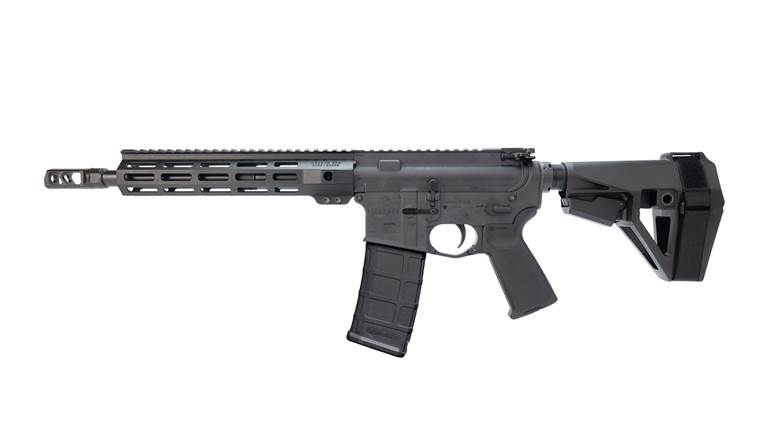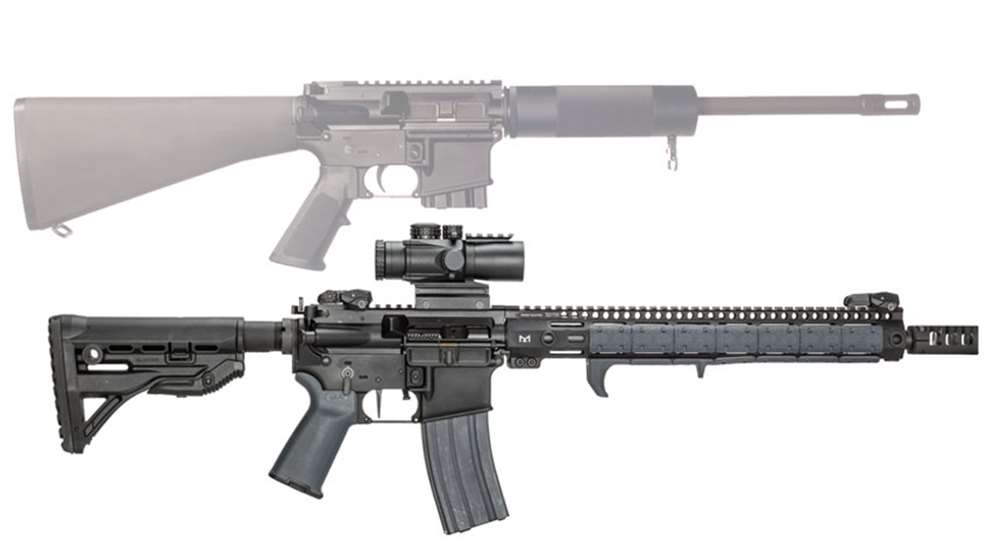
The 450 Bushmaster Carbine (above, top) in its factory form, is a semi-automatic AR design that uses a large .45-cal. bullet and produces recoil unlike that of the standard .223 Rem. Taming that recoil is what the author set out to accomplish (above, bottom) by simply replacing a few parts.
Bryce Towsley’s recent article concerning big-bore AR cartridges compelled me to tinker a bit more with my own, a 450 Bushmaster Carbine. I had previously changed-out the factory furniture and added a few accessories to make the rifle a bit more southpaw friendly, but nothing had been done yet to tame this Thumper’s heavy recoil—which seemed like a fun and appropriate project for this gun.
Now, .450 Bushmaster recoil is by no means punishing, but it is relatively stout compared to a .223 Rem.-chambered AR. A time-honored method of dampening recoil is to simply add weight, but as this 16" carbine was always intended to be lightweight and handy, I made it a point from the outset to cut the recoil without adding undue extra weight. And while the host gun for this project is a big-bore, the basic principles behind these modifications should apply to any AR-15.
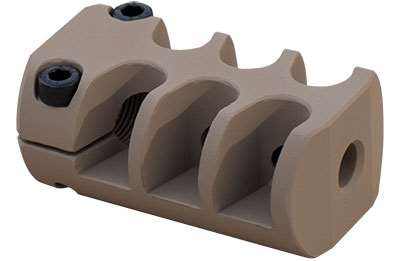
Starting from the front of the gun, I first replaced the flash hider with a more efficacious muzzle brake. There aren’t tons of big-bore muzzle device options on the market today, but Grizzly Gunworks offers several quality models in either thread-on or clamp-on configurations. Available in 7075 aluminum and 416 stainless steel, I selected a threaded, aluminum Defcon 1 brake (MSRP $200) for this project that weighed a scant 2.8 ozs.—only 0.4 ozs. more than the factory device. Lateral blast was, naturally, increased, but rearward push and muzzle rise were noticeably mitigated.
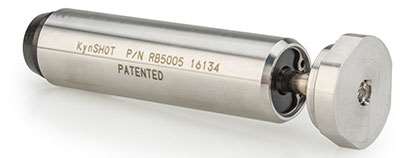
Next, I swapped out the factory buffer for a hydraulic replacement; I chose Kynshot’s RB5005 Marksman Recoil Buffer. Typical buffers use internal weights to slow the speed of the recoiling bolt carrier group, but hydraulic designs incorporate a piston that absorbs some of the energy before it can be transferred into the shooter’s shoulder. Built from corrosion-resistant 17-4 stainless steel, the RB5005 (MSRP $140) is designed for use with collapsible-stocked AR-10s, but is equally compatible with big-bore AR-15s. Installation was no different than with a standard buffer, and at 4.8 ozs., the hydraulic upgrade added only 1.8 ozs. to the weight of the rifle. Kynshot guarantees its product for 10 years or 1 million rounds.
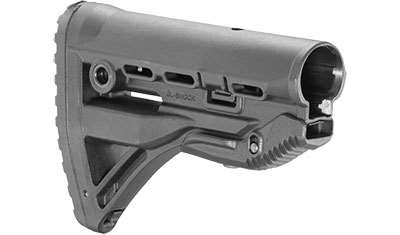
Finally, I replaced the aftermarket buttstock that I had previously installed on the rifle with a recoil-reducing replacement: the FAB Defense GL Shock. An internal chrome-silicon alloy spring absorbs a portion of the recoil before it reaches the operator. This collapsible buttstock also features two small watertight storage compartments and can be mounted to both mil-spec and commercial buffer tubes. The GL Shock (MSRP $110) weighs in at 10.6 ozs., only 0.9 ozs. more than the stock it replaced.
Each of these products individually is capable of producing a tangible impact on felt recoil—operating synergistically, the recoil reduction was substantial. The .450 Bushmaster’s recoil is often equated to that of a 20-ga. shotgun firing a target load, and prior to the modifications, I found that to be a pretty apt comparison.
With the above equipment installed, I would now characterize the recoil as being quite comparable to .30-30 Win. through an old lever-action—an impressive feat given how much more energy the .450 Bushmaster generates. Making this all the more satisfying is the fact that it was accomplished while adding less than 4 ozs. to the existing overall weight of the rifle.
Most shooters who press their big-bore ARs into practical use do so within the realm of hunting, and it is here that the value of these alterations really shines through. The ability to keep the gun’s sights on-target during firing was greatly improved, allowing follow-up shots to be made much more quickly. Reliability was not negatively impacted; the rifle ran 100 percent prior to these installs, and has run 100 percent since them.
Big-bore cartridges bring a lot more potency to the AR platform, but at the cost of controllability. However, with the right accessories and parts upgrades, we can take much of it back.
Most Popular