This article was originally published in American Rifleman, April 1946.
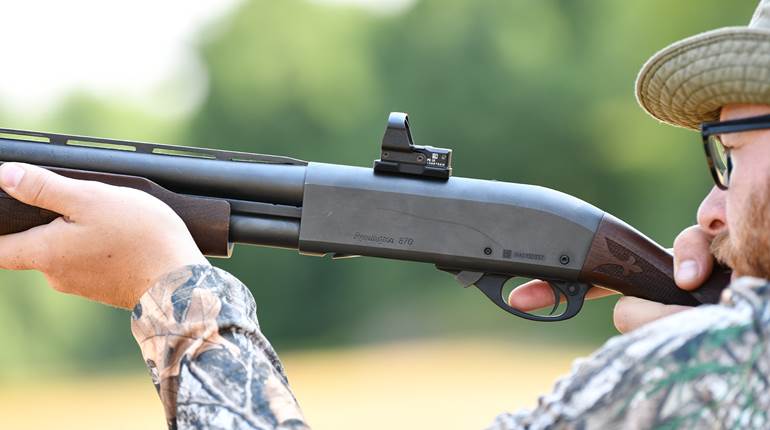
We have recently received some letters asking us about the Nydar reflector sight which is now appearing on the market. This optical sight is made by the Swain Nelson Company, of Glenview, Illinois.
At the present time the Nydar sight is being made for shotguns only, but the Swain Nelson representatives inform us that they plan to produce them for rifles and pistols as well. We hope to get a look at these two latter developments in the near future.
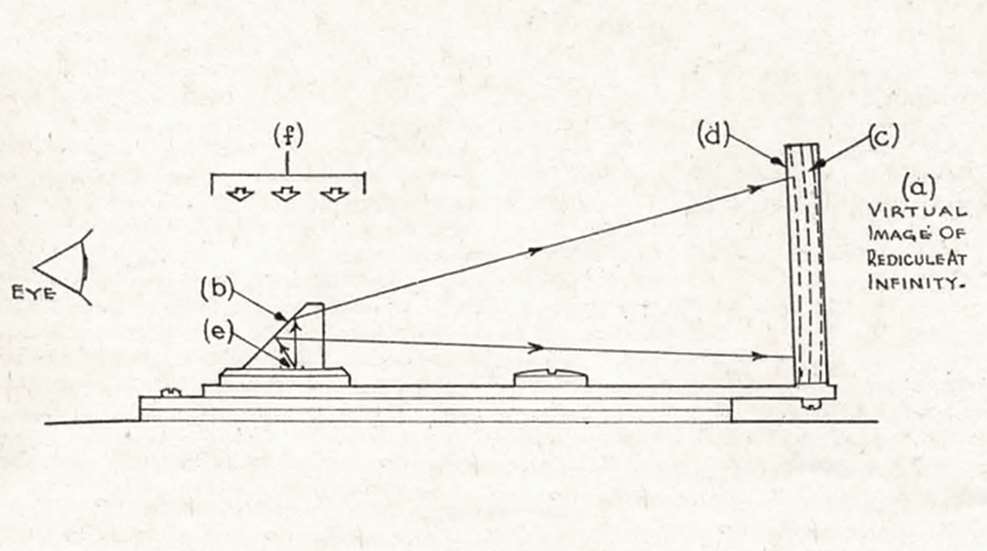
This sight makes use of a principle employed in some military sights and provides a sight picture for the shooter which is substantially the same as Army and Navy illuminated reflector sights. The sight picture is formed by means of a virtual image (a) of a dot centered in a circle. The dot and circle reticule are placed under the prism (b). A lens (c) is fixed in a strong ring (d). This lens is made by cementing two plain meniscus lenses together. An inner surface of one of these lenses has a transparent mirror coating. Thus, from the direction of the shooter's eye, a transparent convex mirror is formed in the lens. The reticule (e) is located at the focal length of this convex mirror so that the virtual image of the reticule is formed at infinity in the same sense that image of the reticule in a scope is formed at infinity because the light coming to the eye is in parallel lines.
To obtain a sight picture, you look over the prism and through the lens to focus your eye on the target. The reticule image, which is white, is clearly visible even against a bright sky when this same bright sky light intensity is illuminating the reticule under the prism. The illumination of the reticule comes from overhead (f) and visibility of the image is dependent upon relative light. It is therefore possible to use the sight under dawn and dusk conditions.
I used this sight at skeet and got a lot of shooting pleasure out of it. There is no difficulty in picking up the reticule image and the target through the large lens. It presents a beautiful sight picture, and it seems very easy to retain a mental picture of the position of the target in the sights at the time the gun is fired. This should be a great help to the man who is learning, or trying to iron out one of his most difficult angles. The seasoned shooter needs a few familiarization shots with this sight before getting down to serious business. He can't “cheek down” on the stock as far as he ordinarily will with the conventional sights. I had the trouble at first of looking square at the back of the prism when I brought my gun up.
For skeet or trap, I think this sight is fine. It is rugged enough to take plenty of punishment. I have seen it dropped from waist height to the floor without doing it any damage. When it comes to use in the field, I want to get the benefit of some experience before drawing any conclusions. I want to see how it will perform in a rain or light drizzle with the face of the prism having droplets of water on it. I am not satisfied that it will provide a clear reticule image in a covered blind where the overhead light is diminished. While standing in a room and sighting into the open light the reticule image is very dim.
Field trials during the hunting season with this sight alone will tell us the answers to these questions.
-E. B.
Most Popular