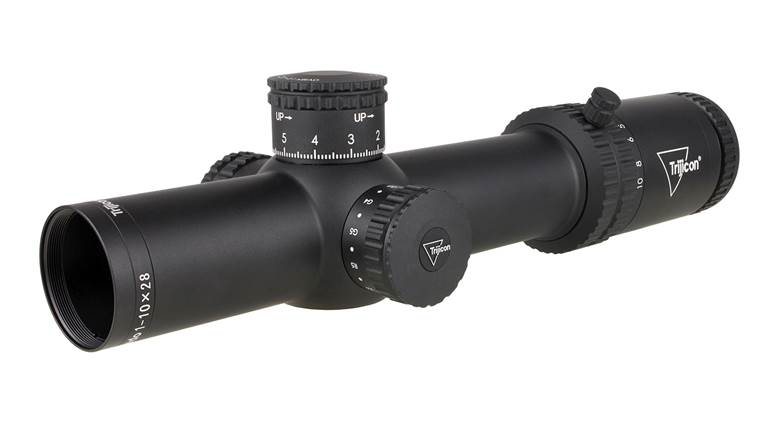
Trijicon is well-known to service men and women for its Advanced Combat Optical Gunsight (ACOG), which is fielded across the U.S. military. Another of the company’s U.S.-produced products, the Sealed Reflex Sight (SRS) reviewed here, benefits greatly from the trickle-down of its stable mate’s military-grade technology.
The SRS is a compact, red-dot sight conceived as a solution to what Trijicon describes as “tube effect,” or the visual occlusion of the shooter’s unaided field of view around the sight body, which can reduce situational awareness. It was also designed to be as small as possible. In addition, the SRS was designed to use the ubiquitous AA battery, augmented by a solar cell, to power its LED-generated, 1.75-m.o.a. dot reticle. Finally, the nitrogen-purged SRS was designed to be water-immersible to 165 feet.
The SRS’s housing is machined from a thick-walled aluminum forging. Its battery compartment cover is both knurled and slotted and is tethered to the sight with a small-gauge wire so as to preclude loss. The sight’s electronics use available current from the solar cell while the AA battery provides supplemental current to power the LED, which is adjustable through 10 settings. The solar cell significantly increases battery life during use in daylight. The LED will illuminate without a battery installed, but a battery must be present to power-up the sight initially. Battery life is said to be more than three years at setting “7” with a lithium battery at 70 degrees F.
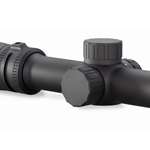
Flush-fitting dials on the housing’s left side and rear can be turned using a cartridge rim to adjust windage and elevation, respectively. Call-offs are laser-engraved in white on the sight’s housing. Rubberized touch pads located on the housing’s left and right sides feature molded-in “+” and “-” markings and increase or decrease reticle brightness, respectively, when used independently. In addition, pressing either turns the sight on and pressing both simultaneously for two seconds turns the sight off.
We field tested the SRS, mounted on a flat-top .223 Rem. DPMS AR-15, in Texas on an eradication exercise aimed at reducing the burgeoning hog and coyote population. Shooting from a helicopter at targets that were also in motion required an optic such as the SRS with its simple, easy-to-acquire reticle. The unit’s non-critical eye relief, and, therefore, mounting position, and its lack of parallax also proved important. Success resulted when the shooter simply placed the reticle at the appropriate area ahead of or behind the target and accounted for its and the aircraft’s speeds before firing.
After two days in the field, we noted no loss of zero even after rough handling. In addition, repeatability of adjustments was confirmed by shooting groups on paper targets at a range with the SRS mounted on a different .223 Rem.-cal. AR-15 rifle.
The Trijicon SRS is simple and robust and, because of its military-level quality, is priced accordingly. But the user who must have absolute confidence in a reflex sight will find the SRS to be an excellent choice.
Manufacturer: Trijicon, Inc.; (800) 338-0563; trijicon.com
Magnification And Objective: 1X 28 mm
Construction: forged and machined 7075-T6 aluminum housing
Finish: hard-anodized matte black
Field Of View (ft. at 100 yds.): 70
Adjustments: 75 m.o.a. (windage and elevation) in 1/2-m.o.a clicks
Reticle: 1.75-m.o.a. red dot
Length: 33⁄4"
Width: 2½"
Height: 27⁄8"
Weight: 13.8 ozs. (as tested with quick-release mount); 15.1 ozs. with thumb screw mount
Accessories: owner’s manual, one AA lithium battery
Suggested Retail Price: $1,050
Most Popular