4/30/2013
Everything’s come down to a moment. The unthinkable is now reality. You’re past the point of shoot/no-shoot. You’re about to use your firearm in a defensive situation against a lethal threat. Your objective is simple: stay alive.
For many, situations of heightened adrenaline reduce fine motor control. Minds race, hands tremble and shake, and most fall back on basic muscle memory and procedural recall. In short, developed habits fall back to default. This is why defensive schools teach simple movements, and stress continued training. Repeating a simple set of instructions and steps reduces the possibility that good ‘ole Mr. Murphy will show up to introduce us his inevitable. For this reason, it’s important not only to practice draw motions: clearing the holster, reloads, downrange assessments, but also to practice defensive accuracy.
In terms of defensive handgun shooting, it’s important to understand the differences between the words accuracy and precision. For your average everyday range trip, precision is what gets the blood pumping—watching as rounds strike repeatedly inside the centermost rings of a target is nothing short of wholly satisfying. In practicing for self-defense, accuracy is what should be valued, which can be simply defined as hitting your target. Whether in the X or hanging on to the edge of the seven ring, a shot on target is an accurate shot.
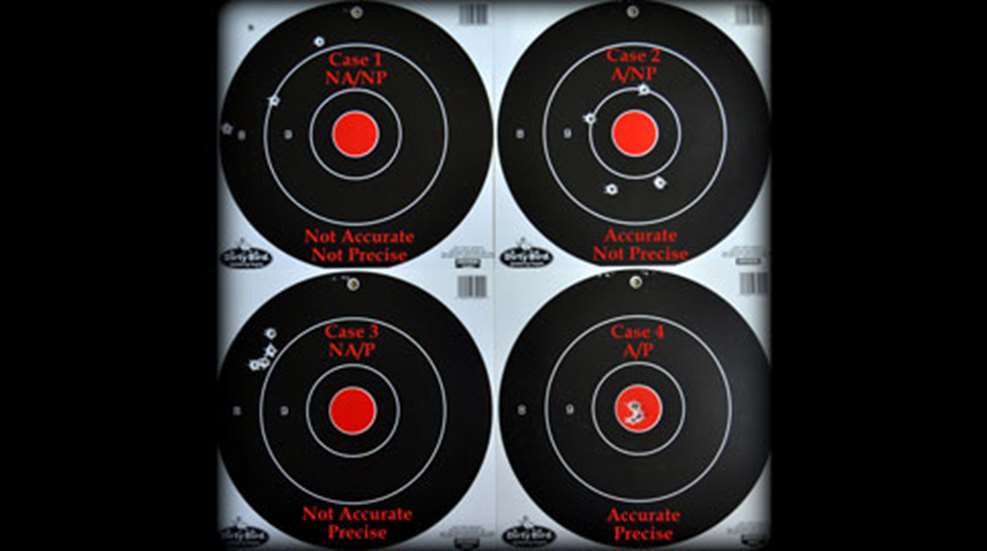
A competent illustration of the differences between the two terms can most readily be explained using an article on site-surveillance from the National Oceanic and Atmospheric Administration. Though not specifically written for the shooting community, the article Accuracy versus Precision uses the case of four shooters firing at four targets to discuss the relationship and relative importance of accuracy and precision.
In the first case, the shooter is neither accurate, nor precise (NA/NP)—the shot group is wide and off-center of the target. Case two illustrates a shooter who is not accurate, but precise (NA/P)—a tight shot grouping, off-center of the target. The third case shows a shooter who is accurate, but not precise (A/NP)—a wide shot grouping, but all strikes near-center of the target. The final case is a shooter who is both accurate and precise (A/P)—a very tight shot grouping, with hits very close to the center of the target.
Of these four cases, which is the most desirable in terms of defensive handgunning? Agreeably, all are more than satisfactory—all rounds remained on target and in all likelihood the threat would have been neutralized; but which shot dispersal would be the most ideal? The answer for defensive handgun use is simple—whichever results in the highest number of hits in the shortest period of time. For most, this is reflected in the results from the third case (A/NP) of the NOAA example, where the shooter is accurate but not precise.
Precision in shooting typically takes a greater amount of time to accomplish, a proper sight picture, smooth trigger squeeze and repeatable follow-through. Precise accuracy requires an even greater amount of time and practice to repeat reliably. It also relies heavily on a shooter’s fine motor skills. While excellent for the range, precision shooting isn’t exactly ideal in a defensive situation. This is where accuracy comes into play.
Relative accuracy can be trained easily, and is even possible without the use of sights. The term “point-shooting,” synonymous with “threat focused shooting” has evolved to encompass a shooting style that relies not on a firearm’s sights, but rather on the shooter’s instinctive reactions. It’s a fancy, dressed-up way of talking about hand-eye coordination. The theory is that where the eye looks, the hand follows. Carry this over to defensive hangunning and you have a situation where the muzzle of your firearm points relatively close to where the eye is trained. The result at combat ranges is that a shooter is able to accurately place rounds on target in a very short period of time.
The U.S. Army Field Manual 23-25 Combat Training with Pistols and Revolvers, Chapter 2, Section II, paragraph 3, has this to say regarding the subject:
“When a soldier points, he instinctively points at the feature on the object on which his eyes are focused. An impulse from the brain causes the arm and hand to stop when the finger reaches the proper position. When the eyes are shifted to a new object or feature, the finger, hand, and arm also shift to this point. It is this inherent trait that can be used by the soldier to rapidly and accurately engage targets.”
Though the above is directly geared toward a soldier in a combat situation, the same can be applied to defensive handgun use. Point shooting is a reliable shooting method for defensive situations where the threat is at close range, and rapid, accurate engagement of the target is needed.
So where can practical defensive handgun marksmanship be learned? In an ideal world, at one of the myriad of firearms training schools and academies spread all over the world, with multiple training sessions under the guidance of seasoned firearms instructors over a period of years. Unfortunately for most, this level of training isn’t a realistic option. In practical terms, a basic understanding and application can be easily achieved at the local shooting range.
In training, keep your targets at 21 feet or under, as years of FBI Crime Reports on handgun use have found that the typical gunfight happens within these ranges. Practice snap-shots, firing the first shot as soon as the muzzle is on target. This may occur at any time between when the pistol exits the holster and is fully presented on the target—you’ll be surprised at how fast you can get your first round off, and at how accurate your hand-eye coordination will prove to be. Practice follow-up shots, taking the second and third shots as soon as the muzzle comes back on target after the previous shot’s recoil. Start slowly, with two or three rounds, and increase the number of rounds as reliability and repeatability increase.
While not as visually impressive as an entire course of fire remaining inside the nine-ring, an afternoon spent practicing this basic theory of marksmanship can greatly increase not only confidence in the ability to carry and handle a firearm, but also competence as a handgunner.
Most Popular