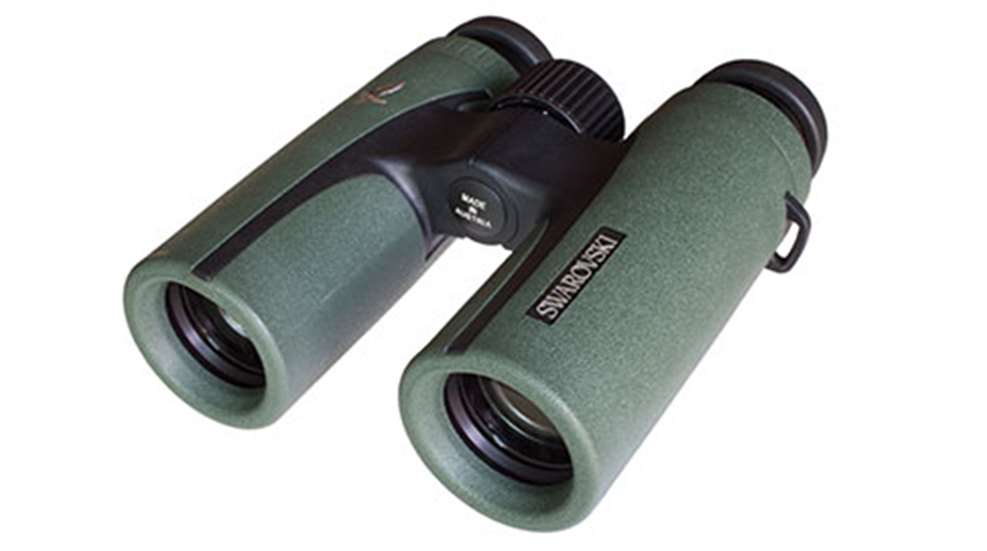
Optics companies are secretive when it comes to the formulas for their lens coatings. We’ll never know the precise mix Austrian maker Swarovski puts into and onto the lens surfaces of its CL Companion 8X 30 mm binocular, but it is undeniably effective.
Although retired from service in 2006, the 1951 U.S. Air Force resolution chart provides a baseline for evaluating optical performance and clarity. From a sandbag rest the Swarovski was clear and countable to the -1 group, element 5 in bright light. An 8X 42 mm binocular used for comparison produced an identical result, as did a less-expensive 10X 42 mm.
It wasn’t until the chart was in the shade that the difference in glass and coatings really started to shine. The other 8X binocular reading dropped off to element 4, and although the 10X kept pace with the Swarovski, the latter’s image was much more crisp. With an orange-colored gel over the chart in sunlight, all three readings were identical. But, the CL Companion claimed top honors handily when the elements were changed to purple, green and blue-the latter two being critical for hunting.
The Swarovski’s 30 mm objective lens can’t defy physics and collect as much light as the less-expensive 42 mm models used for comparison, but biology, glass and coatings level the playing field. The Companion’s exit pupil diameter of 3.8 mm may seem nominal (a middle-aged man can process about 5 mm worth), but the binocular was noticeably brighter in diminished light and its ability to resolve the tiniest of details put the others to shame. It may lack the famed fluoride HD glass of its bigger EL Series brother, but the headache-free image is tack-sharp, edge to edge, and no chromatic aberration was observed.
The binocular is nitrogen-filled and rated as being submersible to 13 ft. of water, so it didn’t come as a surprise that nothing leaked after a two-hour soaking, complete with ice cubes. It didn’t fog when removed from the water bath in an air-conditioned room; but when introduced to 87º F. and 58 percent humidity, moisture condensed on its external surfaces-a natural reaction. Unlike some other high-priced gas-purged optics that have been subjected to the same test, though, the lenses wiped clean instantly and easily, rendering the Swarovski fully functional.
Field of view at 1,000 yds. is 372 ft. and it can focus on objects as close as 9.8 ft. The CL Companion 8X 30 mm weighs only 17.6 ozs. (sans strap and provided lens covers) and measures 4.7"x4.5"x2.3". Part of the weight savings is found in the single hinge instead of the pricier EL Series’ pair. Add a limited-lifetime warranty on optical components with a 10-year guarantee on mechanics, and it’s finally possible for most shooters to savor Swarovski’s heralded optical quality without breaking the bank.
Technical Specifications:
Importer: Swarovski Optik
Magnification and Objective: 8X 30 mm
Type: roof-prism binocular
Finish: black, green or sandbrown
Eye Relief: 15 mm
Exit Pupil Diameter: 3.8 mm
Field of View: 372 ft. at 1,000 yds.
Height: 2.3"
Length: 4.7"
Width: 4.5"
Weight: 17.6 ozs.
Suggested Retail Price: $1,054
Most Popular