From the June, 1944 issue of American Rifleman
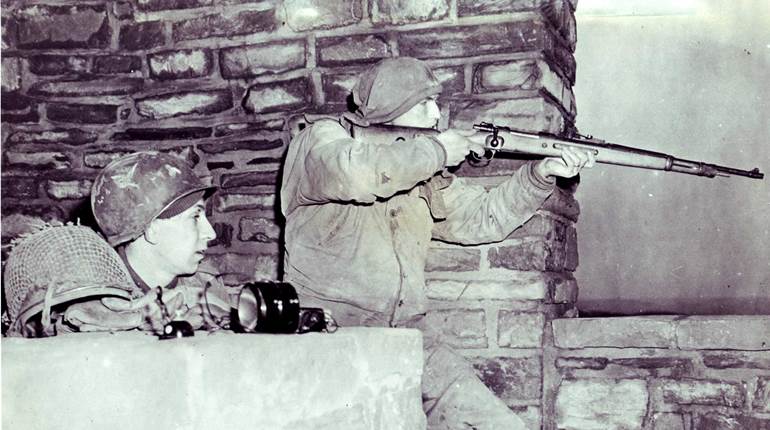
In peacetime, when we talk of rifle shooting and rifle training and rifle competition, the general public thinks it’s just the hobby of a few; a small-time sport. Even in wartime, it takes time and battle experience to get down to the fundamentals. But now, just as in World War I, we’re learning that riflemen count, and that too much emphasis cannot be placed on their training. For battle riflemen aren’t made in a day, nor even in a few weeks on the range.
Here are some stories you haven’t seen in your daily papers—because these men are not heroes; they’re just good all-around riflemen:
On Mt. Castellone, one day in February, a two-hour Boche barrage heralded an attack by two German battalions on a ridge held by one platoon of one company of one battalion of the 36th Division. Two platoons were sent up to help meet that attack: less than a Company, riflemen, with a few ’03 grenade launchers and a supply of grenades for close quarters—against two well-armed German battalions.
Platoon Sergeant H.C. Pruett, of Brownwood, Texas, was in charge of one of those two supporting platoons. The first platoon was already engaged when Pruett arrived. The Jerries had some four hundred yards to cover. Pruett threw his men into the fight as riflemen, in the prone or kneeling position according to each man’s locations. As riflemen, they started picking off Germans. The Boche were coming on in groups of three or four, running, ducking, hitting cover, rising to charge again. Pruett himself knocked down seven out of five different groups, getting one and sometimes two as each group made its short rush forward.
“The guys all around me were doing the same,” Pruett says. “We made ‘em pay for that yardage! But a few finally got up to within about fifty yards of us and we started heavin’ hand grenades. That was a hot spot for Pruett and he was thankful the ‘03’s would still work, for their rifle grenades were effective. “Must have had too much oil on the M1’s,” he suggested. But he had some very definite opinions about marksmanship! “It pays off,” he said. “Every man ought to know his rifle, and how to shoot it. Hunting, back home, helped me. I’ve heard a lot of fellows say the same.”
Sgt. J.B. Johnson of Gustine, Texas, put the whole story of marksmanship in a few words when he said, “I don’t want a fellow around me that can’t shoot! He’s no help, and he’s just usin’ up ammunition—which, around these mountains, you can’t carry enough of, or get more!”
Yes, it pays. One hundred and thirty-two dead Germans were found in front of that ridge position. In the three defending platoons, only three men were hit with small-arms fire.
Most Popular