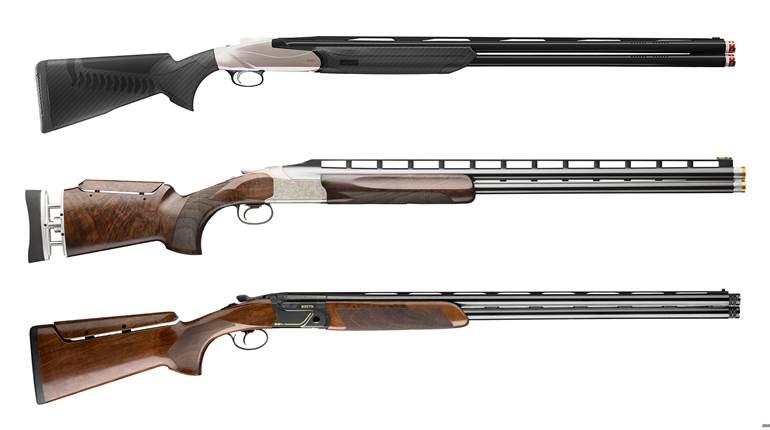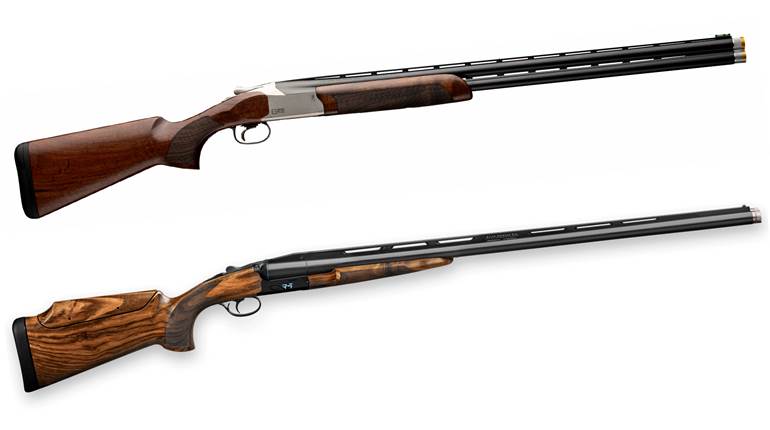
Although the basic concept of an over-under shotgun dates to swivel-breech muzzleloaders, and guns such as the Boss preceded it, the modern stackbarrel smoothbore was born in 1923 when John M. Browning received two patents for an innovative shotgun configuration. Rather than position twin barrels alongside each other, as was common with double guns, Browning stacked the tubes. Browning called his new design the Superposed. It would become the world’s first commercially successful over-under shotgun.
Unfortunately, it would also be the last gun Browning designed. On Nov. 26, 1926, the inventor died of a heart attack while working on the Superposed in his son Val Browning’s office at the Fabrique Nationale factory in Liège, Belgium. It fell upon Val, a brilliant firearm inventor in his own right, to make his father’s sophisticated design a reality.
Even though FN’s Superposed was mass-produced, the labor-intensive gun was comprised of more than 70 individual parts and required 155 hand-fitted assemblies, plus the artistry of engravers and woodcarvers. The Superposed was launched in 1928 with a price of $107.50. The guns initially had double triggers, but in 1933 Val invented a Twin Single Trigger that alternately fired the barrels by either the front or back trigger. This was replaced by a single trigger with a tang-mounted barrel selector in 1939. The gun was first offered in 12 gauge, and 20 and 28 gauges were soon added. Later a .410-bore model was introduced. There was no 16 gauge. Each chambering had its own serial number range.
The Superposed was a spectacular shotgun made in escalating levels with Grades I through VI, primarily reflecting external embellishments. In the 1960s classifications were changed to Grade 1 and post-war epithets of Pigeon, Pointer, Diana and Midas. S.P. Fjestad’s “Blue Book of Gun Values” lists more than 50 variations. Since 2001 the Superposed has been designated as B-125 and B-25 bespoke guns from the FN Browning Custom Shop in Liège.
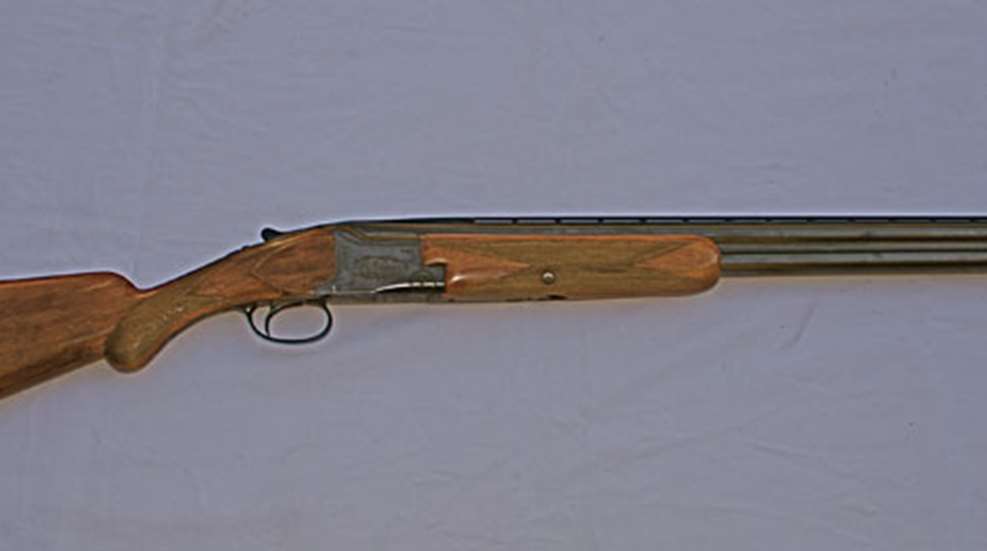
The 12-ga. Superposed Grade I shown here was made in 1952 and purchased by the current owner in 1991 for $800. It is in NRA Excellent condition, retaining its original horn buttplate, crisp hand checkering and engraving. As such, Fjestad’s “Blue Book” values it at $1,825 —a virtual bargain compared to the cost of ordering such a gun today.
Gun: Browning Superposed Grade I
Gauge: 12
Condition: 98 percent, NRA Excellent (Modern)
Serial No: 27XXX
Manufactured: 1952
Value: $1,825
Most Popular