Several years ago, LaserMax staked a claim to a large share of the gun-mounted laser business by incorporating a laser module into an aftermarket recoil spring guide. That meant that the laser remained naturally aligned with the bore and also that the exterior dimensions of the firearm were not altered, meaning the gun would still fit in standard holsters.
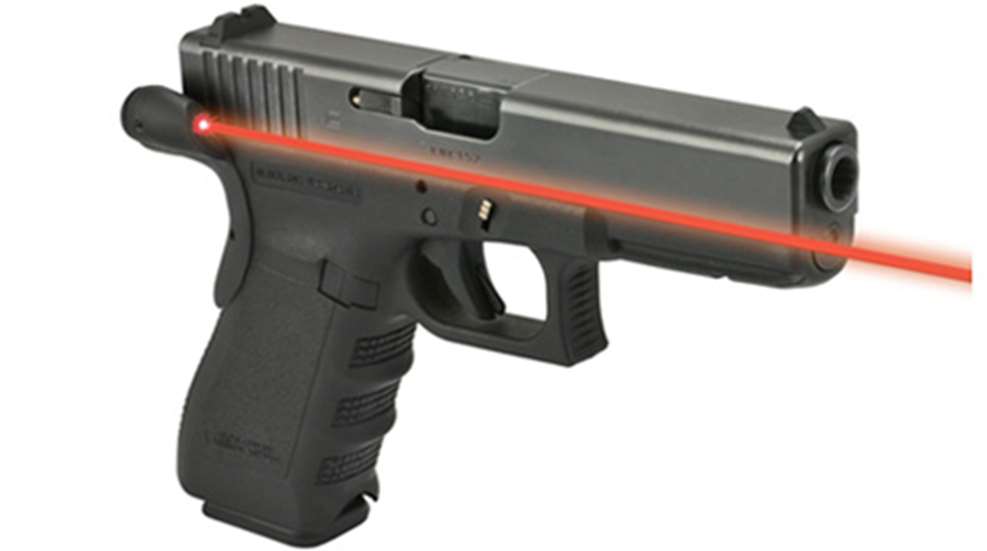
The company though made a marked departure from that concept with the Sabre. The LaserMax Sabre is an external add-on device that attaches to the backstrap. The unit is in the form of a beavertail with the laser module extending forward from the right side of the tang. Unlike previous LaserMax units that were activated by manipulating replacement disassembly levers, the Sabre has a pressure-sensitive activation switch positioned beneath the web of the shooting hand.
It is very clearly aimed at a competitor’s similar design. The question is whether such was necessary, given the considerable virtues of LaserMax’s original design concept.
The Sabre is available for full and compact Glock pistols, but not subcompacts. Installation cannot be simpler. Drive out the stock roll pin with the included punch. Place the Sabre in position, then drive in the longer, included roll pin.
The beavertail orients your hand quickly and is comfortable. Moreover, it helps distribute some of the felt recoil impulse and seems to help get the gun back on target quicker. That is significant, given the muzzle rise typical of .40 S&W pistols.
Previous LaserMax offerings require a conscious act to switch on the laser. In the case of the Glock models, you press in the disassembly lever from one side with your trigger finger or push it in from the opposite side with your thumb. It’s easy, yes, but you have to remember to do it. The Sabre, though (with the master switch set to “on”), activates whenever you take a firing hold on the gun. There’s nothing to remember and no fine motor skills to fail under stress.
LaserMax’s beam has always been distinguished by its rapid pulsing. The company claims that the blinking draws your eye to it and, indeed, it did get attention. The Sabre, however, offers shooters a choice. A three-position master switch at the extreme end of the beavertail gives the shooter a choice of pulsating beam, constant beam or “off.”
The laser module is mounted high on the right side as not to interfere with trigger finger placement in the ready position alongside the frame. However, this does not assure automatic alignment with the bore the way the recoil guide rod model does. LaserMax has therefore made the Sabre fully adjustable for windage and elevation. Adjustments are made with the included allen wrench.
Maintaining alignment is eased by the fact that the Sabre never has to be removed to install fresh batteries. The two cells fit into the tang of the beavertail and are replaced with the Sabre still mounted.
Shooting with the Sabre in place was fast and accurate, with the beam bright and eye-catching in either mode, but particularly when pulsing. The beavertail did a nice job of limiting muzzle rise. Activation was effortless and the master switch performed as designed. There were no malfunctions of any kind and the unit held zero rather impressively, despite some hard-kicking loads.
However, there were two problems typical of designs of this type.
The Sabre is about 1-5/8 inches wide. That doesn’t sound very big, but it represents an approximately 63 percent increase in the width of the gun measured at the slide. Under a loose jacket, it’s not an issue. But if you typically conceal your carry gun with an untucked T-shirt, that module is going to protrude.
Also, if you use a holster with a thumbsnap, be it a belt holster or shoulder rig, know that the Sabre-equipped pistol will no longer fit.
LaserMax’s Sabre offers several nice features, such as easy installation, automatic activation, a choice of beam modes, full adjustability, simple battery replacement and good ergonomics. However, its biggest challenge would seem to come from the company’s own earlier design. The Sabre sacrifices the earlier model’s fixed alignment with the bore, holster compatibility and maintenance of the gun’s original dimensions and appearance.
While I still prefer the company’s original design, the Sabre gives LaserMax customers the option of choosing between two good, but very different systems while staying within the same brand.
Manufacturer: LaserMax; 800-527-3703; www.lasermax.com
Weight: less than 1 oz.
Wavelength: 635 nm (red-orange)
Power Output: 5mW
Battery Type: 357 silver oxide (two included)
Windage/Elevation: fully adjustable
Suggested Retail Price: $219.00
Most Popular