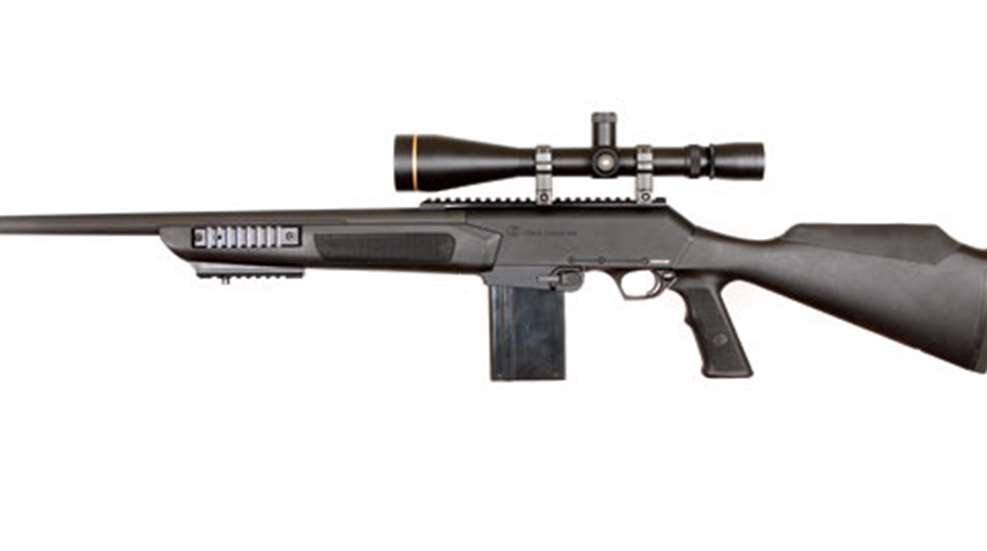
The FNAR is a gas-operated semi-automatic .308 Win. tactical rifle based on Browning’s BAR ShortTrac semi-automatic rifle. Designed to be a short- to medium-range rifle, the FNAR is available in both light- and heavy-barrel variants, the latter being about a pound heavier than the former. All models accept proprietary FN 10- and 20-round magazines.
A simple philosophy guided the development of the FNAR: to provide autoloading speed along with bolt-action accuracy. The FNAR is guaranteed to group into 1 m.o.a. or less with the proper ammunition. Contributing to this is the rifle’s 20-inch chrome-molybdenum steel barrel, with cold-hammer-forged rifling in a 1:12-inch four-groove, right-hand twist. Both bore and chamber are hard-chromed for durability. The chamber is cut to SAAMI specifications for the commercial .308 Win., but is also optimized for the use of 7.62x51 mm NATO ammunition as well. The muzzle has a recessed, target-style crown. The chamber end of the barrel terminates in an integral extension that is clamped firmly in the receiver ring and contains recesses for the bolt head’s locking lugs. Both the light- and heavy profile barrels have six flutes and a matte black finish. The split-ring clamping system that retains the barrel in the receiver allows for a solid barrel/receiver joint and facilitates barrel changes by armorers.
The FNAR’s gas system is essentially the same as that of the BAR. Propellant gas is bled from a port in the barrel about 9¼-inches forward of the receiver ring, and enters the gas cylinder affixed to the underside of the barrel inside the fore-end. The gas impels the gas piston assembly 3/8-inch to the rear, which, in turn, pushes on the inertia block and action bars, which run into the receiver to connect to the bolt carrier. As the carrier moves rearward, the bolt head is cammed counterclockwise until its lugs unlock from the barrel extension, the empty case is extracted and ejected, the action spring beneath the barrel is compressed, and the hammer is cocked. Returning forward, the bolt and carrier strip the top round from the magazine and feed it into the chamber, and the bolt head enters the barrel extension and rotates clockwise to lock the action.
A novel feature of the FNAR is the bolt-forward indicator, a red dot on the bottom edge of the ejection port that is visible only when the bolt is fully forward and locked into the barrel extension.
The trigger group is retained in the receiver by two crosspins. The two-stage trigger is factory-set from 3.25 pounds to 5.5 pounds, and is not user-adjustable. Just rearward of the trigger guard is a crossbolt safety that, when engaged, locks the trigger. The safety can be reversed for left-handed shooters.
Forward of the trigger group is the generous beveled magazine well, a separate piece attached to the underside of the receiver. Release of the FNAR’s magazine is by way of ambidextrous checkered buttons at the rear of the well.
In order to meet the minimum factory standard of 10,000 rounds with no breakages, every major component and system of the FNAR was designed to be stronger and more durable than its counterpart on the BAR.
Law enforcement input in the development of the FNAR is evident in the 9¾-inch-long Picatinny rail atop the receiver, as well as in the gun’s non-reflective black synthetic stock. The fore-end features three 4 3/8-inch-long Picatinny rail sections, with the bottom rail having a stud for sling or bipod attachment.
We obtained an FNAR heavy-barrel rifle with a steel 20-round magazine. We opted to keep the factory-mounted cheekpiece and buttpad units, and installed a Leupold VX-III 8.5-25x50 mm scope on the gun using Leupold rings.
Support was provided by a Harris S-type bipod with Pod-Loc in front, and a Triad Tactical poly-filled bag in the rear. Testing was conducted at 100 yards using American Eagle, Federal and Hornady loads.
The best accuracy was obtained with the Federal Gold Medal match load, which featured Sierra’s 155-gr. MatchKing bullet. Five-shot groups with this load averaged 0.83 inches—vindicating the factory’s 1-m.o.a. accuracy guarantee. Performance averaged slightly more than an inch—impressive results for a short-barreled, relatively light .308 Win. semi-automatic rifle. The 20-inch barrel delivered velocity sufficient to ensure supersonic bullet flight out to the rifle’s practical range of 600 yards with all of the loads we tested.
No malfunctions of any kind were observed during our 100-round-plus test session. Recoil with all loads was mild, thanks largely to the semi-automatic action. In addition to testing from the bench, we also shot from the prone and supported standing (barricade) positions.
We found little we’d improve on the FNAR. We liked the bilaterally actuated magazine release, but it is not as conveniently located in relation to the trigger finger as in the AR-10-class of rifles. Also, the trigger on our sample gun could have been crisper.
The FNAR is an accurate and reliable semi-automatic rifle well suited for applications that require both accuracy and fast follow-up shots.
Importer: FNH USA; (703) 288-1292; Fnhusa.com
Caliber: 7.62X51 mm NATO/ .308 Win.
Action Type: Gas-operated semi-automatic rifle
Receiver: 7075 T6 aluminum, black anodized
Barrel: 20", chrome-moly steel, chrome-lined, fluted
Rifling: Four-groove, 1:12" right-hand twist
Magazine: 10- or 20-round detachable box
Sights: None supplied; 9¾" Picatinny rail for scope mounting
Trigger Pull: Two-stage, 4 lbs. 11-ozs.
Stock: (with neutral shim installed) length of pull, 137⁄8"; drop at heel, 2"; drop at front of comb (medium cheekpiece installed), 11⁄16"; drop at rear of comb (medium cheekpiece installed), 11⁄8"
Overall Length: 41¼" (1/2" buttpad)
Weight: 9 lbs. 11 ozs. (with 20-round steel box magazine)
Accessories: Extra magazine, Versa-Pod bipod, extra cheekpieces, shims and buttpads, owner’s manual, plastic case
Suggested Retail Price: $1,821
Most Popular