Countless firearm manufacturers are making AR-15-style rifles, and for good reason. Almost every gun owner who doesn’t have one wants one; and almost everyone who has one wants another one—or more. As a result, manufacturers large and small have back orders that stretch into next year and I don’t have to tell anyone who reads this magazine that gun stores can’t keep them in stock even when they are priced well above the MSRP.
Years ago, when I answered “Dope Bag” letters, one of the most frequent questions we received was “How can I improve the accuracy of my Mini-14?” I always offered Accuracy Systems as an excellent source for this type of work, but it was difficult to restrain myself from advising, “If you want an accurate semi-automatic rifle or carbine in .223 Rem., why not buy an AR-15. They’ll shoot 1 1/2 m.o.a. out of the box with match or varmint loads, and most of them will shoot much better than that.”
I am always pleased when a fellow shooting enthusiast recognizes the capability and utility inherent to the AR-15 design. And I am especially thrilled when a manufacturer like Ruger so clearly sees the light and warmly embraces the AR-15 platform as it has with its new SR-556. Like Jesus of Nazareth, I’ll take all converts and welcome them to the fold, no matter whether they join the flock at dawn, at midday or at dusk. In the past, Ruger has seemingly been embarrassed by the success of its semi-automatic rifles. Only in the past few years has Ruger taken steps to improve the accuracy and utility of its most popular semi-automatic rifle, the Mini-14.
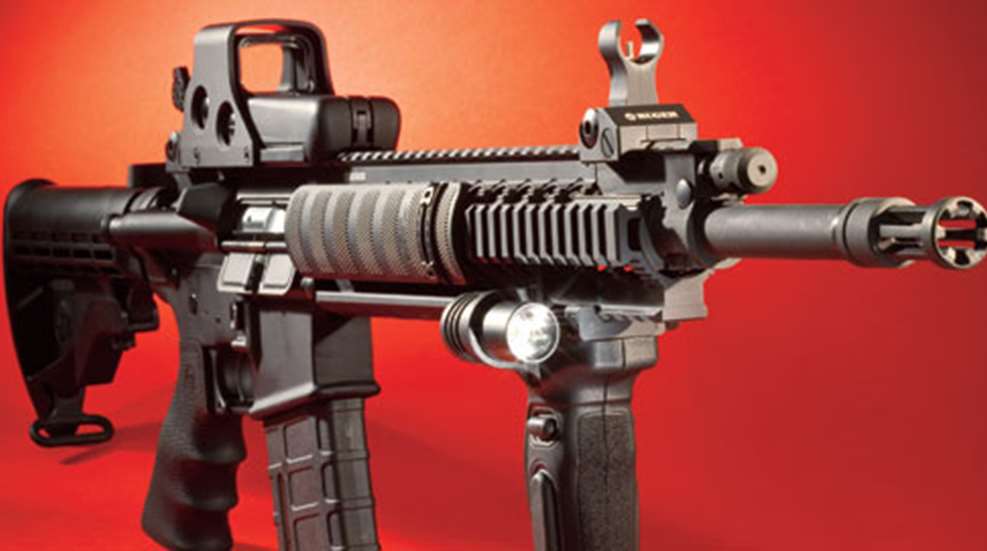
With the SR-556, Ruger has taken a bold leap into the pool. One look at the gun and you can see that Ruger makes no apologies for the SR-556. It is what it appears to be: a semi-automatic rifle in .223 Rem. that accepts standard, AR-15 30-round detachable magazines. More than that, it has all of the bells and whistles we associate with a top-of-the-line gun, including a six-position, M4-style collapsible stock, a quad-Picatinny rail, fold down iron sights and of course, a muzzle brake.
But with this gun Ruger has designed and built more than just another tricked-out AR-15-style rifle. For its SR-556, Ruger dispensed with the standard direct-gas-impingement operating system of the AR-15 built around a gas tube and developed a short-stroke piston system of its own design. Piston guns are in many ways a microcosm of the broader market for AR-15-style rifles. Even though they are expensive, suppliers can’t keep up with demand. Piston guns are rapidly growing in popularity, either as complete guns or as conversion kits, because they offer the promise of a gun that is less prone to carbon build-up in the receiver and hence more reliable.
In reality, piston guns certainly run cleaner and cooler, but their superiority in terms of more reliable operation remains unproven. That a gun with a piston-based operating system should have better potential reliability than one built around a gas tube that dumps carbon directly into the bolt carrier seems to be self-evident. Generally, that may be true, but when you replace the AR-15’s gas tube with a piston without a lot of testing and development, you can create more problems than you solve.
The trouble centers around the AR-15’s bolt. Its weight and other design elements are optimized for best reliability in combination with a gas tube. If energy is transferred to the bolt indirectly by means of a piston or tappet rod rather than directly through a gas tube, the weight of those components can rob the bolt of the energy necessary to cycle reliably. That is not to say that a piston AR can’t work, just that converting an AR into a piston gun is a lot tougher than it looks....
Most Popular