The United States military entered the percussion era pretty early with the 1833 introduction of a caplock, breechloading carbine based on the Model 1819 Hall Flintlock rifle—an issue longarm manufactured variously by Simeon North and Harper’s Ferry up to 1840. The 1819 had the distinction of being the first military breechloader to be adopted by the U.S. government.
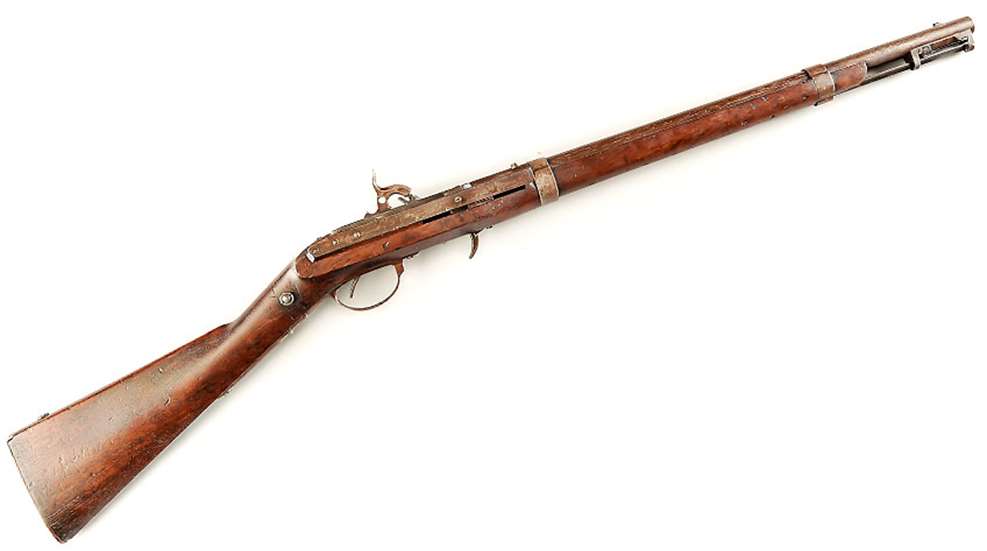
Designed by John H. Hall, its works were fairly simple, based on a rising block hinged at the lower, rear that was released and then held in place by a simple curved catch on the underside of the stock, just forward of the trigger guard.
The firing mechanism was wholly contained within the breechblock, making it easy to dismount, clean and service. To load, a soldier had merely to push rearward on the catch, pop the breechblock open to load using a paper cartridge containing powder and ball, and prime. To ready the rifle for firing, the block was snapped shut and the action put on full cock.
Even though the operation of the mechanism necessitated a gap between the block and barrel, leakage, though noticeable, was certainly not odious enough in good-condition arms to cause distress to the shooter.
Hall’s rifle could be loaded considerably faster than a standard muzzleloading smoothbore musket or a rifle. Though the 1819 Hall was never general-issue, it did see service with specialty troops.
Ordnance types were so impressed with the system they decided it would be just the ticket to incorporate in a cavalry carbine. Accordingly, in 1833, a percussion smoothbore—the U.S. military’s first—was adopted.
The gun was offered in both .52 and .579 calibers. Bowing to the needs of mounted troops, the carbine’s overall length was considerably shorter than that of the rifle, and it was equipped with a sling bar and ring.
Curiously, authorities felt an integral sliding bayonet would also be a good idea, so the arm was fitted with a 24¼"-long, under-barrel triangular blade, which could also be removed and used as a cleaning rod. As well, a compartment for a combination tool and wiper was set into the stock behind the trigger guard.
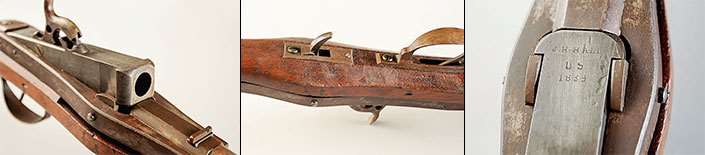
The ‘33 received good marks from its users, but it was felt a few changes were needed; thus, the Model 1836 made its appearance. Overall, it looked much like the 1833, though the caliber was increased to a 0.64" musket bore, and the sling ring and bar were removed and re-sited to the wrist of the stock in the guise of a simple turning eye-bolt.
The hammer had a hole drilled into its midpoint that held a jig during manufacturing. Initially, “Type I” ’36s had an implement compartment, though, for economy, it was eliminated after about 1,000 carbines were built, resulting in the Type II. Finish involved a brown lacquered barrel and fittings and a casehardened breechblock.
Some 2,020 Model 1836 Halls were built between 1837 and 1840. They saw service with the 2nd U.S. Dragoons during the Second Seminole War in Florida (1835-1842). Today, Model 1836s are generally found in better condition than 1833s, indicating their use was probably more limited than that of their predecessors.
The Type II we’re looking at here is a typical example of those usually encountered. It retains about 50 percent of its barrel lacquer, exhibits traces of casehardening, and maintains a pristine bore. As such, value would be $3,250.
Gun: Model 1836 Hall Carbine (Type II)
Manufacturer: Harpers Ferry Armory
Caliber: .64
Manufactured: 1839
Condition: NRA Fine (Antique Gun Standards)
Value: $3,250
Most Popular