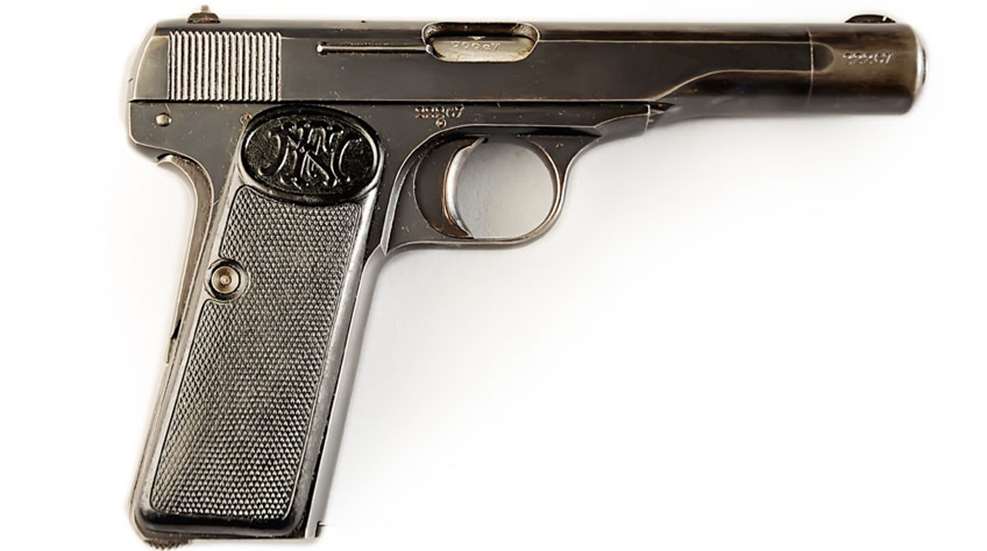
Sarajevo, Bosnia, June 28, 1914: Following a botched assassination attempt earlier in the day, the heir to the Austro-Hungarian throne, Franz Ferdinand, insisted on continuing with his official visit. After leaving the town hall, he decided to visit the hospital where the men wounded in the earlier grenade attack were being treated. Leaving the hospital, the archduke’s driver lost his way and drove down a wrong street, unfortunately where one of the attempted assassins, Bosnian nationalist Gavrilo Princip, was standing outside a café. Realizing his good fortune, Princip quickly drew his Model 1910 FN Browning pocket pistol chambered in 9 mm Kurz (.380 ACP) and fired twice at Franz Ferdinand and his wife Sophie, mortally wounding them. These were conceivably the two deadliest shots in history, as the couple’s death was the dramatic spark that touched off World War I.
As its name implies, the supremely efficient FN Browning Model 1910 and its offshoot, the Model 1922 (aka “10/22”), were designed by firearm marvel John Moses Browning and built in Belgium at Fabrique Nationale. It was a sleek, modern-looking blowback, marrying Browning’s earlier striker-fired mechanism to an arrangement in which the recoil spring surrounded the barrel. A slotted extension at the front of the slide secured the assembly, and a small serrated catch allowed for fieldstripping. Chamberings were .32 ACP and .380 ACP. The gun had grip, magazine and manual safeties.
Measuring but 6" overall in length and weighing just under 1 lb., 8 ozs., this semi-automatic became an instant hit, enjoying brisk civilian and police sales—though military interest in the piece was lukewarm at best.
Things changed in 1922 when the gun was revamped by increasing the 1910’s 3½" barrel length by an inch, which also required changes to the slide and slide extension. Later, the grip was extended to accommodate a magazine of greater capacity, increasing the original 1910’s capacity of seven shots of .32 ACP and six shots of .380 ACP by two rounds each.
Initially adopted by the Yugoslavian military (which was the prime mover in the gun’s alterations), the 1922 gained momentum on the world market and was eventually used by police and/or armies in Belgium, Denmark, Finland France, Greece, Holland, Romania and Turkey.
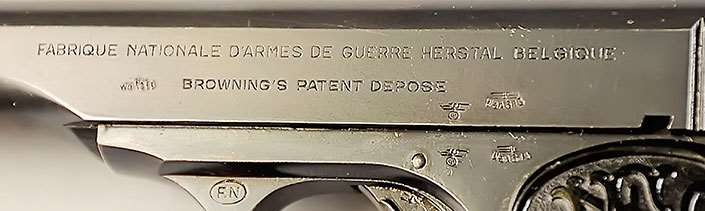
When the Germans overran Belgium in 1940, they commandeered the FN facilities and turned production to their own ends, incorporating the P35 High Power and Model 1922 into the Wehrmacht. Occupation-era Model 1922s will exhibit different acceptance marks (waffenamts) depending upon when a particular gun was manufactured. Both .32 ACP and .380 ACP versions were issued. Early specimens, some of which were constructed of parts already on-hand when FN was taken over, sport a commercial-style finish and have black plastic stocks emblazoned with the “FN” logo, while later pistols show a diminution of quality and are fitted with checkered walnut grips. German-issue 1922s have an eagle test proof, and some early guns may also be seen with Belgian proofs. Eventually some 363,200 1922s were built between 1940 and 1945.
The .32 ACP Model 1922 we are looking at here, having a serial number in the 20,000-23,000 range and a “WaA613” acceptance stamp, indicates it was made in approximately 1941, and thus commands a premium. Condition is NRA Excellent, resulting in a value of $875. A similar gun in .380 ACP would be worth approximately 50 percent more.
Gun: FN Browning Model 1922
Manufacturer: Fabrique Nationale, Herstal, Belgium
Chambering: 7.65 mm Browning (.32 ACP)
Manufactured: 1941
Condition: NRA Excellent (Modern Gun Standards)
Value: $875
Most Popular