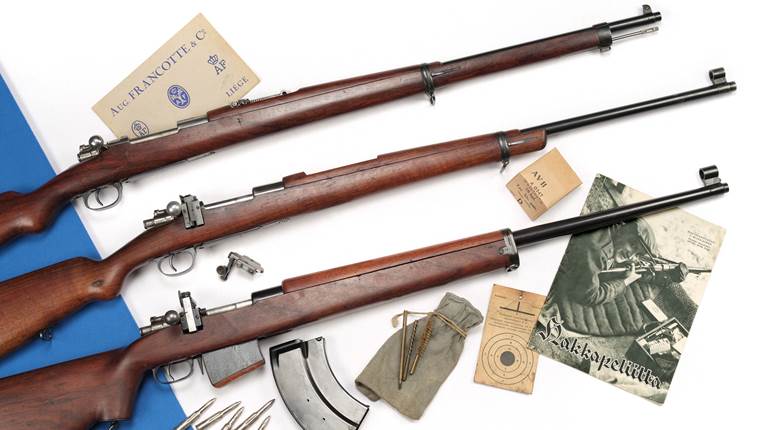
The cover of the Finnish Civil Guard magazine Hakkapeliitta showcases shooter V. Miinalainen who won a gold medal at the 1935 World Shooting Championship in Rome with a koekivääri m/30 rifle.
Shooting sports have always been a part of Finnish culture. In the early 1920s, the Finnish Shooting Sport Federation (Suomen Ampumaurheiluliito or SAL) sought ways for military shooters to represent Finland in international competitions, but the standard Finnish service rifle of the time, the Mosin-Nagant m/91, lacked the accuracy needed of a target rifle.
The solution was for SAL to develop a series of test rifles called “koekivääri.” The test rifles were to be based on the Mauser action with target sights. The decision was made to order new rifles from Belgium as well as modify surplus German Gewehr 98 (G98) and Swedish m/96 Mauser rifles domestically.
It is likely that SAL first approached Fabrique Nationale d’Armes de Guerre (FN) in Herstal, Belgium, as that company was one of the few manufacturing and selling Mauser rifles after the war. Despite the fact that FN was desperately looking for new customers during the post-World War I recession, the Finnish requirements were too specialized. The relatively small quantity needed also did not come close to FN’s minimum-order threshold of 10,000 units to justify the production start-up costs of a new model.
FN’s first postwar military rifle, the FN Model 1922 Mauser, was in the development stages at the time but fell short of Finnish requirements.
Koekivääri m/20
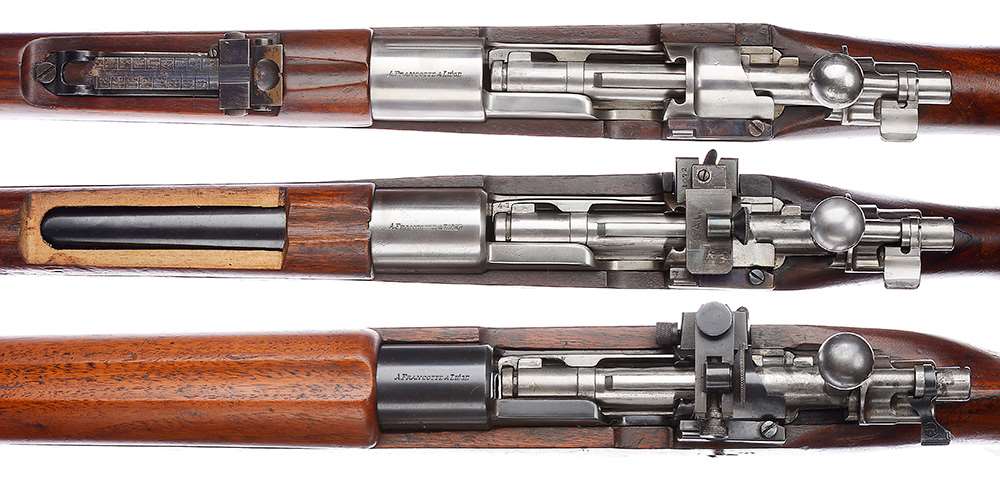
While the genesis of the Finnish m/20 model is not documented, it is clearly a hybrid FN Mauser Model 1893 with some features of the FN Mauser Model 1922 and German G98. A cursory overview shows that the Finnish m/20 rifle is a FN Mauser Model 1893 with a standard-length receiver as found on the G98. The target sights originated from the FN Mauser Model 1922 but were extensively modified to provide for lockable windage and elevation adjustments.
The 7x57 mm Mauser cartridge of the m/20 has its origins in the FN Mauser Model 1893, which was only produced in 7 mm. The FN Model 1922 Mauser was initially also only offered in 7 mm. It is likely that the Finns settled on this military cartridge for its good ballistics, even if they had no prior experience with the chambering.
FN had not produced the military Model 1893 since 1897, but the model was resurrected in FN’s R&D department at the time the Finns were shopping for a Mauser target rifle. The Mauser Model 1893 was better-balanced and shorter than the Model 1922 rifle, an important feature for the Finns who were looking for a shorter rifle than the Mosin-Nagant.
We can assume that the Finns disliked the intermediate-length receiver of the FN Model 1922, as they opted for the receiver length of the G98—a model that they were familiar with, as they had almost 1,000 rifles in inventory that were remnants from the Finnish War of Independence. Also in storage were Swedish Model 96 rifles, but this model seems to have had no influence on the design of the m/20.
The extent of FN’s involvement in the Finnish m/20 is unknown. FN could not bear the cost to tool-up for a mere 1,000 units, so the design and production were performed by Auguste Francotte in Liège.
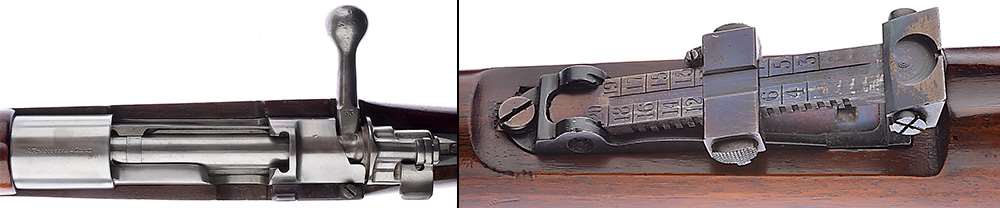
Francotte is Belgium’s oldest gun manufacturer and was one of the manufacturers that embraced mechanization during the Industrial Revolution. The company was also one of the original founders of FN. Francotte’s manufacturing was unique; despite its mechanization, the company retained a high level of craftsmanship and specialized in small production runs of high-end guns. Francotte is best known for its high-end shotguns and improvements on British guns such as the Martini-Henry. Francotte had never produced a Mauser rifle but tackled the project with the same high-quality standards for which the company is known. Close examination reveals that most parts were newly produced except for triggers, sears and magazine followers, which are surplus German parts; barrel bands may have been sourced from FN. The design closely follows FN’s Model 1893 but with a sophisticated rear sight and a novel, yet difficult to manufacture, handguard. The handguard is not retained by a ring but rather has a wooden groove that slips into the receiver itself. A screw locks it in place at the rear sight, similar to the FN Mauser Model 1922. The receiver was left “in the white” for ease of cleaning and maintenance. This was also an FN option for rifles exposed to harsh climatic conditions. The hard steel was not prone to corrosion and could be vigorously cleaned without damaging any bluing.
The Finnish-designated m/20 was Francotte’s first Mauser rifle. It is likely that the Finns made an exclusivity agreement with Francotte, as the model has not been observed in period catalogs. Instead, the m/20 launched Francotte into the production of high-end Mauser sporting rifles.
SAL lobbied the Finnish Ministry of Defense to officially designate the first koekivääri test rifles in 7x57 mm Mauser as the m/20 on March 25, 1923. The name “test rifles” applied because the Ministry of Defense designated these rifles as test or prototype rifles for use by the Finnish military. This officially sanctioned designation, however flimsy as it was, allowed military shooters to use them in international competitions.
Koekivääri m/25
SAL continually sought to optimize the rifles for improved accuracy in ways that met the requirements of Finnish shooters and competitors. The follow-on m/25 incorporated a diopter sight that its designer, SAL secretary and gunsmith Veli Nieminen, modeled after an American Lyman diopter sight. SAL subsequently had the sights manufactured domestically by the Lahden Asepaja company and converted many of the Belgian-made m/20 rifles to the m/25 standard by removing the rear sight, modifying the handguard and installing the diopter sight on the receiver.
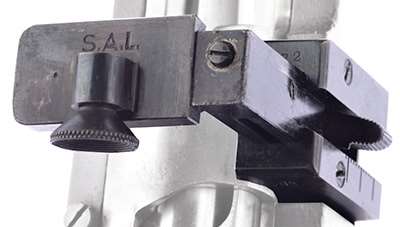
As a result, only a handful of koekivääri m/20 rifles remain in their original, factory-delivered condition. Being a military “test rifle” meant that the original m/20 rifles ordered from Francotte retained a Mauser-style bayonet lug, although it is unknown whether they were supplied with a bayonet.
Based upon its experiences with the m/20 and m/25, SAL pushed the Finnish army to adopt a Mauser rifle as its standard service rifle. However, the cash-strapped Finnish army simply could not afford this and saved money by upgrading the existing Mosin-Nagant design. Subsequently, SAL rebuilt these rifles again as the koekivääri m/30 and m/34 models in 7.62x54 mm R.
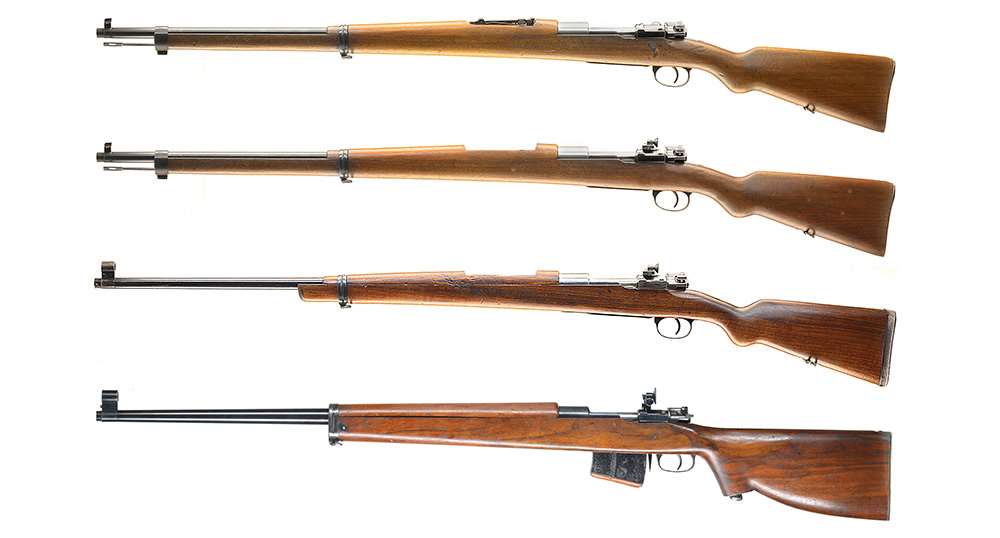
Koekivääri m/30
Officially, SAL discouraged the use of the standard 7.62x54 mm R cartridge for competitive-shooting purposes in the 1920s. Its attitude stemmed from the diverse production characteristics of the surplus World War I-era cartridges held by Finland and their unacceptable ballistic variances. However, the advent of high-quality, domestically produced 7.62x54 mm R ammunition at Valtion Patruunatehdas (VPT or the State Cartridge Factory) and SAKO in the late 1920s softened this stance. Based upon those developments, SAL sought to adapt the cartridge to the experimental Mauser rifles it championed.
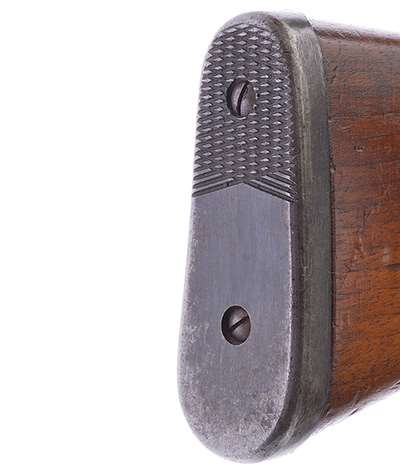
SAL designed the resultant koekivääri m/30 chambered in 7.62x54 mm R by replacing the 7x57 mm barrel on existing m/25 rifles and converting older m/20 models to 7.62x54 mm R with the addition of diopter sights. The m/30 model represented a stopgap in many ways, as SAL did not modify the internal Mauser-style magazines, which could not feed the rimmed 7.62x54 mm R cartridge. Accordingly, a SAL drawing dated March 17, 1930, and submitted to the Ministry of Defense, tacitly acknowledged that the m/30 could only be operated as a single-shot rifle. Although the Finnish army subsequently approved the new design as the koekivääri m/30 on March 24, 1931, it never showed more than desultory interest in SAL’s successful adaptation of the 7.62x54 mm R cartridge to the Mauser rifle system.
Koekivääri m/34
Undeterred by the Finnish army’s unrequited feelings for his m/30 design, Veli Nieminen set about further modifying its design. After nearly exhausting any flexibility left in the basic Mauser design, his efforts took a drastic turn with what became the subsequent koekivääri m/34. Nieminen’s main problem remained the inability of the internal Mauser box magazine to feed 7.62x54 mm R ammunition. He compensated for this fault by replacing the internal box magazine with a modified detachable m/26 Lahti-Saloranta light machine gun magazine and added a heavy Tikkakoski-manufactured barrel chambered in 7.62x54 mm R that rested in a free-floating target stock. The design of the diopter sight was also updated. By the time he finalized the design in 1934, it was hardly identifiable as anything but a heavy target rifle. Undeterred, the Finnish Ministry of Defense approved the design as the koekivääri m/34 test rifle along the same lines as the previous models.
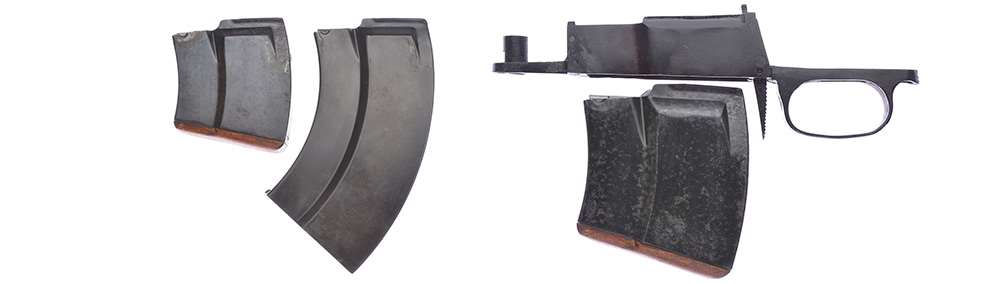
The Finnish army evaluated the m/34 and found it utterly unsuited for combat or even light field use. After middling sales of a few hundred examples, the m/34 rifle proved controversial even within Finnish shooting circles and provided the death knell for the army-sanctioned koekivääri test rifles. Unfortunately for Nieminen and SAL, the overwhelming success of the Civil Guard’s Mosin-Nagant-derived m/28-30 rifle at the 1937 World Shooting Championships in Helsinki overshadowed any potential that their new design might have possessed.
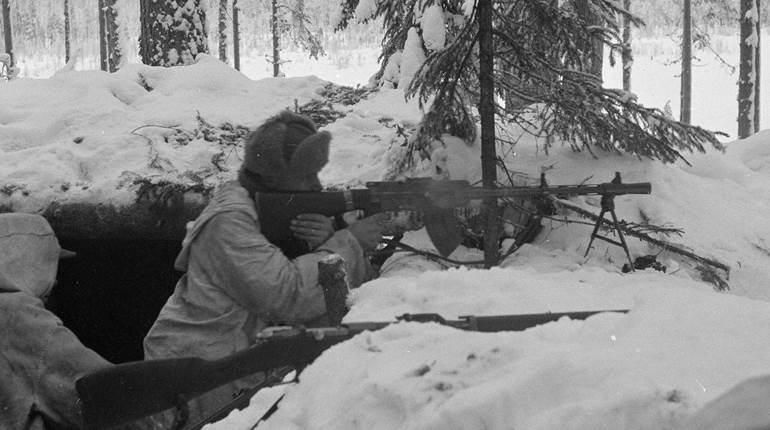
The series of Francotte and other Mauser koekivääri test rifles remain a fascinating footnote in Finnish small-arms history. They saw no combat usage despite dire shortages of small arms during the Winter War and Continuation War. As an interesting historical coda, the 1951 small-arms report of the Finnish Defense Forces listed only a single koekivääri variant out of the 557,427 firearms inventoried—with this solitary example being an m/34 rifle.
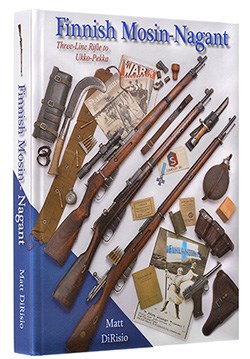 Finnish Mosin-Nagant: Three-Line Rifle To Ukko-Pekka
The book from which the accompanying article is excerpted, Finnish Mosin-Nagant: Three-Line Rifle To Ukko-Pekka, encompasses the most complete work on Finnish small arms to date. Not only does it cover the Finnish Mosin-Nagant models, it describes the historical context that influenced their development, production and use. This approach would not have been comprehensive without including the small arms purchased and captured by Finland.
Author and historian Matt DiRisio’s research extends beyond collecting; he has immersed himself in Finnish culture, history and language. The resulting book is the product of extensive collaboration between collectors, museums and archives worldwide. Highlights include: all Finnish Mosin-Nagant models; Finnish sniper and target rifles including the m/27 PH, m/33, m/39 PH, m/39 SOV and m/39-44; the origins of the m/91 B Barrels; .22-cal. training rifles; Finnish Mausers; World War II pistols; captured SVT-40 rifles; serial number data; accessories, bayonets and much more.
The 9.25"x12.25"-format hardbound book is printed in the United States on quality coated paper and contains 584 pages featuring 1,510 color and black-and-white photos.
Price: $90 (NRA members receive free U.S. shipping with coupon code NRAMEMBER). Contact: Wet Dog Publications; (336) 394-4138; www.wetdogbooks.com.
Most Popular