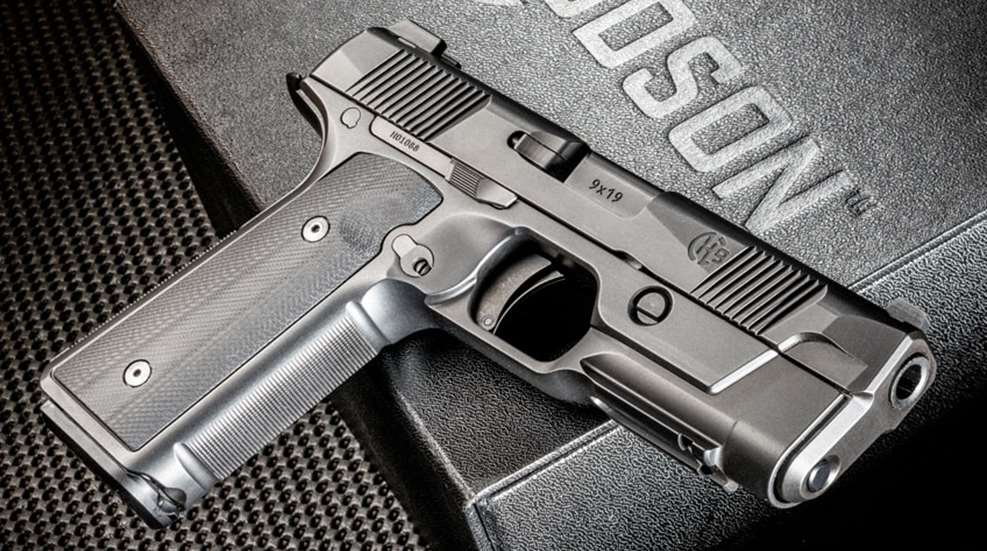
Touted by the company as “the marriage between a 1911 and a striker-fired gun,” the Hudson Mfg. H9, introduced in 2017, incorporates what the company considers to be the best design elements of both styles of guns with a number of innovations of its own. The H9 is a full-size, steel-frame, striker-fired, semi-automatic 9 mm Luger pistol that fires from a locked breech and feeds from 15-round detachable box magazines. Its M1911 lineage is immediately recognizable in the grip area and magazine release, however, it forgoes the hammer-fired ignition system of “old Slabsides.”
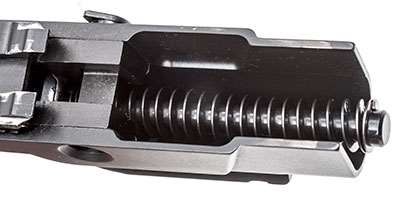
The H9 uses a short-recoil operating system, with its barrel hood locking into the slide’s ejection port. But to keep the gun’s bore axis as low in the hand as possible, Hudson dispensed with the M1911-style barrel link in favor of a cammed lug located forward of the trigger. The design makes for a very consistent lock-up into battery, but it precludes the placement of the recoil spring in the conventional location directly under the barrel. Instead, the H9’s flat-wire recoil spring is positioned forward of the trigger guard and low inside the dustcover, lending the gun its distinctive appearance and helping to reduce torque and muzzle rise.
Hudson machines the H9 frame from 4140 steel, and it houses the frame insert, or chassis, which contains the slide rails, ejector, bilateral slide stops, sear and disconnector. When in place, the frame insert also captures the recoil spring guide. Hudson serializes the insert, and that means it could be moved to a different frame. In the likely event that Hudson manufactures a compact or lightweight frame in the future, H9 owners will be able to switch their chassis between grip frames.
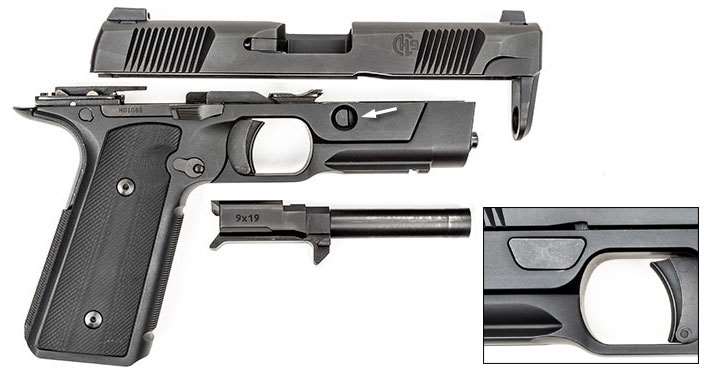
The frontstrap of the frame is machine-checkered for a positive grip. Hudson uses G10 material for both the H9’s stock panels and its backstrap, the latter of which is checkered and has a relief cut into its bottom in the event the user wants to add a lanyard to the pistol. To speed reloads, Hudson flares the opening to the magazine well. A relief is cut at the front of the frame and the magazine’s base pad to give the shooter the ability to pull a stuck magazine from the gun. Along with the bilateral slide stops, the magazine release is reversible, making the H9 southpaw friendly. Our test sample did not include manual thumb safeties, however, Hudson will soon be offering them for the H9; right-side-only, left-side-only and bilateral options will be available.
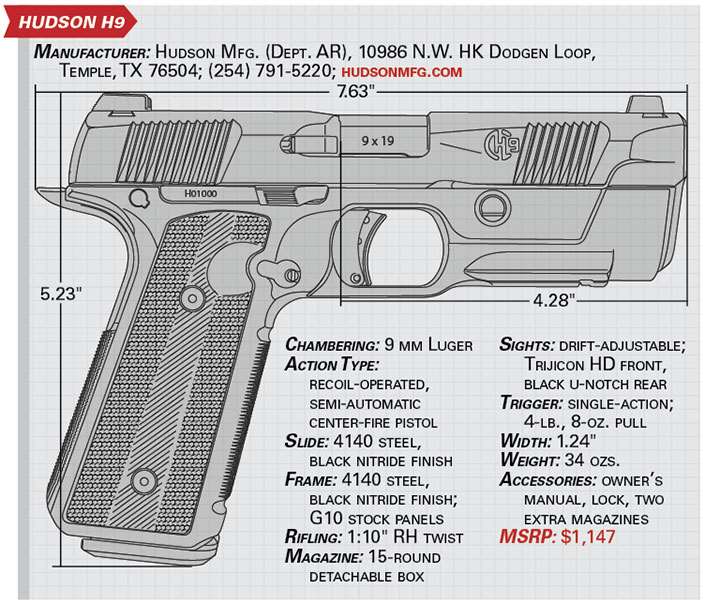
One of the M1911-pattern features that Hudson wanted to include on the H9 was a great single-action trigger, which is a difficult feat on a striker-fired gun. Our test gun’s trigger broke crisply at 4 lbs., 8 ozs., with just a little take-up and almost no overtravel. Like most striker-fired guns, the H9 possesses a trigger safety. Unlike the others, however, the safety pivots at the trigger’s bottom and is barely noticeable when firing the gun. The safety shoe is as wide as the trigger itself, rather than the blade-style inserts other manufacturers use.
The H9 is a very aesthetically pleasing gun; all of the contours in the frame and slide seem to flow, and the transitions between parts are tastefully blended. Cocking serrations are machined into both the front and the rear of the slide, and its flat top surface has been serrated. All of the H9’s edges have been beveled for painless carry, and the juncture of the trigger guard and frontstrap has been undercut for a high hold grip. Normally we see these types of features on high-end custom guns. Hudson didn’t skimp on the H9’s sights either. The front sight is a Trijicon HD sight that has a tritium lamp surrounded by a fluorescent orange ring that makes the sight visible in nearly any lighting condition. The black rear sight is serrated to reduce glare and has a U-shaped notch.
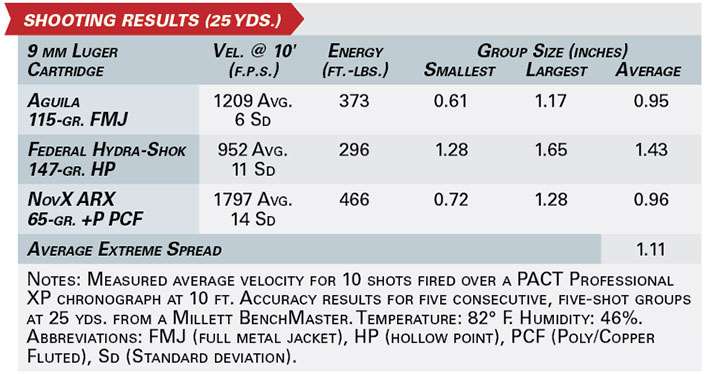
With the H9’s one-slot accessory rail resting on a Millett BenchMaster, it was easy to keep the gun’s sights aligned as we pressed its trigger straight back. It is a non-pivoting trigger, like the M1911, and it needs to only travel 0.115" for the striker to release. We were all impressed with the H9’s accuracy; our average group sizes ranged from just under 1" to about 1.5". During the field portion of our evaluation, we found the H9 to be extremely flat-shooting; muzzle flip and torque seemed inconsequential. The placement of the H9’s recoil spring and its low bore axis proved to be very effective during rapid fire. We fired more than 400 rounds during our evaluation using a variety of ammunition with different bullet nose profiles, weights and overall lengths. The H9 fed, fired, extracted and ejected them all without failure.
Hudson Mfg.’s H9 pistol is an impressive first offering from a brand new company. The gun possesses an exemplary degree of fit and finish, as well as superb accuracy and commendable reliability. In an industry full of “me too” products, it is refreshing to see a newcomer turn some heads with its innovation and quality manufacture.
Most Popular