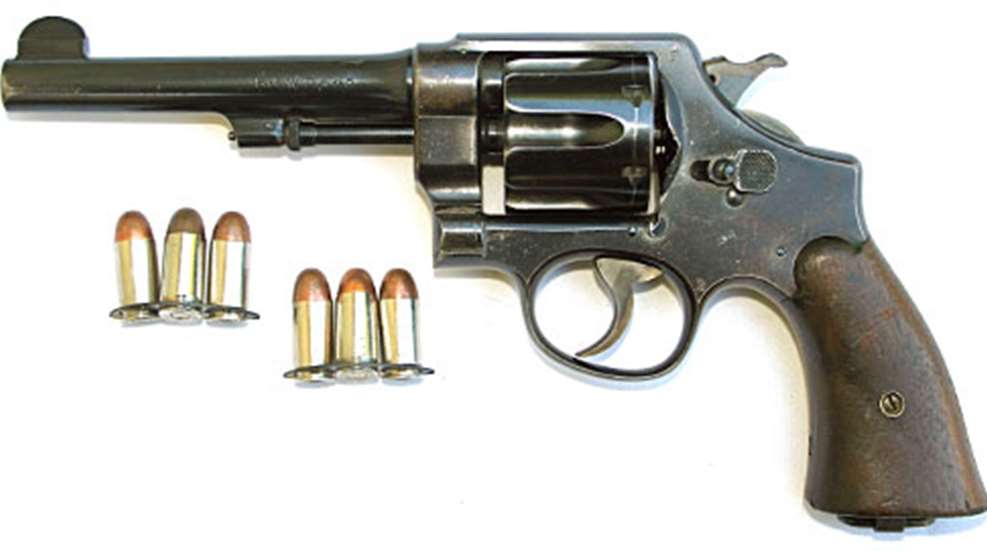
Although commonly referred to as the Smith & Wesson Model 1917, this revolver is officially the “.45 Hand Ejector Model of 1917,” which means it is a S&W Second Model Hand Ejector chambered for the .45 ACP.
With World War I looming and a subsequent shortage of M1911 pistols apparent, S&W and Springfield Armory began a joint project to develop a “half-moon” steel clip for the large-frame Second Model that would hold three of the rimless .45 ACP cartridges, thus enabling them to be engaged by the extractor. As a fail-safe, S&W “step” machined the cylinder chambers to maintain proper headspace on the case mouths, enabling .45 ACPs to be fired without the clips, although cases would have to be removed individually.
The U.S. declared war against Germany on April 2, 1917, and S&W’s Second Model in .45 ACP became what the factory workers called “The Government Model.” This series began with serial number 1, and by the end of the war 163,476 Model 1917s had been produced. The first guns were shipped on Sept. 6, 1917. They sported 5 1/2-inch barrels, polished blued finish, casehardened hammers and triggers, fixed sights, and two-piece smooth walnut stocks with lanyard rings attached to the butts. After Sept. 13, 1918, S&W factory production came under the auspices of Springfield Armory, and most guns were shipped to Springfield Armory or army depots.
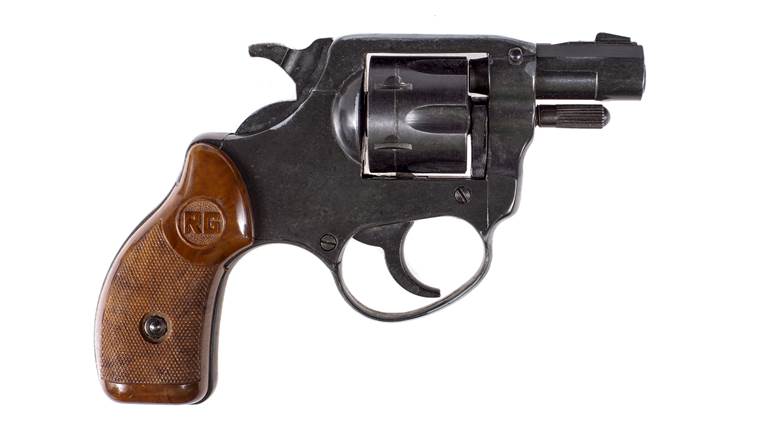
The gun shown here, serial number 132065, is unusual in that according to S&W historian Roy Jinks, it was shipped directly to Camp Huntington (exact address unknown) on Nov. 2, 1918. Because of their association with World War I and their reissue during World War II, Model 1917s hold their value, especially when in above-average condition. This 85 percent gun would easily fetch $850 to $1,100 as both a shooter and a military collectable.
Gun: Smith & Wesson .45 Hand Ejector Model of 1917
Caliber: .45 ACP
Condition: 85 percent (NRA Modern Very Good)
Manufactured: Nov. 2, 1918
Value: $850 to $1,100
Most Popular